
- Buy Crypto
- Markets
 Futures
- Spot
- Copy Trade
- Earn
- More
「Crazier Than Cryptocurrency」: 10-Year Treasury Yield Records Largest Leap in 20 Years, Flash Crash Warns of Financial Crisis

Original Article Title: "A Historic Week Has Passed, Both US Stocks and Bitcoin Have Risen, But the Market Has Changed Completely!"
Original Article Author: Richard Bo, Wall Street View
US stock market volatility has rarely surpassed that of emerging markets and Bitcoin. At the same time, US Treasuries, which have always been seen as a safe asset, experienced sharp fluctuations, leading investors to start questioning the wisdom of holding US assets. UBS believes that once global risk-free rates experience volatility, it means that all markets will be disrupted. Analyst Ed Al-Hussainy bluntly pointed out, "I'm actually not worried about a recession, I'm worried about a financial crisis."
US stocks rebounded on Friday, suggesting a restoration of market risk appetite. However, investors have actually started questioning the safety of US assets, especially with the drastic fluctuations in US Treasuries, reigniting fears of a financial crisis on Wall Street.
Over the past week, the US 10-year Treasury yield saw its largest weekly jump in over 20 years, while US stocks experienced a rollercoaster ride of a dive followed by a surge. On the surface, the S&P 500 index rose by over 5% for the week, US bond yields returned to February levels, and Bitcoin closed higher, appearing as if everything was business as usual.
However, what is unsettling is the simultaneous decline this week in US stocks, US bonds, and the US dollar, a typical characteristic of emerging markets rather than a performance of the world's safest assets. Particularly with such a large fluctuation in US long-term bonds this week, a liquidity crisis seems imminent, prompting investors to question the wisdom of holding US assets. Bhanu Baweja, Chief Strategist at UBS Group, even stated:
This is too scary. We are redefining the global risk-free rate, and if the global risk-free rate experiences volatility, it will disrupt all markets.
Historically Rare: US Asset Volatility Surpasses that of Emerging Markets and Bitcoin
Trump's recent tariff policies have not only damaged confidence in the US economy but also shaken investors' trust in the US policy direction and US dollar assets. Even by Wall Street's long historical standards, this week has been a brutal trading week, with US stocks feeling like they are on a rollercoaster ride, and the movements of US bonds and the US dollar suggesting that the US safe haven status seems to be unsteady:
On Monday, due to the so-called tariff confusion, US stocks experienced a 15-minute seismic pulse, with the Nasdaq plummeting by 10% at one point and US Treasuries taking a nosedive.
On Tuesday, news of no tariff exemptions shattered hopes of a US stock rebound, with the Dow plunging over 2000 points at one point, the S&P erasing over a 4% gain to negative territory, and the US Treasury market experiencing a deleveraging sell-off.
On Wednesday, the US temporarily delayed some tariffs, with the three major US stock indices rising by nearly 8% at least, the S&P seeing its largest gain since 2008, US stock trading volume hitting a historic high of 30 billion shares. The 10-year US Treasury yield spiked and then retreated.
On Thursday, global investors fled from US assets, leading to a triple hit on US stocks, bonds, and the dollar. The Nasdaq plummeted over 4%, marking the dollar's largest daily drop in two years and pushing gold to a new high.
On Friday, the Federal Reserve hinted at intervention, prompting a rebound in US stocks. However, the downward trend of US bonds and the dollar served as a warning that the US's status as a safe haven may no longer be assured.
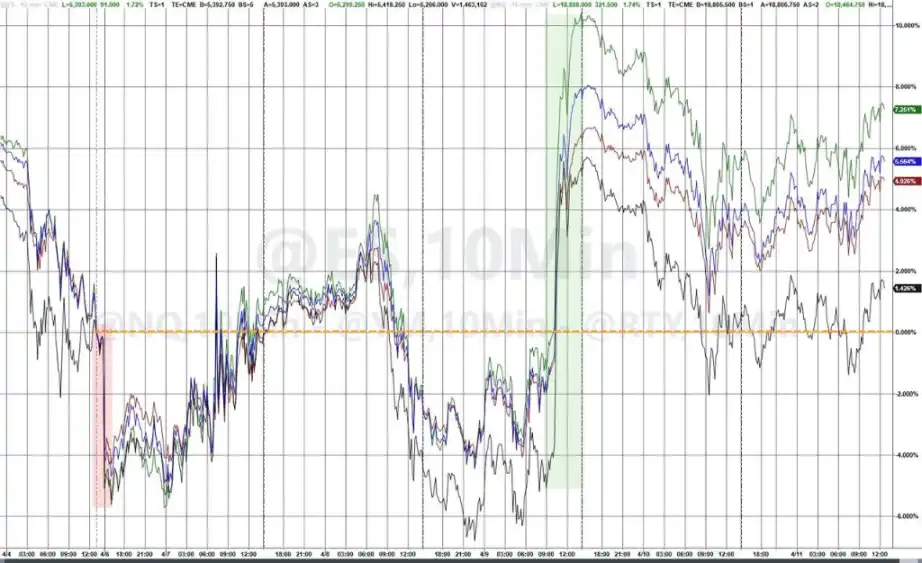
Andrea DiCenso, an investment manager at Loomis, Sayles & Company, stated, "Is the US market starting to behave like an emerging market? Undoubtedly, yes, that is exactly what we are seeing."
According to data, the volatility of US stock ETFs has even exceeded that of funds tracking emerging markets and has at times been higher than Bitcoin. This situation has rarely occurred except during the pandemic, the crisis in August of last year, and the Fed's aggressive rate hike period.
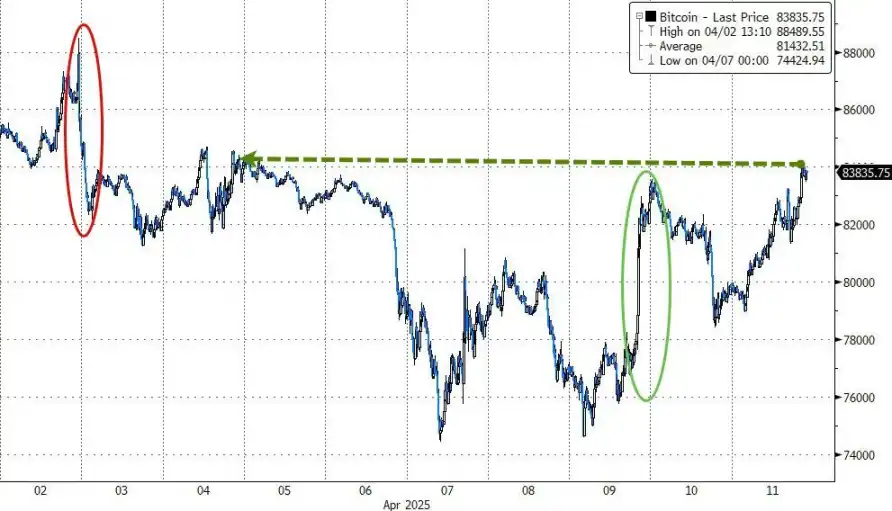
Neil Dutta from Renaissance Capital bluntly expressed in a client email, "The S&P 500 index is trading like a cryptocurrency, and that may not be a good thing."
Sharp Fluctuations in Risk-Free Rates Signal a Replay of the Financial Crisis
When the long-term bond market experiences sharp volatility, significant spreads, and low liquidity, it affects all other capital markets, especially exerting upward pressure on rates and US government debt, potentially evolving into a financial crisis if sustained over the long term.
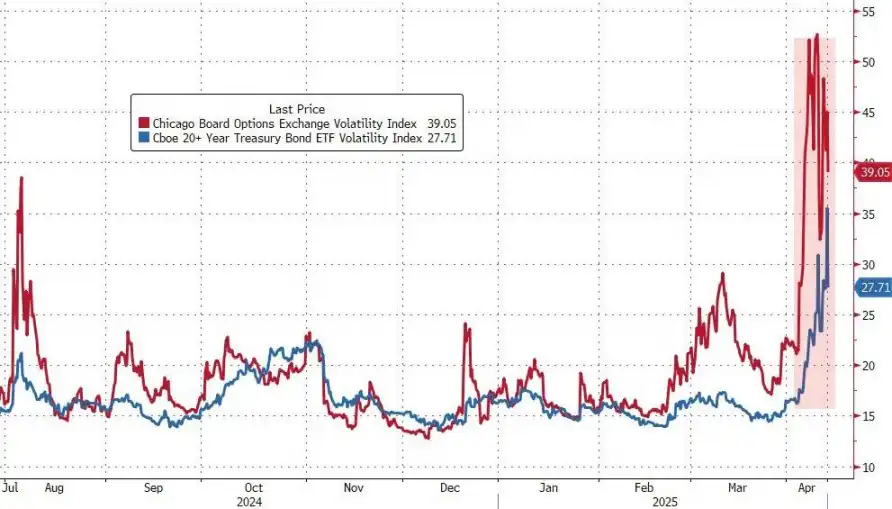
US bond volatility surged this week, with the 20-year Treasury bond volatility rapidly catching up to the VIX stock volatility.
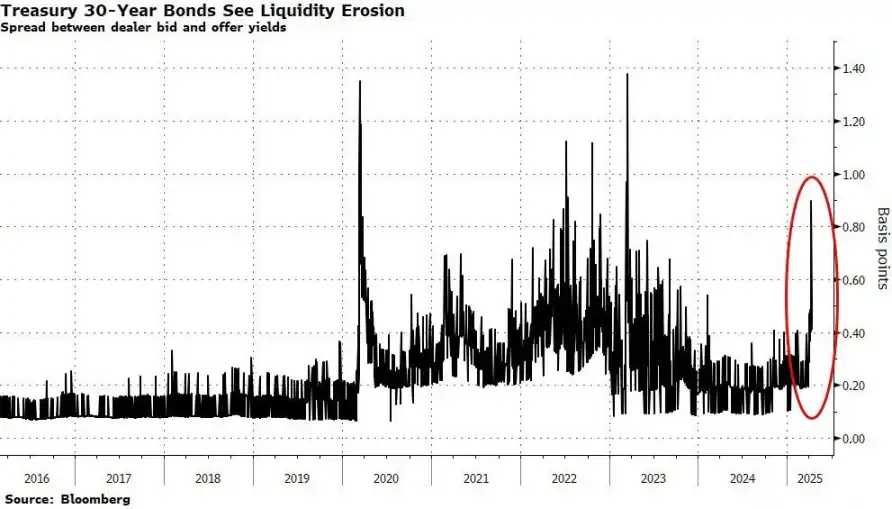
Although this week the decline in 30-year US bonds did not continue from last week, presenting a broadening trend, there were some cracks in the trading spread of the benchmark 30-year bond—which is a signal of the long-term decline in liquidity in the US Treasury yield curve. This week, the spread almost reached a full basis point, a level unseen since early 2023.
Confidence from regions outside the US in the quality of US stocks, fixed-income, and currency assets has been eroded. Fund strategist Nathan Thooft stated, "The question is whether this is a temporary shock or a long-term shift. We still believe the former. However, it cannot be denied that some large asset owners are seeking alternative safe-haven assets and diversified allocations."
Analyst Ed Al-Hussainy succinctly pointed out:
I'm actually not worried about a recession, I'm worried about a financial crisis.
Funds Flowing to Safe-Haven Assets, Wall Street Calls for Fed Intervention
Under the shadow of a financial crisis, global investors, after withdrawing from the U.S., have poured into safe-haven assets such as the European bond market, gold, the yen, and the Swiss franc to avoid broader turmoil.
This week, German bond yields remained largely unchanged, while U.S. 10-year bond yields surged over 50 basis points, marking the largest divergence between U.S. and German bond yields since 1989. In contrast, the U.S. dollar index fell below the key level of 100, posting its most severe two-week decline since November 2022, while the euro strengthened significantly, with the week's appreciation surpassing that of the yen.
Extreme volatility has brought unprecedented psychological pressure to investors and traders, prompting calls from Wall Street for Fed intervention. On Friday, JPMorgan CEO Jamie Dimon stated that he anticipates "turmoil" in the U.S. Treasury market.
Dimon said during an earnings call, "When you have a lot of volatile markets, very wide bid-offer spreads in Treasuries, low liquidity, it affects all other capital markets. That's the reason the Fed should intervene, not to help the banks."
Fortunately, Fed Governor Lael Brainard stated on Friday that if market conditions become disorderly, the Fed is "absolutely prepared" to help stabilize the financial markets. However, she emphasized:
"The markets are functioning well, and we haven't seen broad-based liquidity concerns."
You may also like

Wall Street Shorts ETH: Vitalik is aware and has front-run, while Tom Lee remains oblivious

Social Capital CEO: How Equity Tokenization is Reshaping Capital Markets from US Stocks to SpaceX?

CoinGecko Report: Surge of 346% vs Dip of 20.8%, The Wild Rise of DEX

a16z: The Real Opportunity of Stablecoins Lies Not in Disruption but in Filling Gaps

Mining Exodus: Someone Holds $12.8 Billion AI Order

March 6 Market Key Intelligence, How Much Did You Miss?

a16z: The True Opportunity of Stablecoins is in Complementing, Not Disrupting

Predict LALIGA Matches, Shoot Daily & Win BTC, USDT and WXT on WEEX
The WEEX × LALIGA campaign brought together football excitement and crypto participation through a dynamic interactive experience. During the event, users predicted matches, completed trading tasks, and took daily shots to compete for rewards including BTC, USDT, WXT, and exclusive prizes.

Ray Dalio Dialogue: Why I'm Betting on Gold and Not Bitcoin

Who Took the Money in the AI Era? A Must-See Investment Checklist for HALO Asset Trading
Wall Street Bears Target Ethereum: Vitalik In the Know Takes Flight, Tom Lee Remains Bullish
Pump.fun Hacker Steals $2 Million, Receives 6-Year Prison Sentence, Opts for 'Self-Detonation'

6% Annual Percentage Yield as Musk Declares War on Traditional Banks
36 years, 4 wars, 1 script: How does capital price the world in conflict?

Mining Companies' Great Migration: Some Have Already Secured $12.8 Billion in AI Orders
What Is Vibe Coding? How AI Is Changing Web3 & Crypto Development
What is vibe coding? Learn how AI coding tools are lowering the barrier to Web3 development and enabling anyone to build crypto applications.
The parent company of the New York Stock Exchange strategically invests in OKX: The intentions behind the $25 billion valuation

WEEX P2P update: Country/region restrictions for ad posting
To improve ad security and matching accuracy, WEEX P2P now allows advertisers to restrict who can trade with their ads based on country or region. Advertisers can select preferred counterparty locations for a safer, smoother trading experience.
I. Overview
When publishing P2P ads, advertisers can now set the following:
Allow only counterparties from selected countries or regions to trade with your ads.
With this feature, you can:
Target specific user groups more precisely.Reduce cross-region trading risks.Improve order matching quality.
II. Applicable scenarios
The following are some common scenarios:
Restrict payment methods: Limit orders to users in your country using supported local banks or wallets.Risk control: Avoid trading with users from high-risk regions.Operational strategy: Tailor ads to specific markets.
III. How to get started
On the ad posting page, find "Trading requirements":
Select "Trade with users from selected countries or regions only".Then select the countries or regions to add to the allowlist.Use the search box to quickly find a country or region.Once your settings are complete, submit the ad to apply the restrictions.
When an advertiser enables the "Country/Region Restriction" feature, users who do not meet the criteria will be blocked when placing an order and will see the following prompt:
If you encounter this issue when placing an order as a regular user, try the following solutions.
Choose another ad: Select ads that do not restrict your country/region, or ads that allow users from your location.Show local ads only: Prioritize ads available in the same country as your identity verification.
IV. Benefits
Compared with ads without country/region restrictions, this feature provides the following improvements.
Aspect
Improvement
Trading security
Reduces abnormal orders and fraud risk
Conversion efficiency
Matches ads with more relevant users
Order completion rate
Reduces failures caused by incompatible payment methods
V. FAQ
Q1: Why are some users not able to place orders on my ad?
A1: Their country or region may not be included in your allowlist.
Q2: Can I select multiple countries or regions when setting the restriction?
A2: Yes, multiple selections are supported.
Q3: Can I edit my published ads?
A3: Yes. You can edit your ad in the "My Ads" list. Changes will take effect immediately after saving.


 App
App