
- Buy Crypto
- Markets
 Futures
- Spot
- Copy Trade
- Earn
- More
Crypto Market Downturn, Most Comprehensive 2025 Stablecoin Investment Strategy Takes You Through Bull and Bear Markets

Original Author: @arndxt_xo, Crypto Researcher
Original Translation: zhouzhou, BlockBeats
Editor's Note: This article discusses the strategies and returns of several interest-bearing stablecoins, including how different platforms generate returns through investing in U.S. Treasuries, DeFi lending, and real-world assets. Each stablecoin has different strategies and yields, such as earning returns through staking, lending, or liquidity mining. The article also mentions the characteristics of these stablecoins, such as no lockups, automatic compounding returns, suitable for long-term investment, and users who require stability, providing an innovative decentralized finance solution.
The following is the original content (slightly rephrased for better readability):
What is an interest-bearing stablecoin? It is a stablecoin pegged to 1 USD that also generates passive income. How is this achieved? Through lending, staking, or investing in real-world assets like U.S. Treasuries. You can think of it as an on-chain money market fund, but it is programmable and borderless.
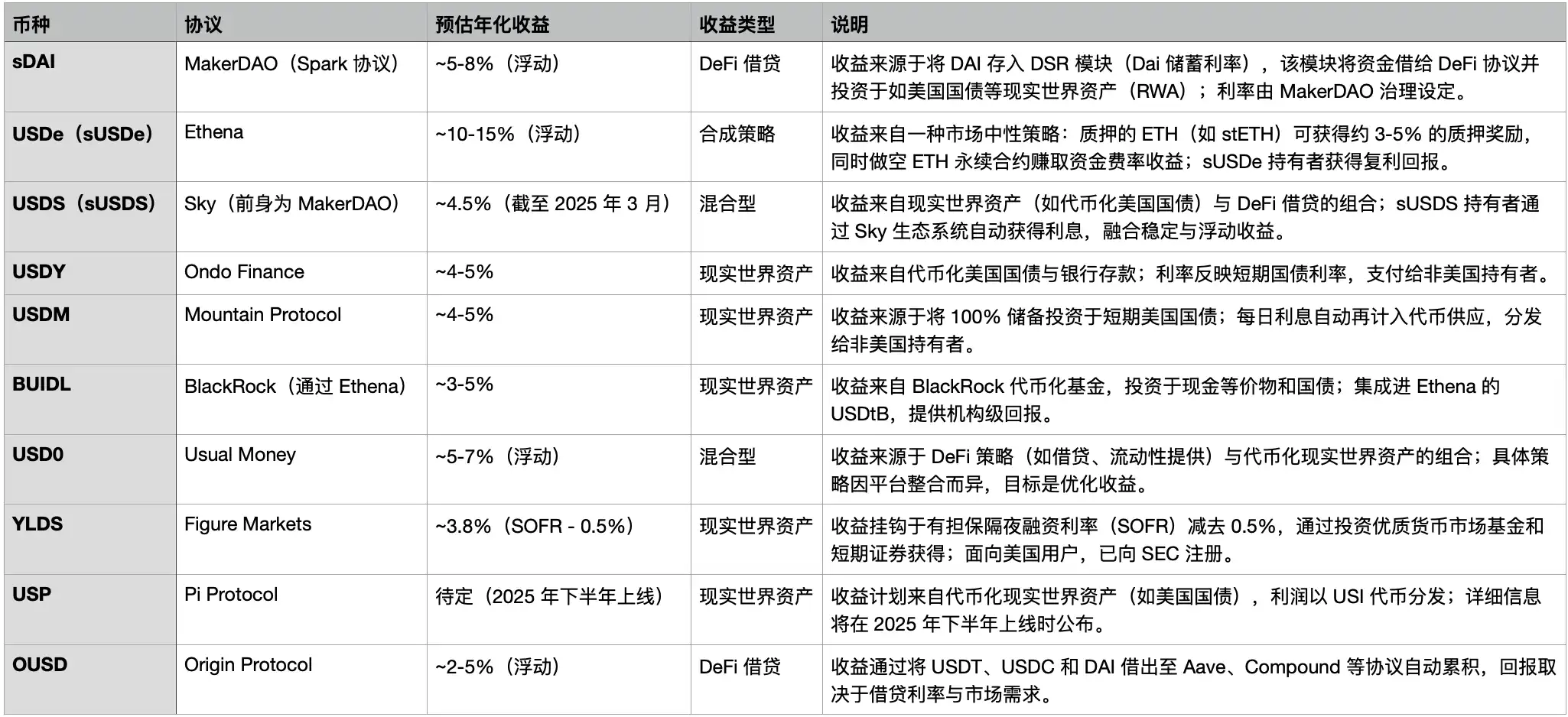
In a stablecoin market exceeding 225 billion USD with annual transaction volumes in the trillions, interest-bearing stablecoins are emerging as:
• On-chain savings accounts
• Yield-bearing products backed by RWAs
• Alternatives to banks and fintech
• Maintaining assets in USD while offering annual yields of around 3–15%
Next, let's break down how mainstream protocols achieve these returns
sDAI – Provided by MakerDAO via @sparkdotfi
→ Annual Percentage Yield: Around 5–8% (variable)
→ Strategy: DSR (Dai Savings Rate) returns from various sources
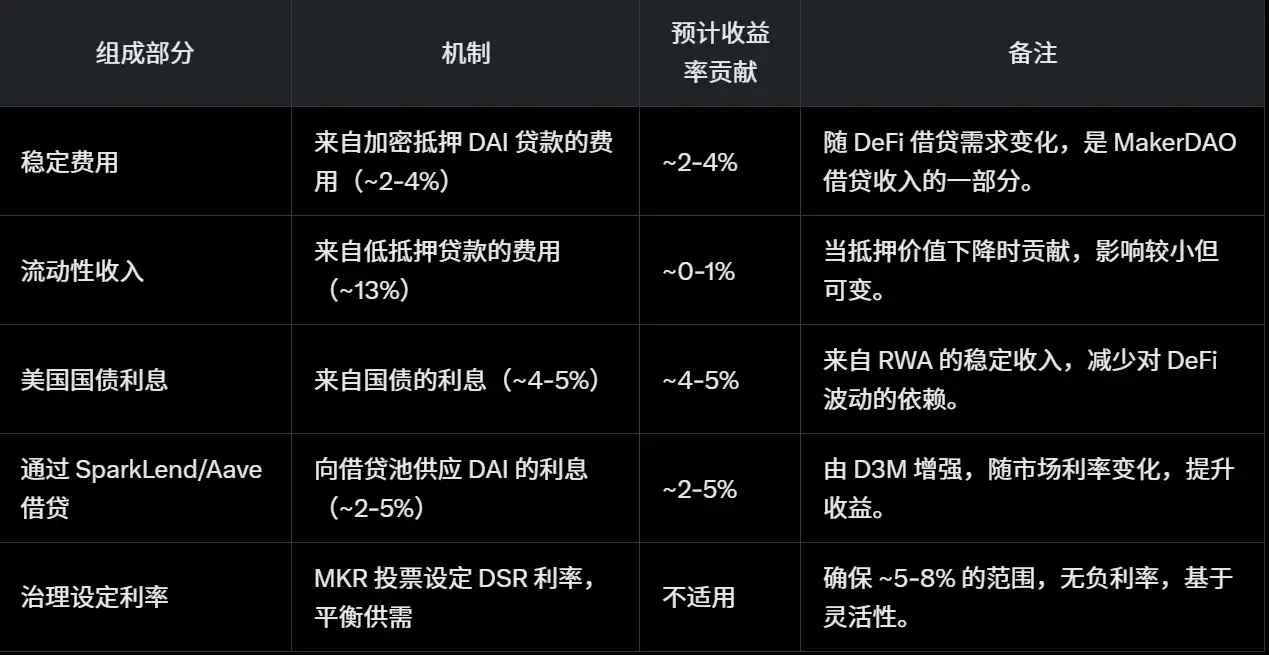
• Deposit DAI into Spark
• Sources of returns include:
• Stability fees from loans
• Liquidation proceeds
• DeFi lending (e.g., Aave)
• Tokenized Asset of US Treasury Bonds
You will receive sDAI, a token based on the ERC-4626 standard, with an automatically increasing value (non-rebasing), and the yield is adjusted by the governance mechanism based on market conditions.
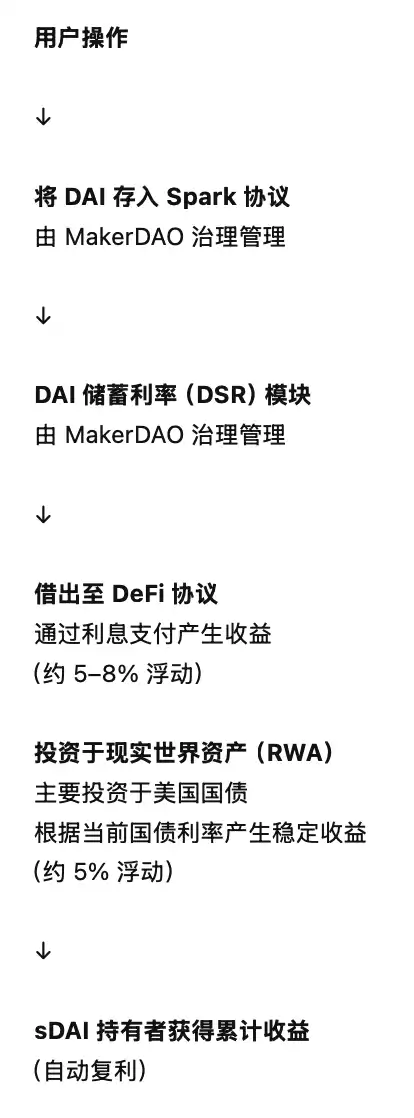
sUSDe – Synthetic Yield provided by @Ethena_Labs
→ Annual Yield: About 8–15% (up to 29% at peak in a bull market)
→ Strategy: Delta-neutral yield from Ethereum

• Deposit ETH → Stake via Lido
• Simultaneously short ETH on CEXs
• Financing Rate + Staking Reward = Yield
sUSDe holders will receive compound interest. High yield = High risk, but not reliant on banks at all.
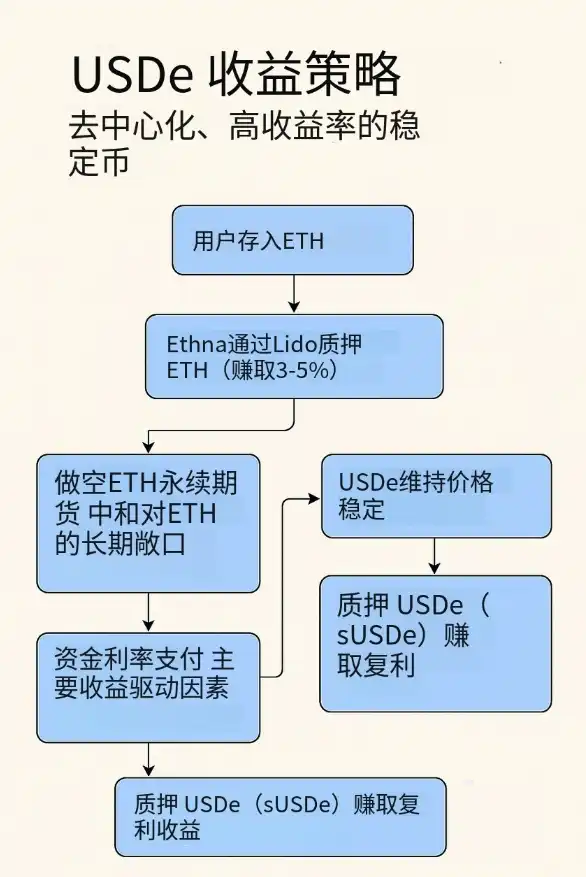
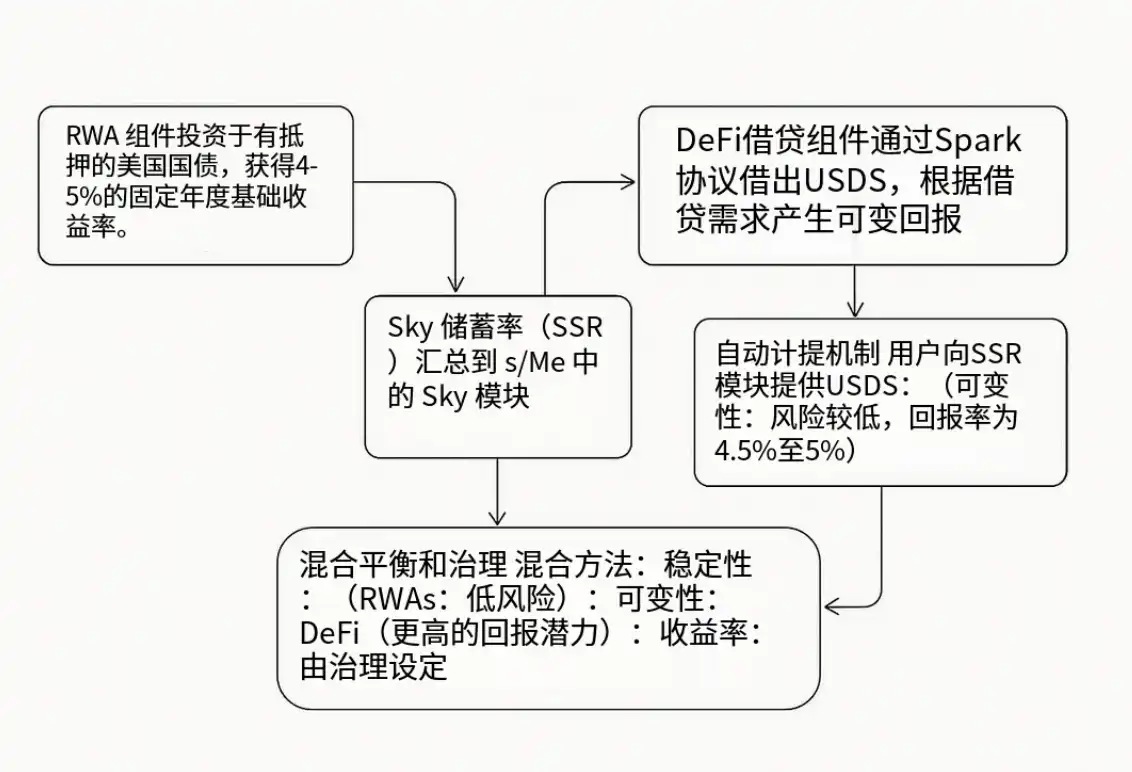
sUSDS – Provided by @SkyEcosystem (formerly MakerDAO team)
→ Annual Yield: About 4.5%
→ Strategy: Hybrid RWA + DeFi Lending
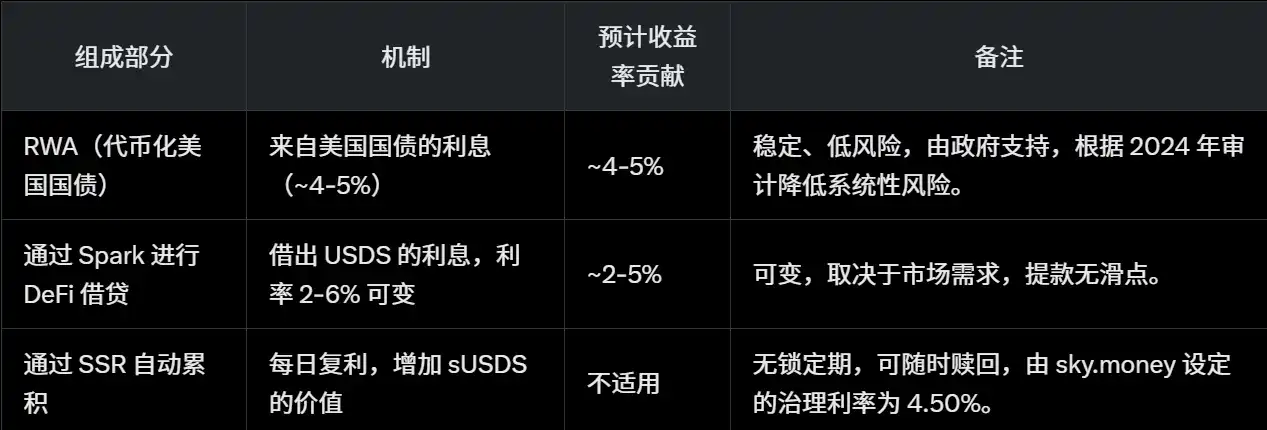
• Base Yield from Tokenized US Treasury Bonds
• Additional Yield from Spark Lending
• Yield distributed through Sky Savings Rate (SSR)
No collateral, no lock-up, automatic balance accumulation, governance mechanism sets the target annual yield for SSR.
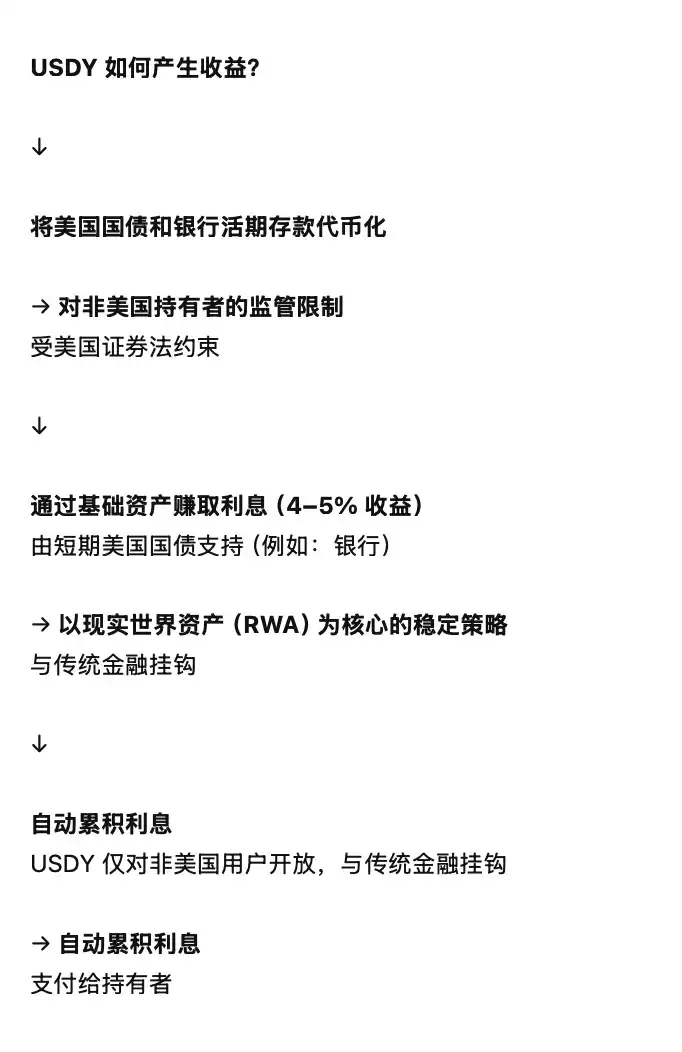
USDY – Provided by @OndoFinance
→ Annual Yield: About 4–5%
→ Strategy: Tokenized Traditional Finance for non-US holders
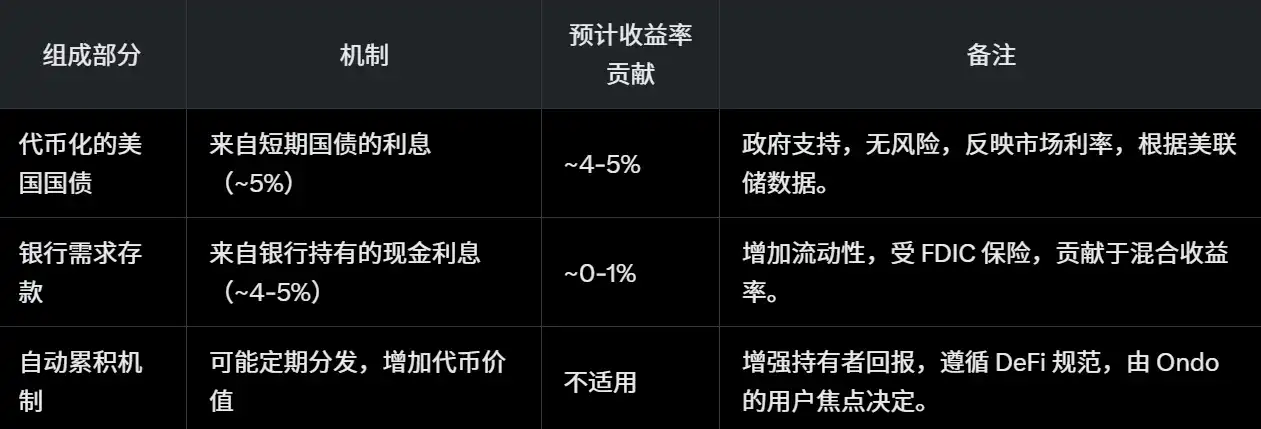
• 1:1 Backed by Short-Term US Treasury Bills + Bank Deposits
• Earn Yield Similar to a Money Market Fund
• Due to Reg S, Yield Distributed to Non-US Users
Likely auto-compounded, making passive income even more seamless.
USDM – Provided by @MountainPrtcl
→ Annual Percentage Yield: Around 4–5%
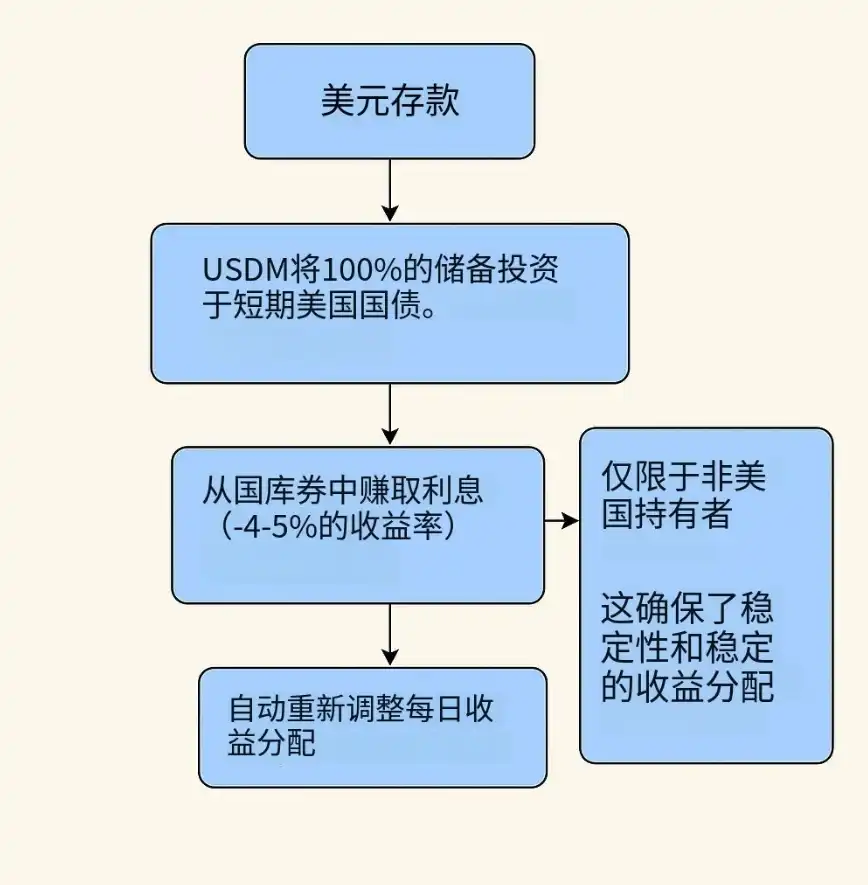
→ Strategy: 100% Backed by US Treasury Bills (T-Bill)
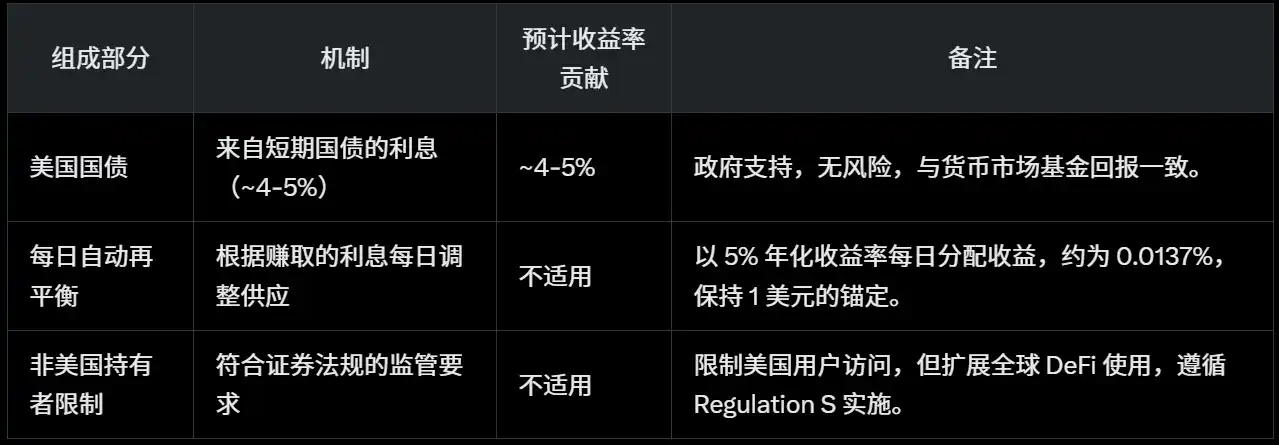
• All Reserves Comprised of Short-Term US Treasury Bills
• Daily Rebasement for Balance Growth (e.g., Daily Growth of 0.0137%)
• Only available to non-US holders
Simple, stable, and fully transparent through audits.
USDtb – Provided by @Ethena_Labs and @BlackRock
→ Annual Percentage Yield: Around 3–5%
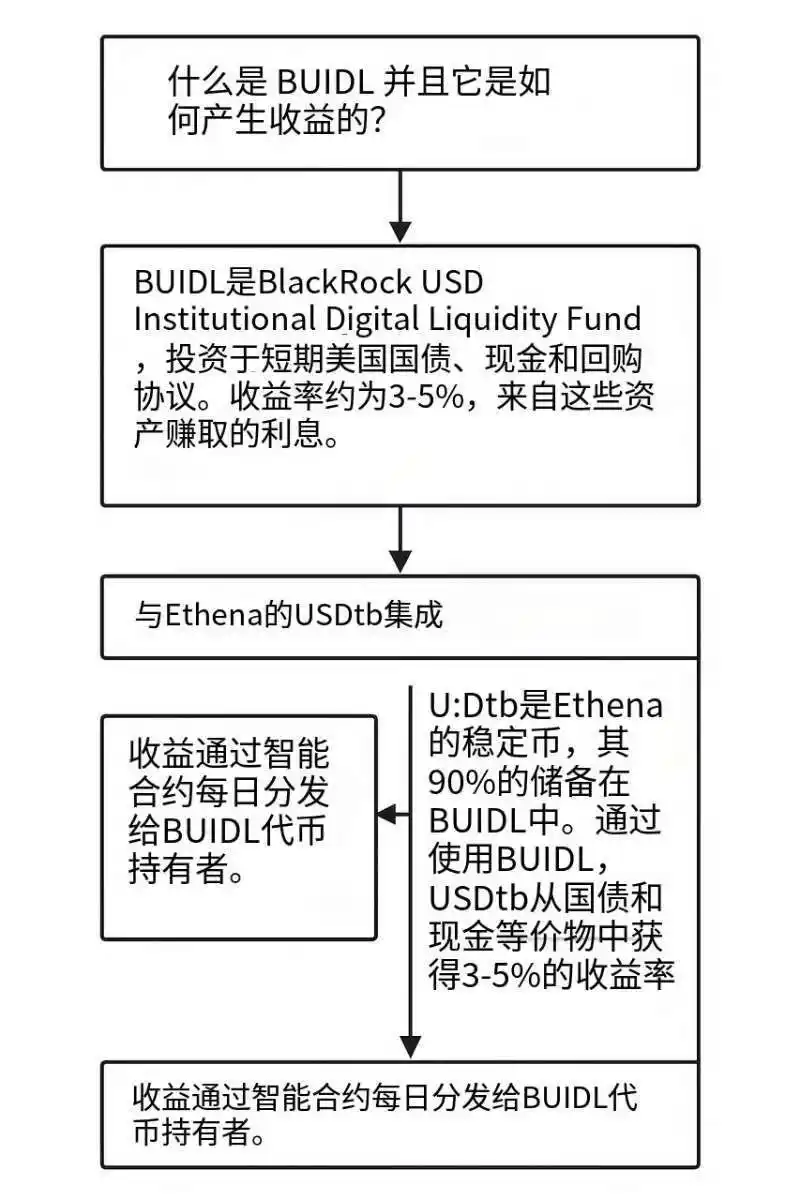
→ Strategy: Institution-Grade Tokenized Fund
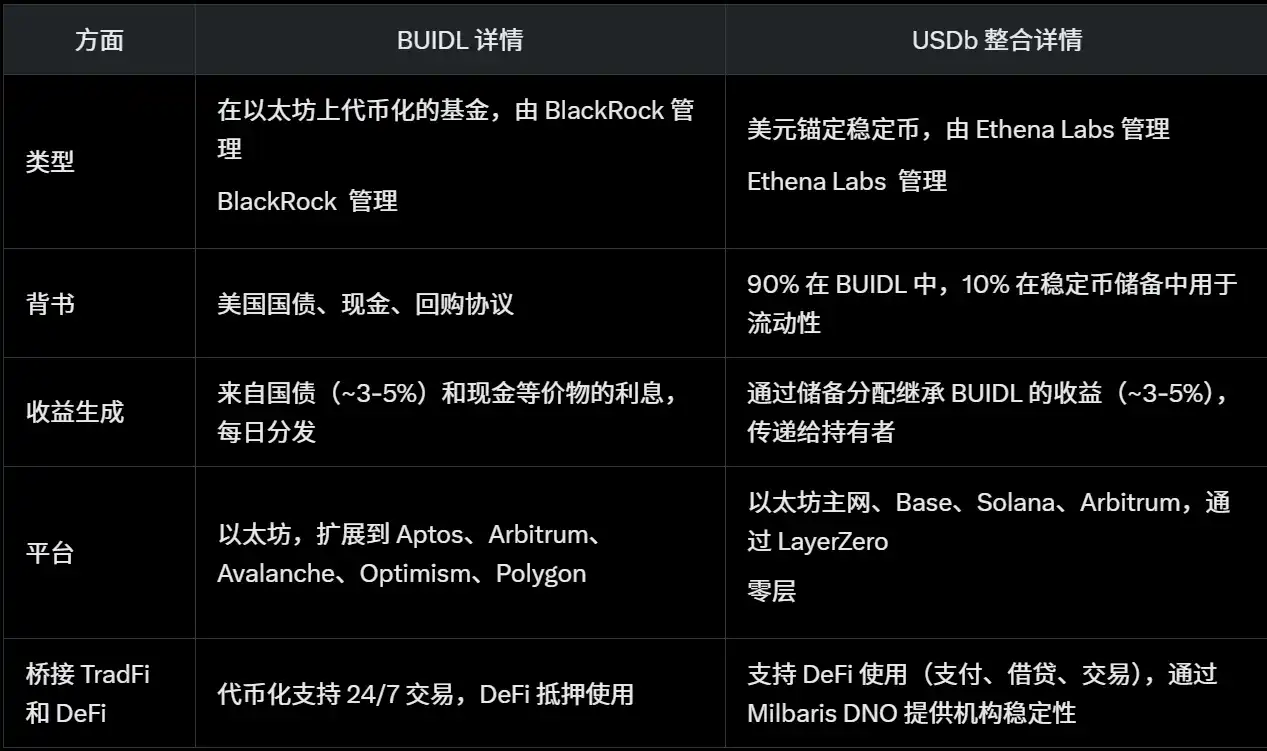
• BUIDL is a tokenized fund composed of US Treasury Bills, cash, and repurchase agreements (repos)
• USDtb uses BUIDL to back 90% of reserves
• Combines traditional financial security with 24/7 DeFi availability
Highly suitable for DAOs and protocols seeking security and yield.
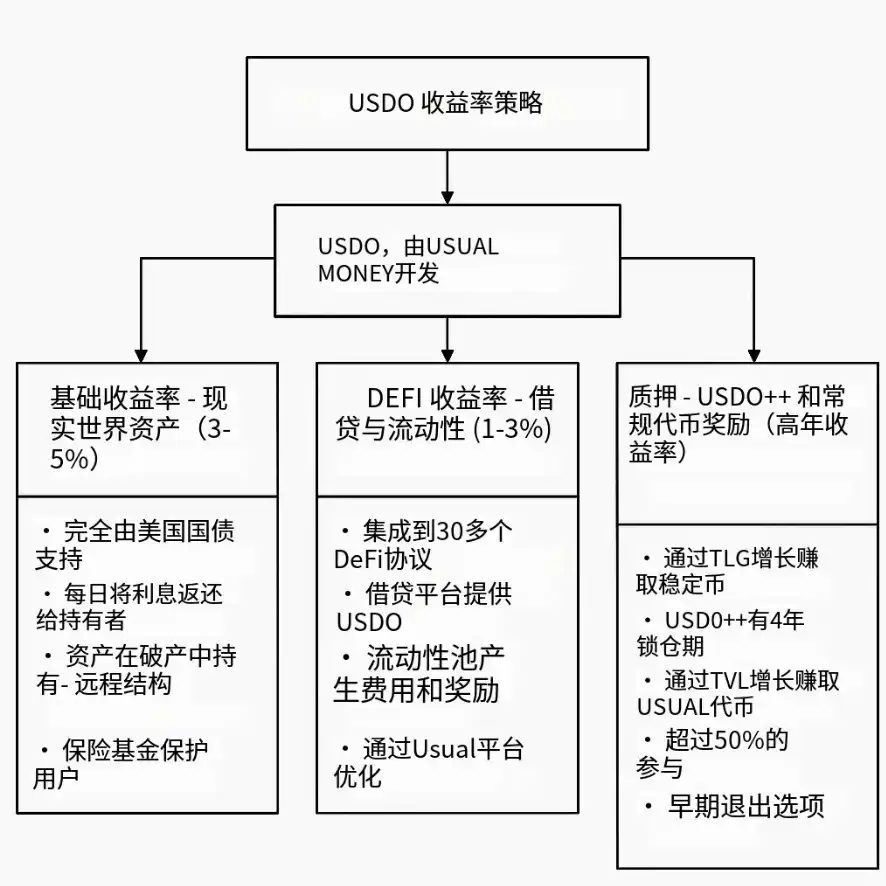
USD0 – Provided by @UsualMoney
→ Annual Yield: About 5–7%
→ Strategy: RWA+ DeFi + Staking Rewards
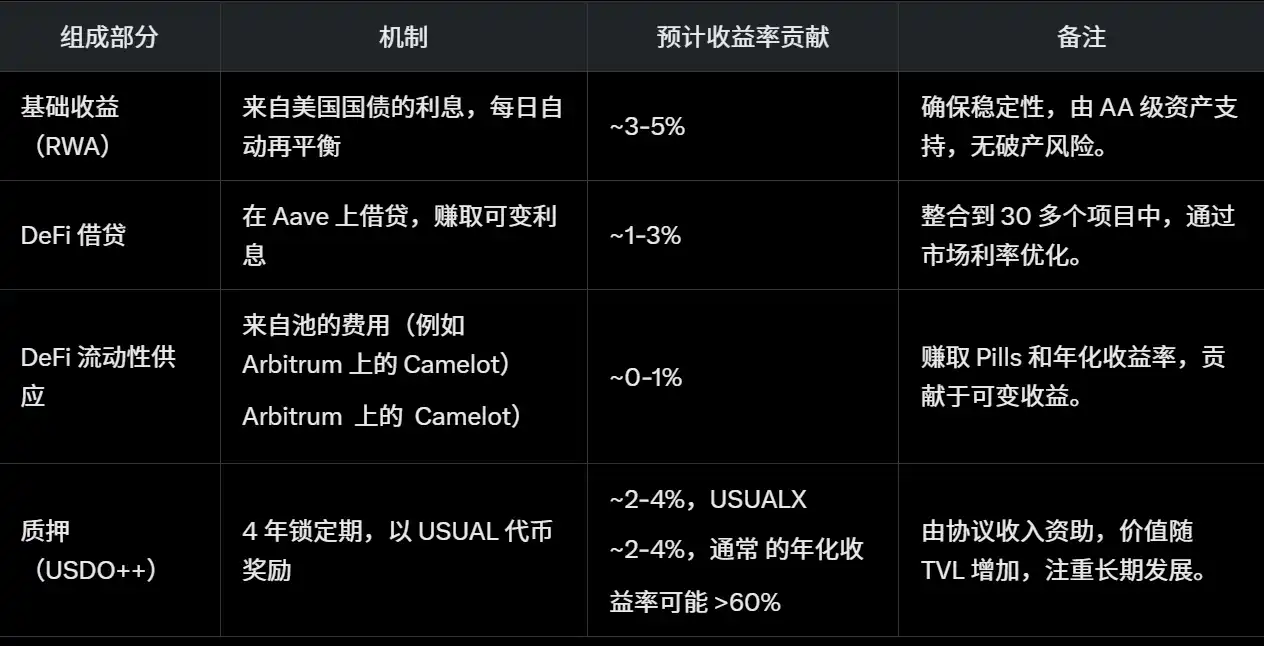
• Base Yield: 3–5% from US Treasury Bonds
• Additional Yield: 1–3% from DeFi Lending and Liquidity Mining
• Staking USD0++ → Receive USUAL Token (up to 60% APY)
Highly composable, deployed on 27 chains and 30+ decentralized applications.
YLDS – Provided by @FigureMarkets
→ Annual Yield: About 3.8%
→ Strategy: Linked to SOFR (Secured Overnight Financing Rate), Yield compliant with SEC regulations
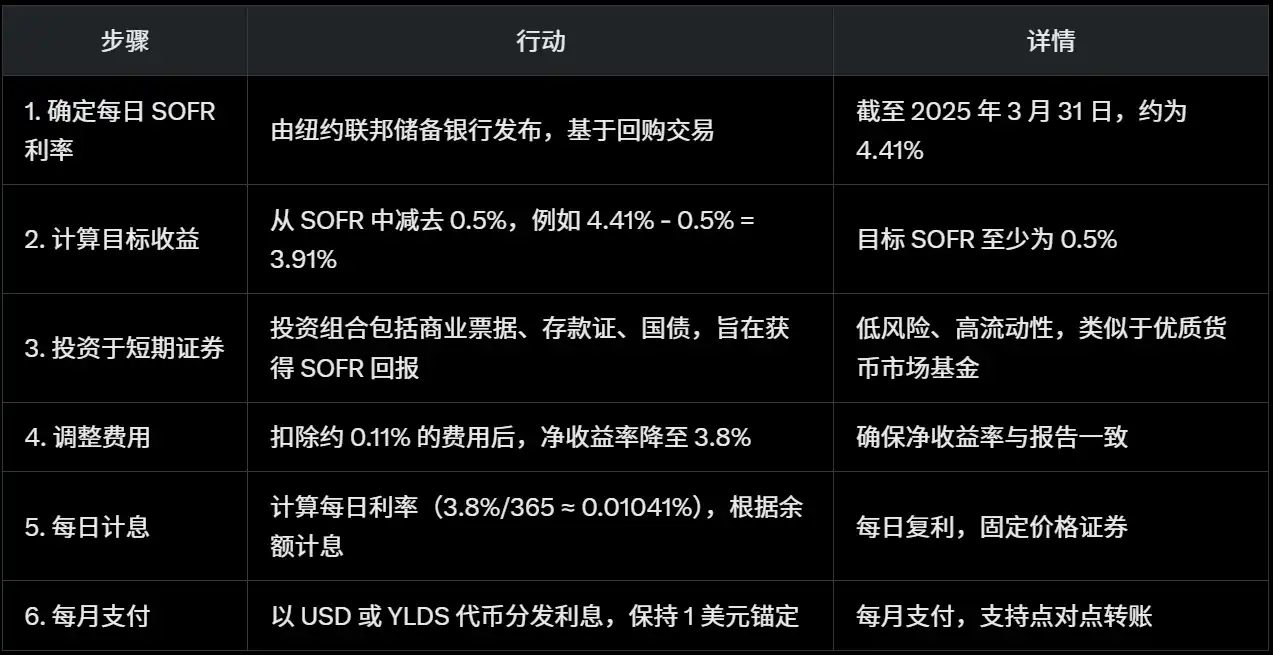
• Anchored to SOFR - 0.5%
• Reserve funds held in Prime Money Market Funds (MMFs) and US Treasury Bonds
• Daily compounding, monthly yield payouts
• Registered Public Securities—Available for US investors to purchase
Stable, regulated, very suitable for compliant on-chain investments.
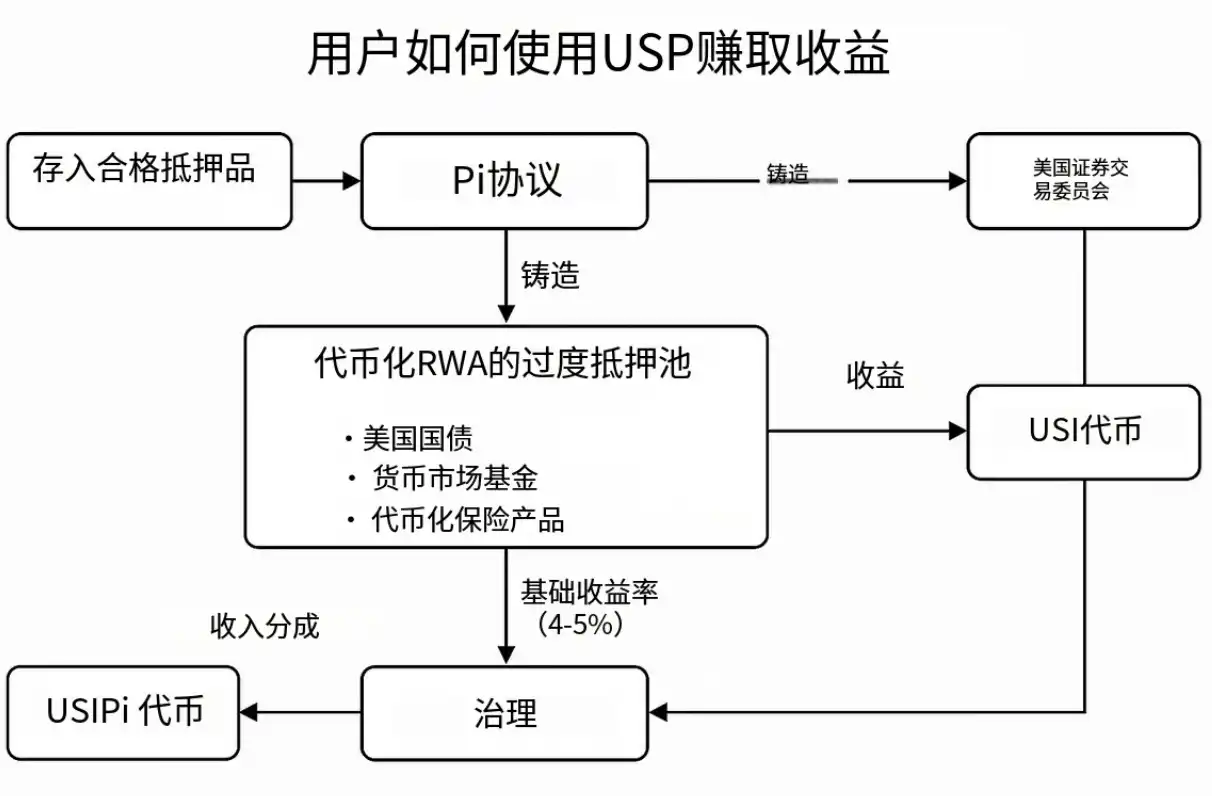
USP – Provided by @Pi_Protocol_ (Expected to launch in the second half of 2025)
→ Annual Yield: About 4–5% (Projected)
→ Strategy: Tokenization of US Treasury Bonds, Money Market Funds (MMFs), Insurance
• Overcollateralized RWA support
• Dual Token Model:
• USP (Stablecoin)
• USI (Yield)
• USPi NFTs offer revenue sharing + governance rights
Designed to align user interest with platform long-term growth.
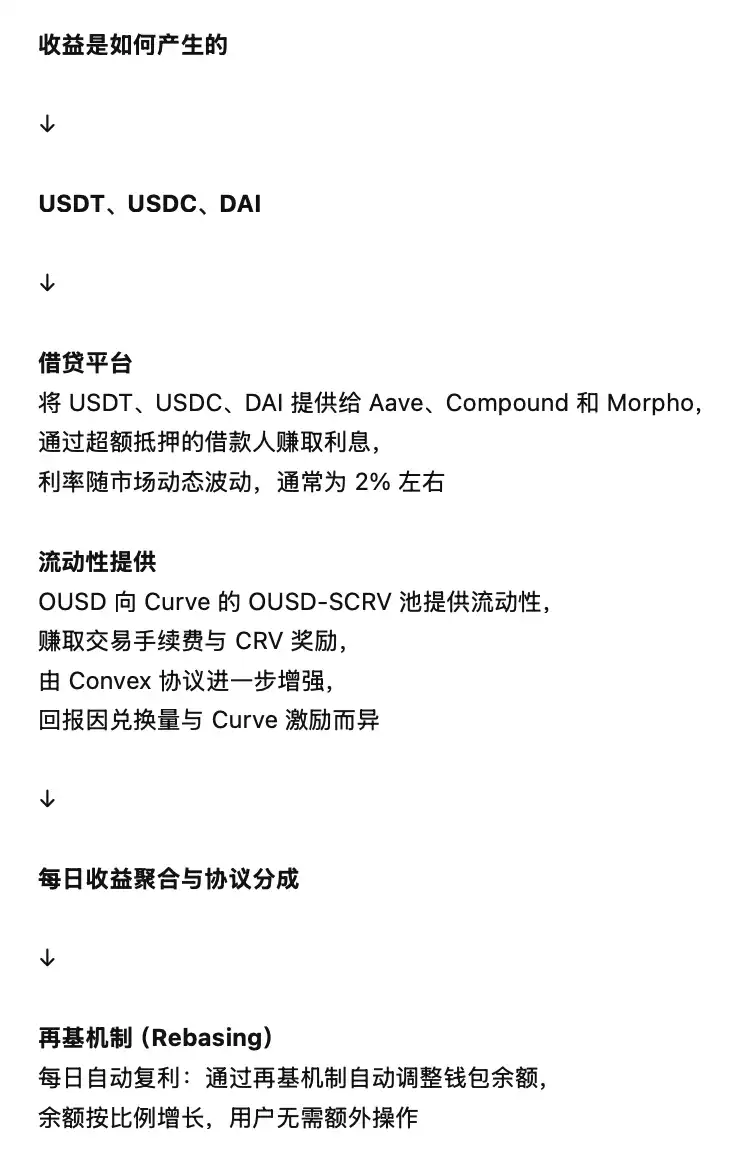
OUSD – Provided by @OriginProtocol
→ Annual Percentage Yield: Approximately 4–7%
→ Strategy: DeFi-native, auto-compounding yield
• Lend USDT, USDC, DAI to Aave, Compound, Morpho
• Provide liquidity on Curve + Convex
• Daily auto-compounding to increase wallet balance
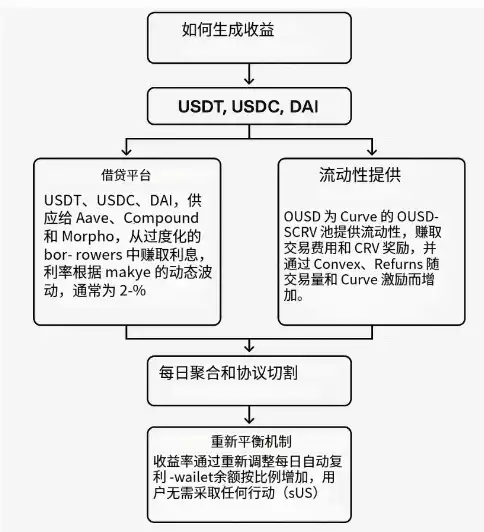
No staking, no lock-ups.
You may also like

Wall Street Shorts ETH: Vitalik is aware and has front-run, while Tom Lee remains oblivious

Social Capital CEO: How Equity Tokenization is Reshaping Capital Markets from US Stocks to SpaceX?

CoinGecko Report: Surge of 346% vs Dip of 20.8%, The Wild Rise of DEX

a16z: The Real Opportunity of Stablecoins Lies Not in Disruption but in Filling Gaps

Mining Exodus: Someone Holds $12.8 Billion AI Order

March 6 Market Key Intelligence, How Much Did You Miss?

a16z: The True Opportunity of Stablecoins is in Complementing, Not Disrupting

Predict LALIGA Matches, Shoot Daily & Win BTC, USDT and WXT on WEEX
The WEEX × LALIGA campaign brought together football excitement and crypto participation through a dynamic interactive experience. During the event, users predicted matches, completed trading tasks, and took daily shots to compete for rewards including BTC, USDT, WXT, and exclusive prizes.

Ray Dalio Dialogue: Why I'm Betting on Gold and Not Bitcoin

Who Took the Money in the AI Era? A Must-See Investment Checklist for HALO Asset Trading
Wall Street Bears Target Ethereum: Vitalik In the Know Takes Flight, Tom Lee Remains Bullish
Pump.fun Hacker Steals $2 Million, Receives 6-Year Prison Sentence, Opts for 'Self-Detonation'

6% Annual Percentage Yield as Musk Declares War on Traditional Banks
36 years, 4 wars, 1 script: How does capital price the world in conflict?

Mining Companies' Great Migration: Some Have Already Secured $12.8 Billion in AI Orders
What Is Vibe Coding? How AI Is Changing Web3 & Crypto Development
What is vibe coding? Learn how AI coding tools are lowering the barrier to Web3 development and enabling anyone to build crypto applications.
The parent company of the New York Stock Exchange strategically invests in OKX: The intentions behind the $25 billion valuation
WEEX P2P update: Country/region restrictions for ad posting
To improve ad security and matching accuracy, WEEX P2P now allows advertisers to restrict who can trade with their ads based on country or region. Advertisers can select preferred counterparty locations for a safer, smoother trading experience.
I. Overview
When publishing P2P ads, advertisers can now set the following:
Allow only counterparties from selected countries or regions to trade with your ads.
With this feature, you can:
Target specific user groups more precisely.Reduce cross-region trading risks.Improve order matching quality.
II. Applicable scenarios
The following are some common scenarios:
Restrict payment methods: Limit orders to users in your country using supported local banks or wallets.Risk control: Avoid trading with users from high-risk regions.Operational strategy: Tailor ads to specific markets.
III. How to get started
On the ad posting page, find "Trading requirements":
Select "Trade with users from selected countries or regions only".Then select the countries or regions to add to the allowlist.Use the search box to quickly find a country or region.Once your settings are complete, submit the ad to apply the restrictions.
When an advertiser enables the "Country/Region Restriction" feature, users who do not meet the criteria will be blocked when placing an order and will see the following prompt:
If you encounter this issue when placing an order as a regular user, try the following solutions.
Choose another ad: Select ads that do not restrict your country/region, or ads that allow users from your location.Show local ads only: Prioritize ads available in the same country as your identity verification.
IV. Benefits
Compared with ads without country/region restrictions, this feature provides the following improvements.
Aspect
Improvement
Trading security
Reduces abnormal orders and fraud risk
Conversion efficiency
Matches ads with more relevant users
Order completion rate
Reduces failures caused by incompatible payment methods
V. FAQ
Q1: Why are some users not able to place orders on my ad?
A1: Their country or region may not be included in your allowlist.
Q2: Can I select multiple countries or regions when setting the restriction?
A2: Yes, multiple selections are supported.
Q3: Can I edit my published ads?
A3: Yes. You can edit your ad in the "My Ads" list. Changes will take effect immediately after saving.


 App
App