
EVM is not yet online, how to evaluate the future of Hyperliquid?


Original title: The Bull Case for Hyperliquid Hyperliquid
Original author: fmoulin7, Crypto Kol
Original translation: zhouzhou, BlockBeats
Editor's note:Hyperliquid attracts users through low fees and strong incentives, and is expected to provide incentives of nearly $1 billion in the first year, with an inflation rate of 11.65%. After the launch of EVM, it may become an important platform for new DeFi protocols to drive the growth of HYPE demand. The platform makes profits through transaction fees and token auctions, and fee allocation is automatically executed, supporting staking rewards, platform operations and token destruction. Increased capital inflows, especially through Kucoin, will drive HYPE prices if more market funds can be attracted. However, centralization and EVM transition risks may affect user experience, and investors need to be cautious and do research.
The following is the original content (the original content has been reorganized for easier reading and understanding):
Hyperliquid is a perpetual trading protocol built on its own L1, which aims to replicate the user experience of centralized trading platforms, while providing a fully on-chain order book and decentralized trading, supporting spot, derivatives, and pre-listed market transactions.
This article will focus more on Hyperliquid's market opportunities and the basic bullish logic of HYPE.
At present, HYPE's trading price has exceeded $20, becoming a top 30 asset with a market value of $7.5 billion and a fully diluted valuation (FDV) of more than $20 billion. So, where does Hyperliquid's popularity come from? What is the bullish logic?
Next we will discuss:
Trading platform opportunities
EVM ecosystem opportunities
Income composition, valuation and comparative analysis
Risk
1. Trading platform opportunities
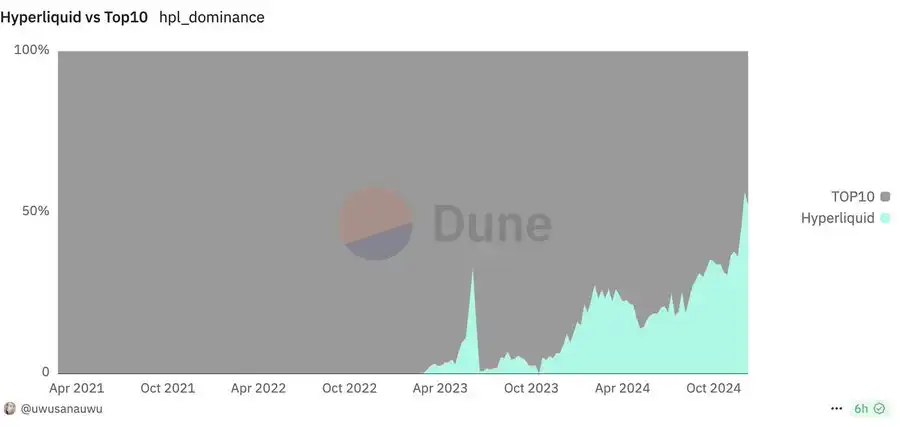
Hyperliquid dominates the field of perpetual decentralized trading platforms, accounting for more than 50% of trading volume in the past month.
As of now, Hyperliquid's open interest (OI) accounts for about 10% of Binance.
A few things to note here:
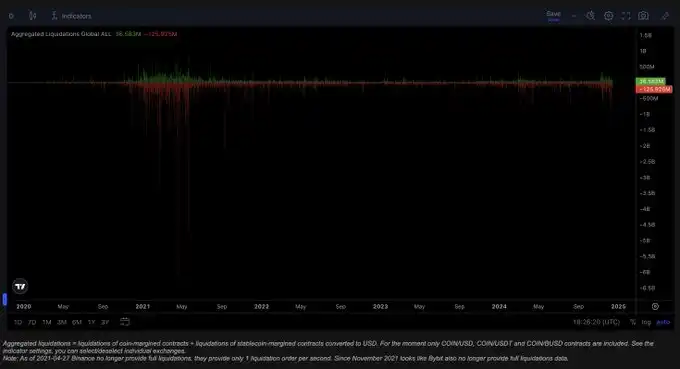
As the bull run deepens and market volatility increases (the crypto volatility index is currently only 64), open interest (OI), trading volume, funding rates, and liquidations are expected to continue to grow.
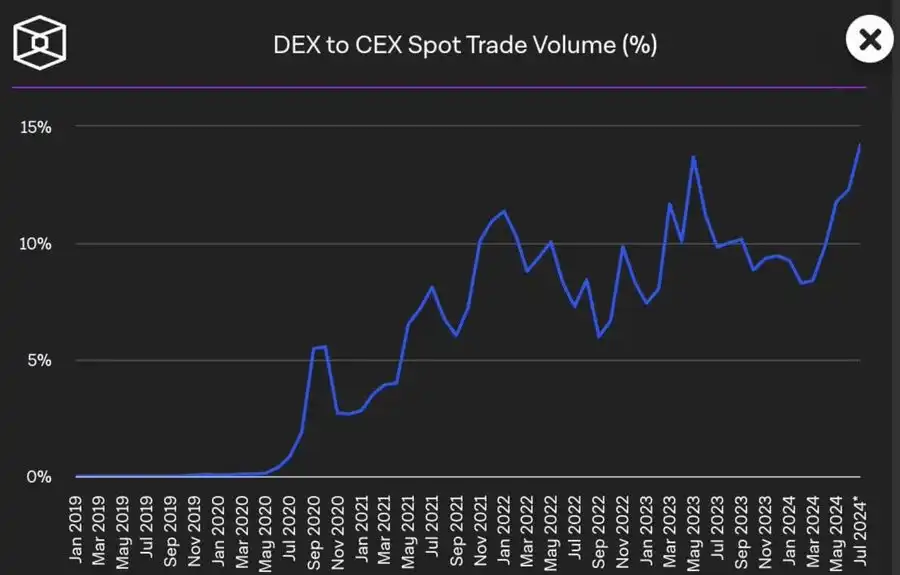
The share of DEXs vs. CEXs for perpetual swaps may increase, just as AMMs and Uniswap have contributed to the growth of DEX vs. CEX share in spot trading.
With lower fees and stronger incentives than its CEX competitors, Hyperliquid has a great opportunity to attract more users and capital away from CEXs. The Token Generation Event (TGE) and the rapid rise in HYPE prices have undoubtedly become the strongest marketing campaign.
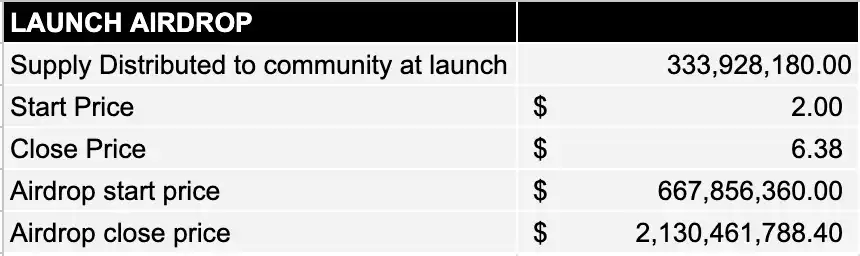
Regarding the incentive mechanism, although the specific structure has not yet been disclosed, it is easy to speculate that perpetual swaps and spot trading volume may be incentivized (or already incentivized), after all, more than 40% of the token supply is reserved for community rewards. Here are the details of the initial airdrop:
Assuming 10% of the reserved supply is used for incentives in the first year, the situation will be as follows:
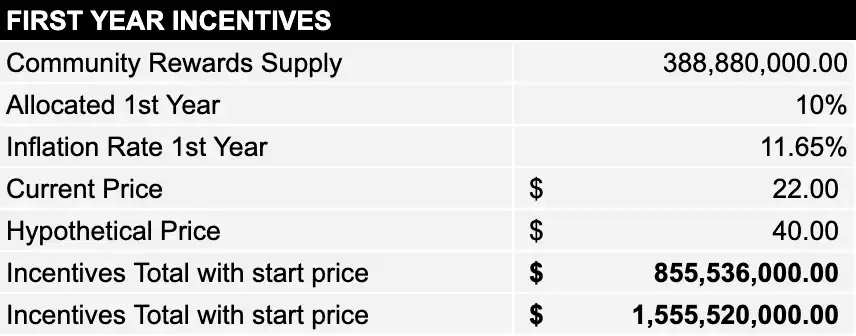
At current prices, nearly $1 billion in incentives will be distributed in the first year, which is far more than the amount distributed at the $2 opening price during the airdrop. The resulting incentive inflation rate is about 11.65% (including staking rewards, which may need to be calculated separately).
More users will bring more trading volume, revenue, destruction and buybacks, so in this case, the actual dilution cost to token holders caused by incentives will be less than 11.65%.
The team can also choose higher inflation rates and incentive levels to attract more users. This is exactly the difference in HYPE's fully diluted valuation (FDV) dynamics mentioned by blknoiz06.
Brief summary of the perpetual contract sector:
Growing market (cyclical + DEX gradually dominates CEX)
Hyperliquid market share is expected to grow (relying on incentives)
In addition:
The spot market may also continue to grow, and Hyperliquid is expected to become a top 3 spot DEX in the short term. Yesterday's trading volume was about $500 million, enough to make Hyperliquid the fifth-largest spot DEX in the entire chain.
With the addition of EVM, more interesting assets may enter the spot market for trading, such as new issuance of utility tokens and native assets (such as native USDC and SOL/ETH/BTC spot trading pairs).
More trading tools are being developed based on Hyperliquid's open infrastructure and builder codes. There are already many cool applications launched by teams such as InsilicoTrading, KatoshiAI and pvp dot trade, and more products will be released in the future to improve the user experience and attract more traffic to the exchange.
The above factors are already very bullish in themselves.
Exchanges and stablecoins are the most profitable and valuable businesses in the crypto space. Competing directly with mainstream players (Binance, Coinbase, Bybit, OKX) for perpetual contracts and spot trading is bullish in itself.
The most optimistic scenario is:
1. Major trading platforms use Hyperliquid as a decentralized backend;
2. Trading platforms hedge by including HYPE in their balance sheets (Refer to ThinkingUSD proposal).
While the possibility of achieving these two points in the short term is unclear, who would have thought that Trump would buy $ENA? Everything is possible.
2. EVM Ecosystem Opportunities
What is HyperEVM?
Description from hyperdrivedefi: "The Hyperliquid stack consists of two chains, Hyperliquid L1 and HyperEVM (EVM). The two chains exist as a unified state under the same consensus mechanism, but run in independent execution environments.
L1 is a permissioned chain that runs native components such as perpetual contracts and spot order books, and is designed to meet the high performance requirements required to run these native components. L1 provides API programmability, and operations submitted through the API must be signed like transactions submitted to the EVM chain.
EVM is a general EVM-compatible chain that supports common tools of Ethereum. EVM It is permissionless and anyone can deploy smart contracts that can also directly access on-chain perpetual contracts and spot liquidity on L1."
HyperEVM is scheduled to launch in the coming months and many teams are already preparing for it. Why is this bullish?
The new home of DeFi?
Many DeFi teams are preparing to launch with the EVM. Most of the "well-known" DeFi protocol types (AMMs, lending, liquidity pledge, CDPs) are expected to be launched with the launch of the EVM.
These projects will improve overall capital efficiency by allowing HYPE holders to use HYPE as collateral in lending and money market protocols.
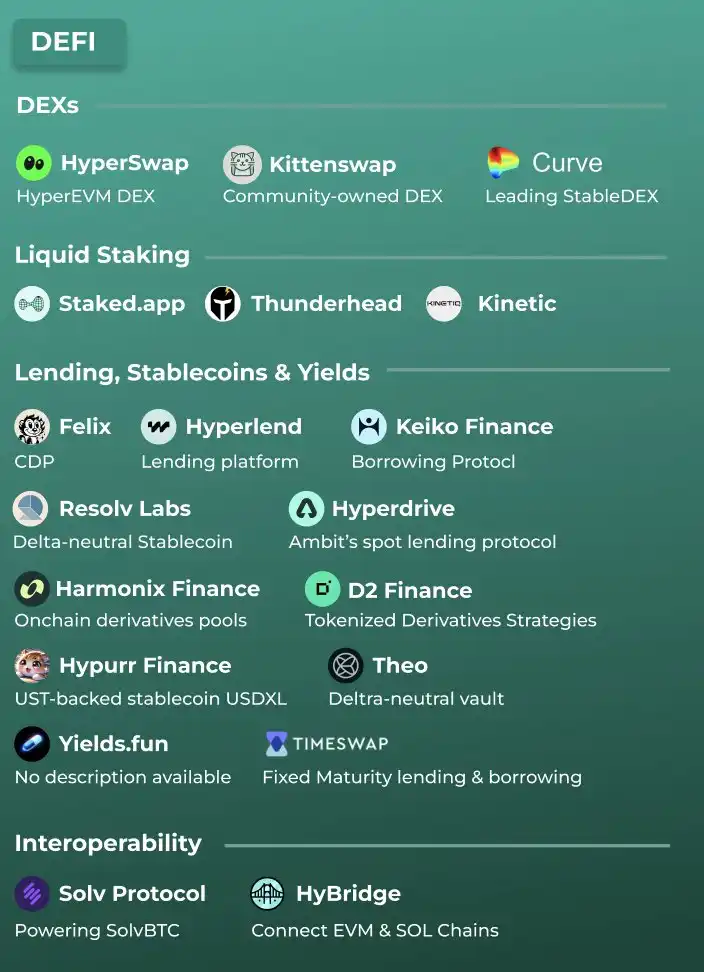
As existing protocols are applied, it will be interesting to see whether putting order book liquidity directly on-chain will unlock new DeFi primitives. I would not be surprised if brand new DeFi primitives appear first on Hyperliquid.
For example, ethena labs will reduce its reliance on centralized trading platforms, which will improve its system resilience and potentially diversify and reduce counterparty risk by partially integrating Hyperliquid in its hedging process. 【Reference link】
The market needs "utility projects"
Whether it is the AI craze on Base and Solana, the performance of Hyena, or the trading volume of $HFUN and $FARM on Hyperliquid, market participants are showing that they are eager to see projects with real value.
With many DeFi projects coming soon, Hyperliquid is likely to become a platform for the rise of "utility projects" in the near to medium term. At the same time, there is a high probability that the AI infrastructure currently built on Solana by AI16Z, Zerebro, etc. may be extended to Hyperliquid.
Hyperliquid's unique features
Hyperliquid natively supports the creation of vaults. These strategies running on vaults are able to take advantage of the same advanced features as DEX, such as efficient liquidation of ultra-leveraged accounts and high-throughput market-making strategies. Anyone can deposit money into the treasury to get a share of the profits, including DAOs, protocols, institutions or individuals. The owner of the treasury can get 10% of the total profits.
This primitive provides an ideal competitive scenario for AI agents to attract capital.
Why is the launch of EVM a bullish signal?
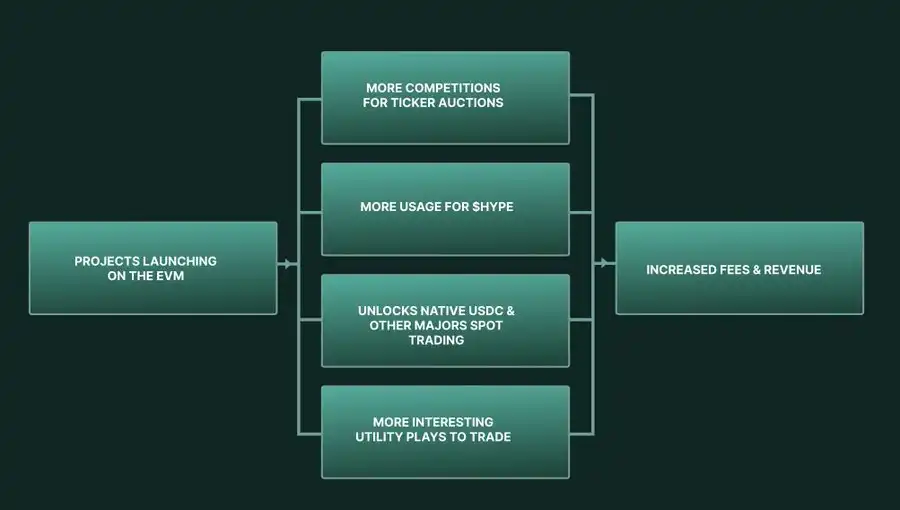
The launch of EVM will bring more fee income, which can be used for staking rewards, token destruction, etc. Take Base as an example, it has generated $15 million in fees in the past 30 days. I think HyperEVM's activity may be on par with Base in the next few months.
EVM also unlocks more use cases for the HYPE token within the ecosystem. HYPE will become a necessary asset to pay gas fees, and can also be used for lending, staking, locking positions to earn income, etc. This will significantly increase buying demand.
We can refer to the examples of SOL in 2024 (Meme) and ETH in 2020 and 2021 (DeFi and NFT) - on-chain activities directly drive demand for native assets.
Higher market value utility projects + more native asset bridging options (such as native USDC, spot BTC, SOL, ETH, etc.) will drive spot trading volume up, thereby bringing more revenue.
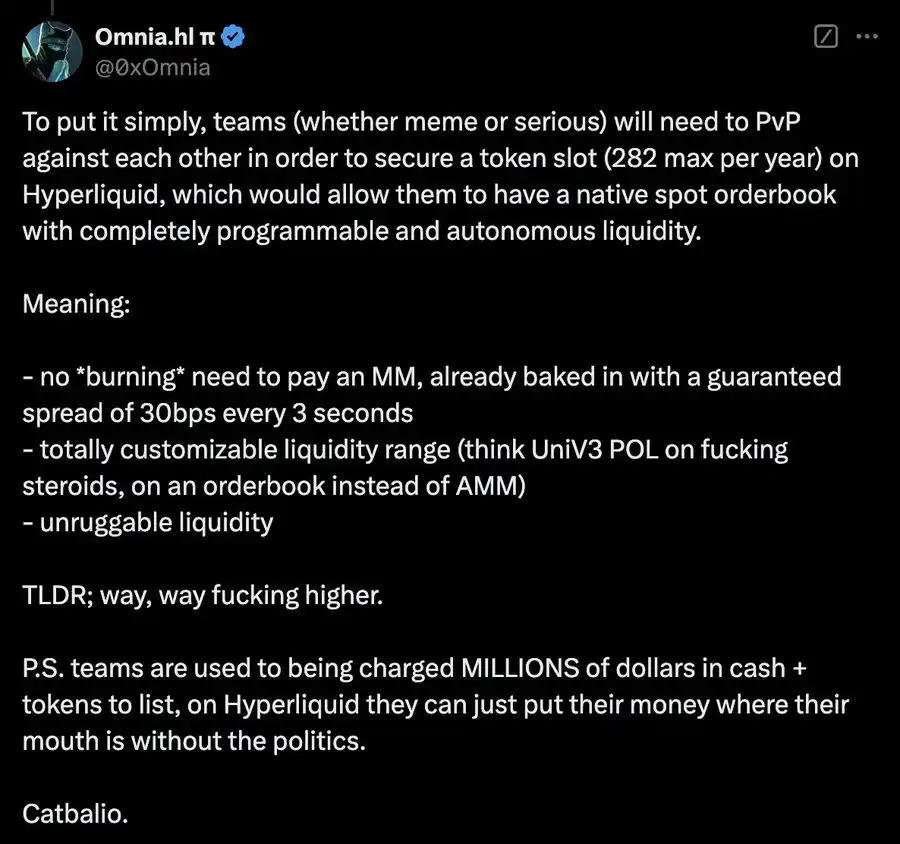
As more teams go online on EVM, the auction price of token codes (tickers) will continue to rise, further increasing revenue.
In addition, EVM will make Hyperliquid an "official" L1 network in the minds of more people and attract more attention to its ecosystem. This may release capital currently on the sidelines to enter the market.
Revenue Breakdown, Valuation and Comparable Companies
How does Hyperliquid make money?
Hyperliquid's profit sources mainly include platform fees and token code (ticker) auctions.
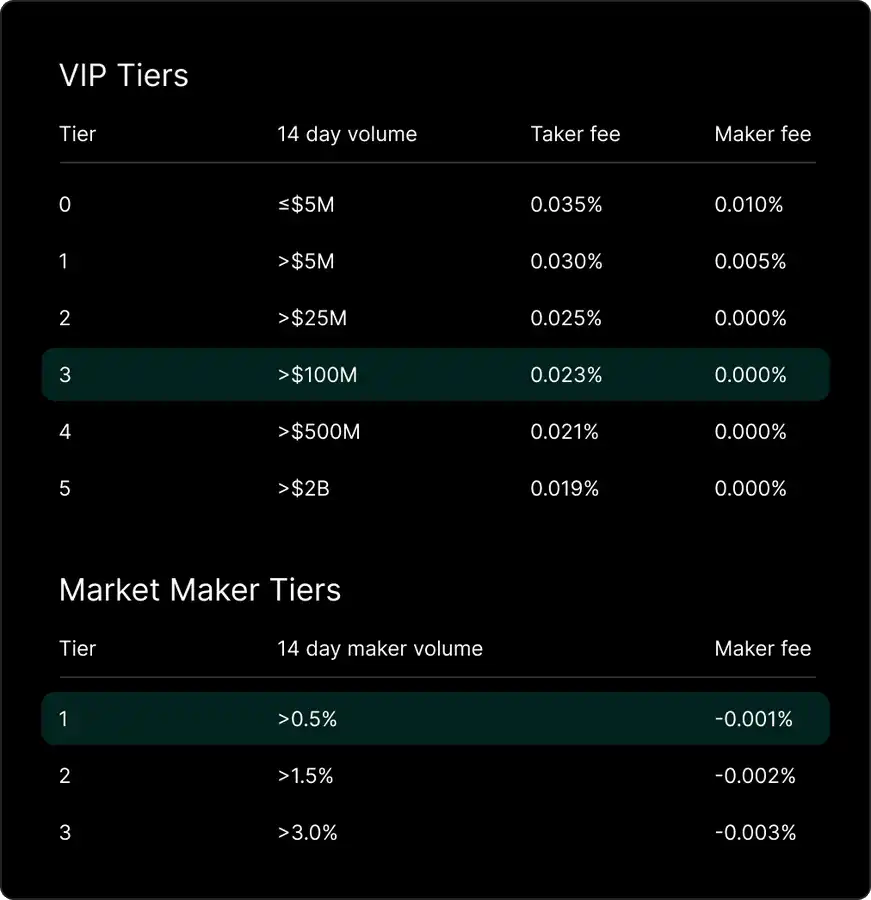
Platform Fees:
Ticker Auctions:
Hyperliquid earns revenue through ticker auctions. In these auctions, projects bid to purchase specific tickers, which are key identifiers for them to display and trade on the platform. As more projects go live on the EVM, the ticker auctions will become more competitive and prices will gradually rise, bringing more revenue to Hyperliquid.
This is how fees flow on-chain:
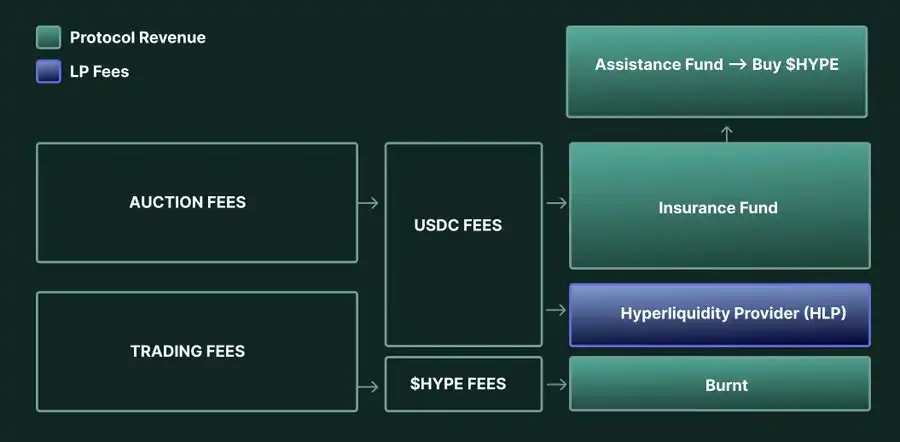
As of writing, the rescue fund holds 10,761,181.28 HYPE (over 3% of circulating supply) and 3,143,786.73 USDC. The insurance fund has also accumulated 7,071,990.99 USDC that has not yet been transferred to the rescue fund. In total, over $10 million in USDC has not yet been put on the market to buy HYPE.
So, how much revenue does Hyperliquid have? In the past 30 days, Hyperliquid has generated approximately $26.5 million in USDC revenue. Revenue from auctioned tokens accounted for $2 million of that, with the rest coming from platform fees. These revenues were primarily redistributed to the insurance fund.
In addition, since HYPE went live, approximately 79,600 HYPE tokens have been burned by transaction fees, which are denominated in HYPE. At today's prices, this equates to approximately $1.75 million in additional revenue. Therefore, Hyperliquid's total revenue in the past 30 days is over $28 million, which equates to over $336 million per year.
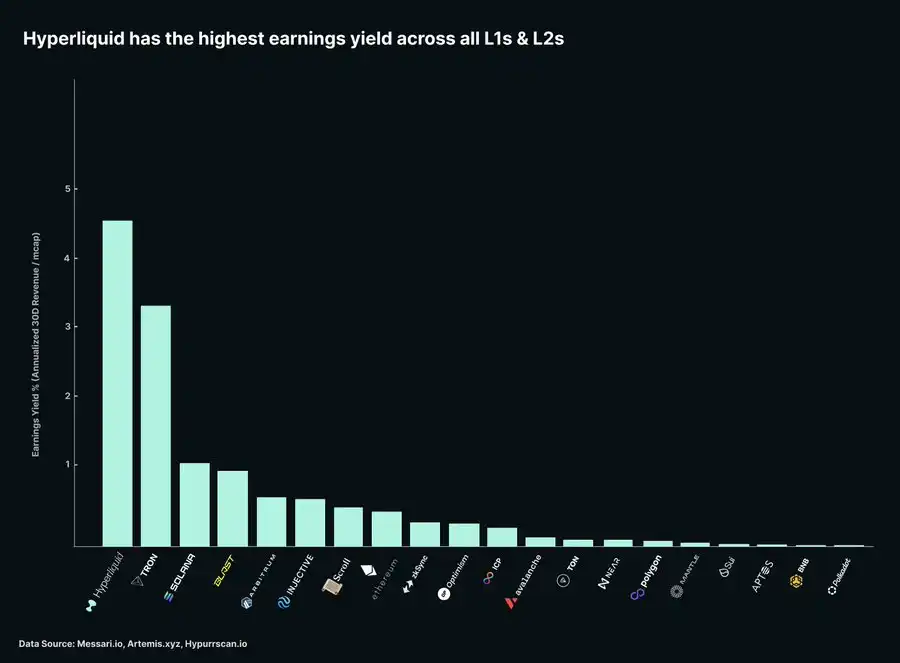
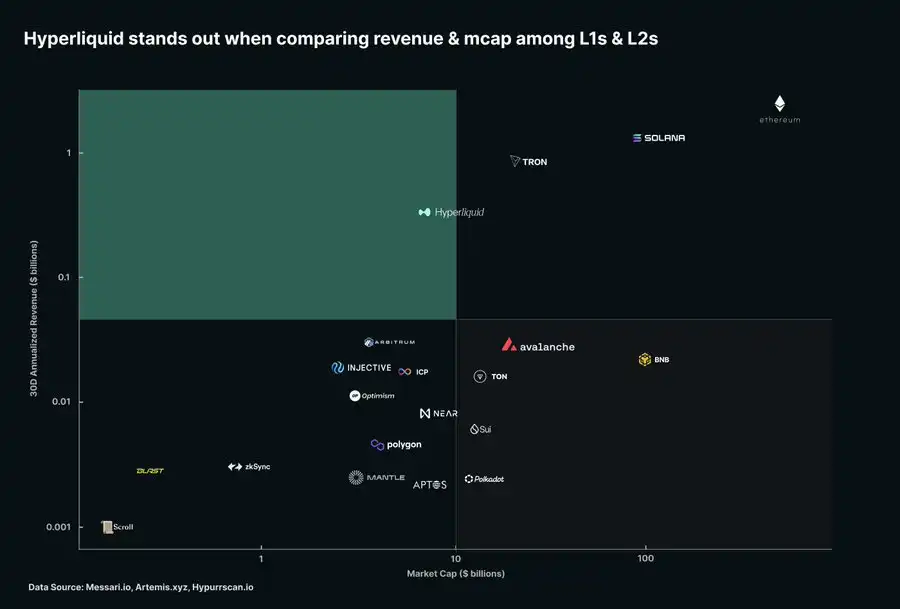
Currently, only 3 first-level blockchains (L1) have more revenue than Hyperliquid: Ethereum, Solana, and Tron, which have much higher market caps. In fact, Hyperliquid's yield (annualized revenue/circulating market cap) is far ahead and the highest among all L1 and L2 platforms.
Potential Revenue Growth
Where can it go next? The main drivers of revenue include:
Platform fees
Auctions
Future revenue mechanisms (EVM fees?)
Let’s analyze each of these factors one by one.
Platform fees
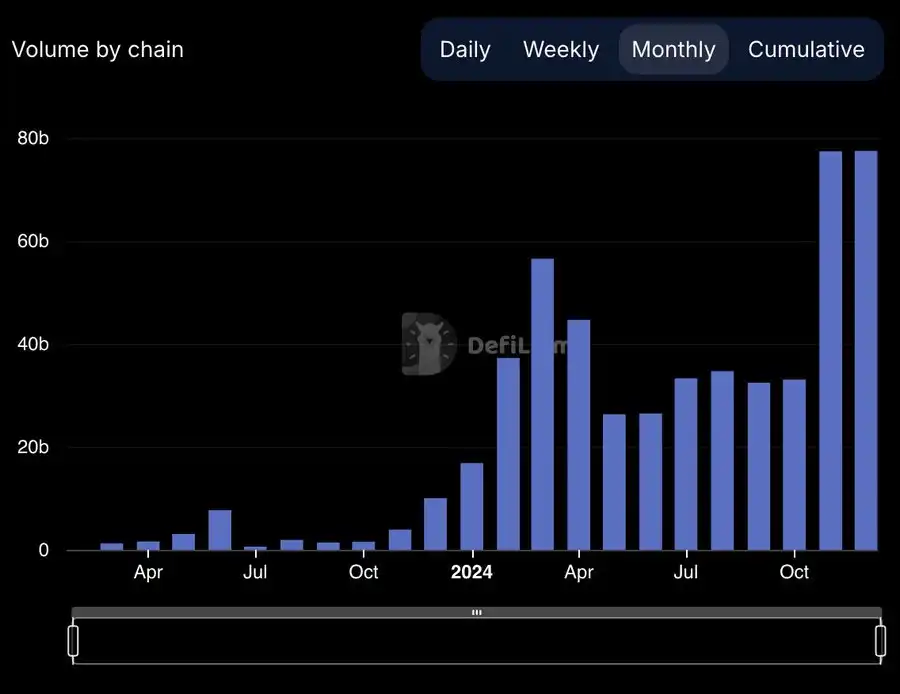
Trading volumes in December are already on par with November. If trading volumes remain at similar levels in the second half of the month, this would represent a 100% month-on-month increase.
Auction
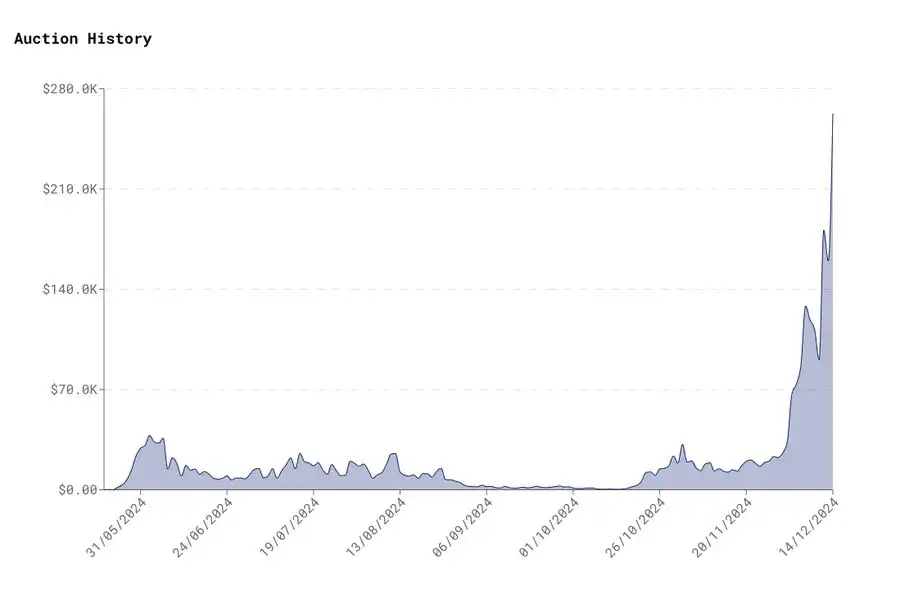
Recently, auction prices have soared, showing a sharp upward trend.
Auction
The latest round of auctions settled today at a price close to $500,000.
As more projects look to secure their spot (there are only 282 spots available per year), auction prices are likely to continue to rise.
EVM Fees
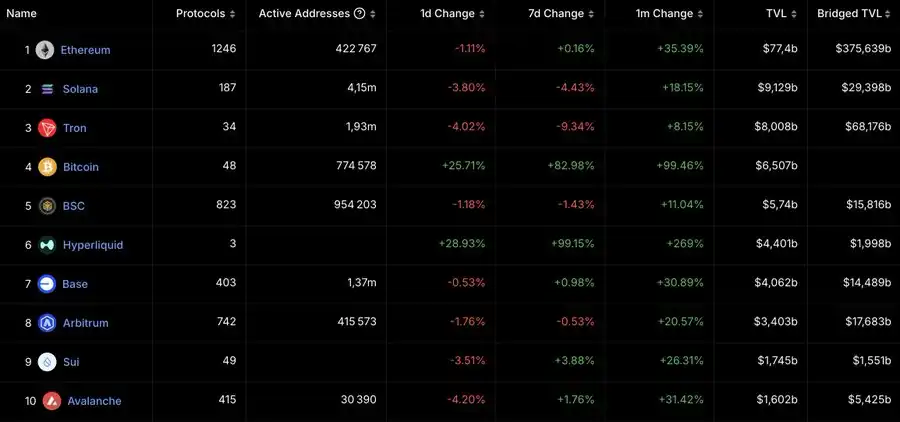
Base has generated roughly $15M in fees over the last 30 days. According to DeFiLlama, Hyperliquid has surpassed Base in TVL over the last 24 hours, and given current trends, it is possible that economic activity on the EVM will be comparable to or even higher than Base by the time Hyperliquid goes live.
Scenarios and Valuations
Based on the above, we can come up with a Base Scenario and a Bull Scenario. This post is about the Bull Scenario, so there is no Bear Scenario, but the risks are discussed in the last section.
Base scenario
Volume is one-third higher than last 30 days
Auction price remains stable
EVM activity is similar to Base
Bull scenario
Volume is twice as high as last 30 days
Auction price doubles and then remains stable ($1 million per auction round)
EVM activity is twice as high as Base
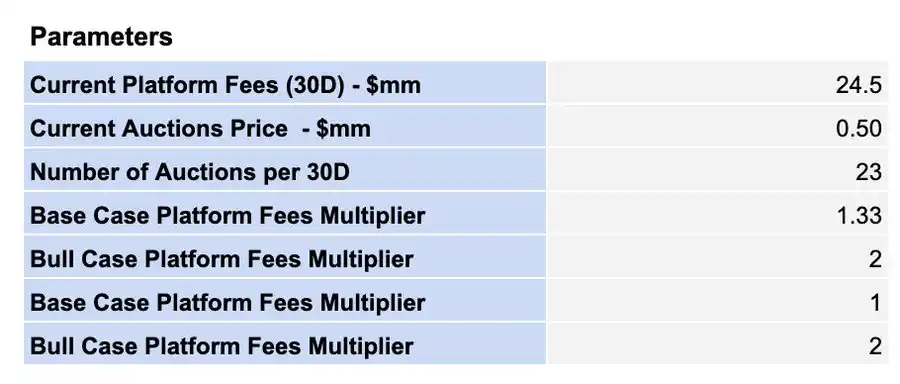
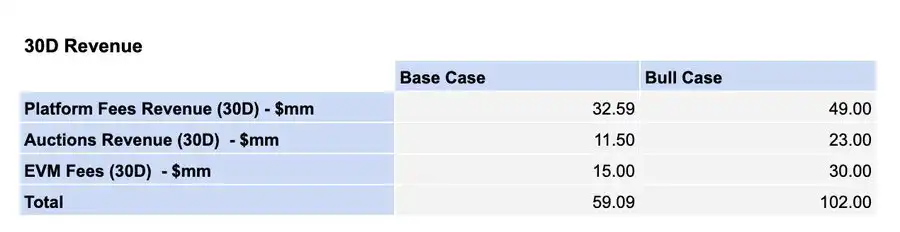
In the Base scenario, 30-day revenue is $59 million, while in the Bull scenario it is $102 million. To arrive at a valuation, we can use different price-to-earnings (PE) multiples, which are based on observations of the main first-level chains (L1) and combined with annualized revenue.
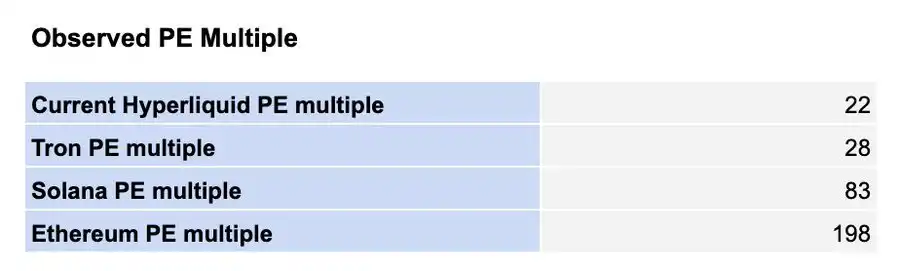
Next, we calculate the market value for the base case and bull case scenarios based on revenue and PE multiples. To arrive at the price of HYPE, we use the current circulating supply, plus an inflation rate of 11.6% (for incentives and rewards), which was calculated in Part I.
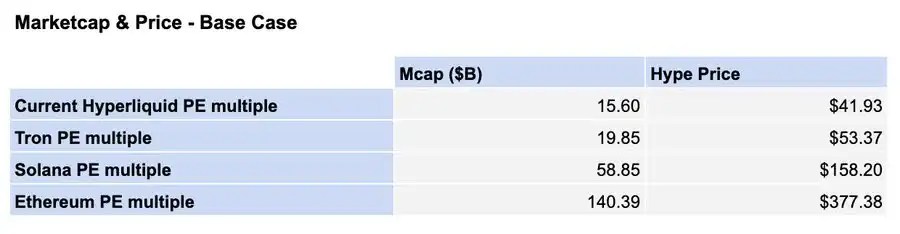
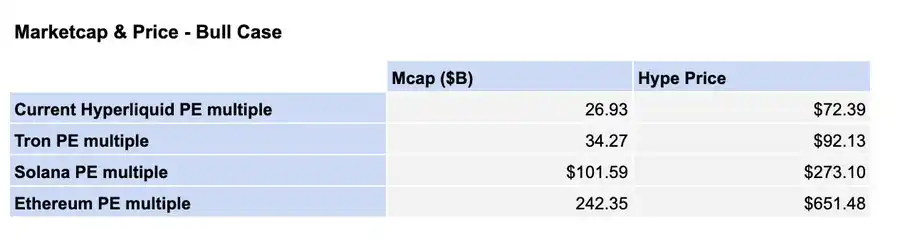
Under these conditions, we can see HYPE’s price range from $41.93 (base case, lowest multiple) to $651.48 (bull case, highest multiple).
Given HYPE’s relative immaturity and higher risk relative to Solana and Ethereum, it makes sense that HYPE’s P/E ratio should be on the lower end. Additionally, HYPE’s revenue is primarily derived from decentralized exchanges (DEXs), which Solana and Ethereum do not capture. Therefore, it is logical that HYPE’s P/E ratio is closer to DeFi protocols.
That being said, Hyperliquid’s current P/E ratio may be low given the P/E ratios of other first-level chains (L1) and second-level chains (L2). A “reasonable” scenario might be:
· 40x P/E
· Between the base case and the bull case: $1 billion in annualized revenue
This would bring the valuation to $40 billion ($100 billion fully diluted) and HYPE’s price to just over $100.
Comparison with the previous cycle
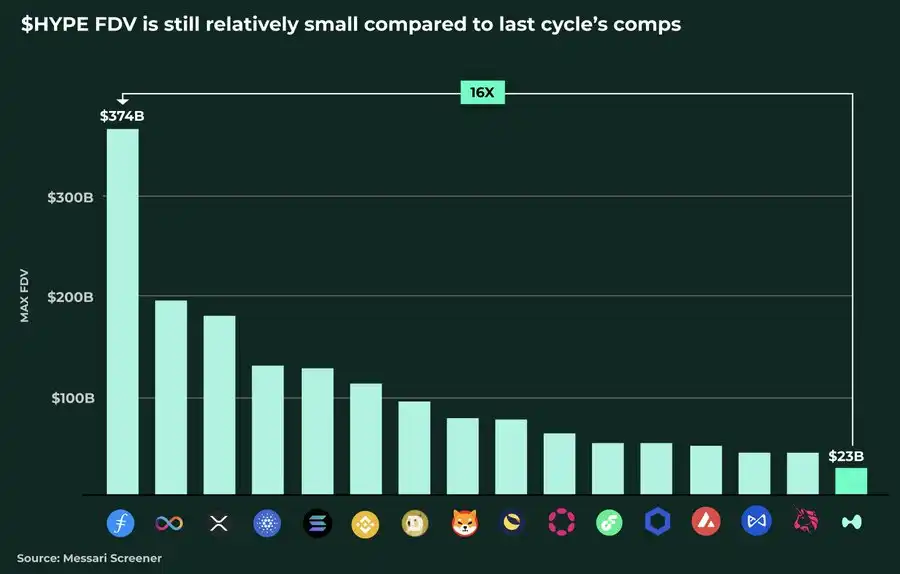
While a $40 billion market cap and a $100 billion fully diluted valuation may seem high, bull markets tend to be even crazier.
In 2021:
· BNB market cap grew from $5 billion to $100 billion (20x)
· ADA market cap grew from $5 billion to $95 billion (19x)
· SOL market cap grew from $86 million to $77 billion (900x)
· AVAX market cap grew from $282 million to $30 billion (100x)
· MATIC market cap grew from $85 million to $20 billion (235x)
· FIL’s fully diluted valuation reached $373 billion, 16x today’s HYPE valuation.
Capital Inflows
We have seen a large amount of capital inflow into Hyperliquid.
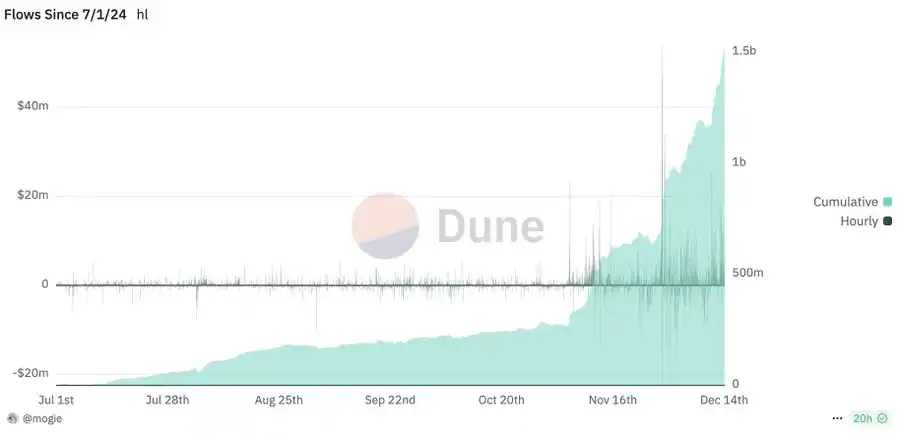
While the number of holders is increasing, the current number of HYPE holders is still relatively small, especially considering that HYPE is currently only listed on Kucoin.
Comparison data:
HYPE: 60,000 holders
KMNO: 55,000 holders
WIF: 211,000 holders
BONK: 861,000 holders
In an old Messari report, robustus calculated that the "capital inflow multiple" for an asset could be as high as 10x, meaning that a net inflow of $1 billion could increase an asset's market cap by $10 billion. While this cannot be calculated exactly, it is particularly important given HYPE's potential as the third most active L1. If HYPE could get 5% of Solana’s market cap and 1% of Ethereum’s market cap as inflows, this would represent a $10 billion inflow and have a huge impact on price.
We have partially seen this inflow since the TGE, but as fiskantes said, there is still a lot of capital on the sidelines waiting for the release of HyperEVM and the transition to decentralized validators before it will be allocated to HYPE.
Risks
While this article paints a fairly optimistic picture for the future of Hyperliquid, it is not without risks.
One major risk is the validator set, which is currently completely centralized (4 validators operated by a team based in Tokyo). Although the testnet is now live and has a decentralized validator set (over 60 validators), including some experienced validators (such as Chorus One, ValiDAO, B Harvest, Nansen, etc.), the transition is still risky. If performance degrades, user experience and trust will be threatened.
Another risk is the unrealization of the EVM ecosystem. High-quality projects need to be on the EVM for the ecosystem to thrive. If most of the projects are low-quality or simply copied from other chains, less capital and activity will be attracted. Therefore, attracting high-quality developers rather than speculative developers will be key.
On the EVM side, we may see HYPE become more and more capital efficient (such as liquidity staking, lending, etc.). Depending on what is built and its interaction with L1, we may see some new risks that are not present in existing DeFi protocols and may pose a threat to HYPE or the entire trading platform.
Regulatory risks remain, but as Fiskantes said (again, quoting), geo-fencing and Trump administration policies can reduce these risks.
Like all assets, especially as a trading platform, HYPE's performance should be highly correlated with the overall market. The team needs to deliver results before the market reaches weakness.
The crypto market is uncertain and everything can go to zero. I own HYPE, the above is not financial advice, investors please do your own research (DYOR).
You may also like

Morning Report | BitMine increased its holdings by 126,971 ETH last week; trader Eugene announced his exit from the crypto market

Wang Chuan: How can one not feel anxious after the neighbor Old Wang made thirty times profit by investing in storage stocks? (Seven) - A quarter-century cycle

Cryptocurrency CEXs are flocking to sell US stocks, and traditional brokerages are facing an "uninvited guest."

$75 billion in foreign capital has fled, and South Korean retail investors have absorbed it all using leverage

Japan’s Three Megabanks Plan Joint Stablecoin Issuance in Fiscal 2026
MUFG, SMBC, and Mizuho reportedly plan to jointly issue fiat-pegged stablecoins in fiscal 2026, signaling Japan’s growing push into bank-led digital payment infrastructure.

Humanity Discloses H Token Dual-Chain Attack Details, With Losses on Ethereum and BSC Exceeding $36 Million
Humanity said the H token attack across Ethereum and BSC caused more than $36 million in losses after leaked ProxyAdmin keys enabled malicious contract upgrades and token minting.
White House Discusses CLARITY Act With Law Enforcement Ahead of Senate Vote
The White House discussed the CLARITY Act with law enforcement ahead of a Senate vote, focusing on illicit finance risks and developer protections.

Bitcoin Trading Guide 2026: Strategies for Experienced Traders

What Is XAUT and PAXG? Why Tokenized Gold Is Booming in 2026

Will the SpaceX IPO Hurt Bitcoin? Here's What Traders Are Watching

Foreign selling in the South Korean stock market accelerates, with cumulative net sales reportedly reaching $75 billion this year
On June 9, The Kobeissi Letter, citing Goldman Sachs data, reported that global investors are selling South Korean stocks at an unusually rapid pace. In the latest trading session, foreign investors sold about $801 million worth of Kospi constituent stocks again; total foreign outflows last week reached about $10 billion, and the market has been in net foreign selling on nearly every trading day over the past month. According to the data cited in the report, foreign investors have sold about $75 billion worth of South Korean stocks so far this year. Meanwhile, South Korean retail and institutional investors together recorded roughly $69 billion in net buying over the same period, suggesting that the market’s main buying support has come from domestic capital rather than returning overseas funds. The information currently disclosed still mainly comes from The Kobeissi Letter’s retelling and Goldman Sachs data summaries, while public details on the statistical period and the specific definition of “selling” remain relatively limited.

Fortune Warns of Strategy’s Financing Structure Risks as Bitcoin Premium Narrows
Fortune warned that Strategy’s Bitcoin treasury model faces growing financing risks as MSTR’s net asset premium narrows and preferred stock dividend pressure increases.

Ferrari Challenge Le Mans: Carl Moon to Dominate in WEEX Livery

Sahara AI Responds to SAHARA’s Sharp Drop: No Contract or Product Security Issues Found, Internal Investigation Underway
Sahara AI responded to SAHARA’s 60% price drop, saying no token contract or product security issues have been found and an internal investigation is underway.

WEEX Deposit/Withdrawal Dynamic Island: Your Asset Status, Always in Sight
Scaling Crypto Derivatives: The Digital Asset Infrastructure Behind High-Volume Trading
In the fast-moving digital asset ecosystem, derivatives platforms face an extreme architectural test. High-leverage futures markets demand more than just standard security—they require absolute operational precision, zero-latency matching engines, and ironclad structural scalability, all while navigating intense market volatility.
As global platforms scale to meet these demands, the industry is shifting away from rigid, monolithic setups toward a more agile, "decoupled" infrastructure philosophy.
The Blueprint for High-Volume Copy TradingFor elite global exchanges like WEEX (founded in 2018), this architectural choice becomes critical when scaling high-volume retail features like social copy trading. When thousands of users automatically mirror the real-time strategies of elite traders simultaneously, it triggers sudden, monumental spikes in concurrent transactional volume.
To prevent execution latency or settlement bottlenecks during these peak volatility events, a platform's primary engine must remain entirely dedicated to risk management, copy-trade synchronization, and order matching.
The Architectural Rule: New-generation platforms must separate front-end user execution engines from heavy backend infrastructural overhead to eliminate operational friction.
By separating these layers, platforms can maintain complete sovereignty over their trading environments and user experiences while strategically aligning with institutional-grade infrastructure ecosystems. This strategic framework allows modern exchanges to leverage advanced Digital Asset Custody infrastructure such as Cobo’s behind the scenes, ensuring that backend wallet management scales elastically alongside trading spikes.
Capitalizing on Market Momentum and 400× LeverageIn a derivatives arena where platforms offer up to 400× leverage on perpetual contracts, capital efficiency and market agility are core business metrics. To capture market momentum, an exchange needs the ability to rapidly expand its asset offerings, supporting everything from legacy crypto assets to sudden, trending altcoins across a massive library of trading pairs.
Adopting a flexible, scalable Wallet-as-a-Service (WaaS) solution such as Cobo’s could completely rewrite the development timeline for high-growth exchanges. Instead of spending months of engineering capital building out custom backend wallet architectures for every new blockchain network, platforms can deploy localized infrastructure in days.
This agility allows platforms to instantly scale their listings to over a thousand trading pairs without compromising security or delaying time-to-market. It mirrors the exact operational advantages seen during high-velocity market events, similar to how advanced wallet infrastructure empowers platforms during sudden asset surges; allowing exchanges to pass that speed and liquidity directly to their global user base.
A Mature Foundation for GrowthThe synergy between trusted infrastructure ecosystems and global trading platforms represents the natural evolution of a maturing crypto market. As WEEX continues to scale its global spot and derivatives offerings for over 6 million users, adopting robust backend paradigms proves that platforms no longer have to compromise between cutting-edge trading velocity and uncompromised structural security.

Get Paid to Onboard? Try WEEX’s New Homepage with Rewards for Registration, Deposit & Trade
WEEX Custom Layout: Build Your Perfect Trading Workspace in Seconds
Morning Report | BitMine increased its holdings by 126,971 ETH last week; trader Eugene announced his exit from the crypto market
Wang Chuan: How can one not feel anxious after the neighbor Old Wang made thirty times profit by investing in storage stocks? (Seven) - A quarter-century cycle
Cryptocurrency CEXs are flocking to sell US stocks, and traditional brokerages are facing an "uninvited guest."
$75 billion in foreign capital has fled, and South Korean retail investors have absorbed it all using leverage
Japan’s Three Megabanks Plan Joint Stablecoin Issuance in Fiscal 2026
MUFG, SMBC, and Mizuho reportedly plan to jointly issue fiat-pegged stablecoins in fiscal 2026, signaling Japan’s growing push into bank-led digital payment infrastructure.
Humanity Discloses H Token Dual-Chain Attack Details, With Losses on Ethereum and BSC Exceeding $36 Million
Humanity said the H token attack across Ethereum and BSC caused more than $36 million in losses after leaked ProxyAdmin keys enabled malicious contract upgrades and token minting.


