
- Buy Crypto
- Markets
 Futures
- Spot
- Copy Trade
- Earn
- More
HackVC is launching a new VC investment model called the "Community Round" on Echo

Recently, the well-known blockchain venture capital firm HackVC announced the opening of a community investment group on Echo. As one of the first regulated major U.S. crypto fund management companies to participate in Echo's "community round," they hope to take this opportunity to make HackVC a truly community-driven VC. With the Crypto market gradually losing trust in VCs, VCs also seem to be seeking transformation, hoping to get closer to the market.
HackVC's founder Alexander Pack made his first cryptocurrency investment at the age of 22 at a fintech VC firm in Hong Kong. At that time, the cryptocurrency market was still in its early stages, but Pack believed it would be a future trend. He later returned to the U.S. to join Bain Capital, helping them invest in crypto. In 2018, Alexander ventured out on his own, co-founding the cryptocurrency venture fund Dragonfly Capital with Bo Feng and serving as its first managing partner. The firm has since become one of the largest crypto funds in Asia. In 2020, Alexander left Dragonfly Capital and founded HackVC.
Just from the name, it is clear that HackVC's investment focus heavily on technology. In Pack's own words, HackVC is a group of hackers investing in another group of hackers. Managing Partner Ed Roman initiated the well-known hackathon event "hack.summit()," while Research Partners Christopher Maree and Sean Brown come from the UMA oracle team. The former was a member of the Ethereum Foundation Devcon V Scholar, and the latter served as an IBM Blockchain Senior Consultant. It can be said that HackVC's investment preference to some extent focuses on the technical feasibility and scalability of the projects they invest in.
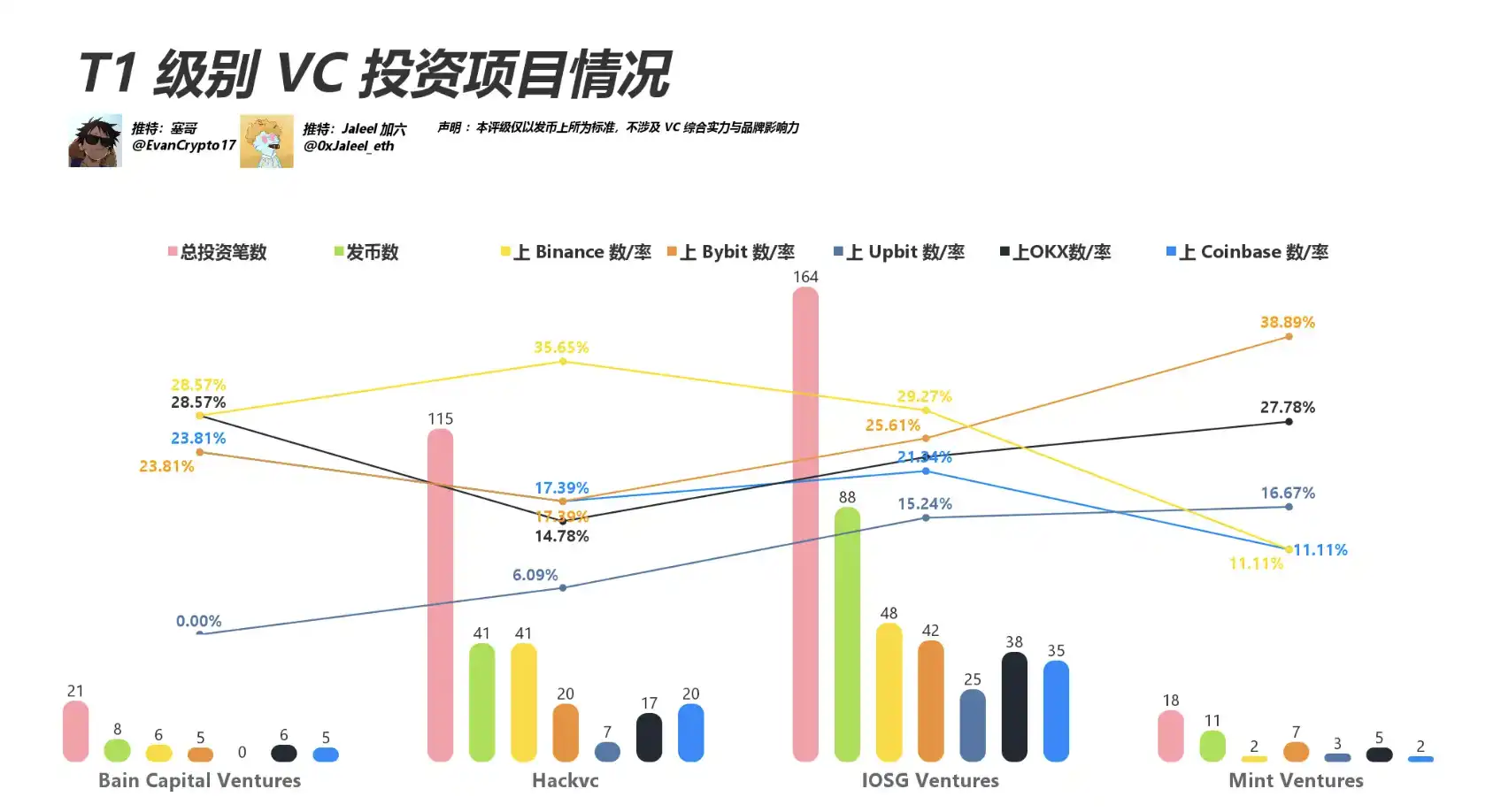
This has also enabled HackVC to achieve quite a good performance in this round of investments, having early investments in quality projects such as Berachain, EigenLayer, Morpho, Grass, and Soon.
Related Reading: "Everyone's Criticizing VC Coins, Let's See How VCs Are Performing This Round"
Rediscovering the Original Intention: The "Echo Model"
However, with the emergence of Agency Research and KOL Round in the investment ecosystem, the financing cycle has become shorter, and the participation in projects has become more profound, leading to a higher success rate in investment models. It seems that VCs also need to find a more excellent investment logic and model.
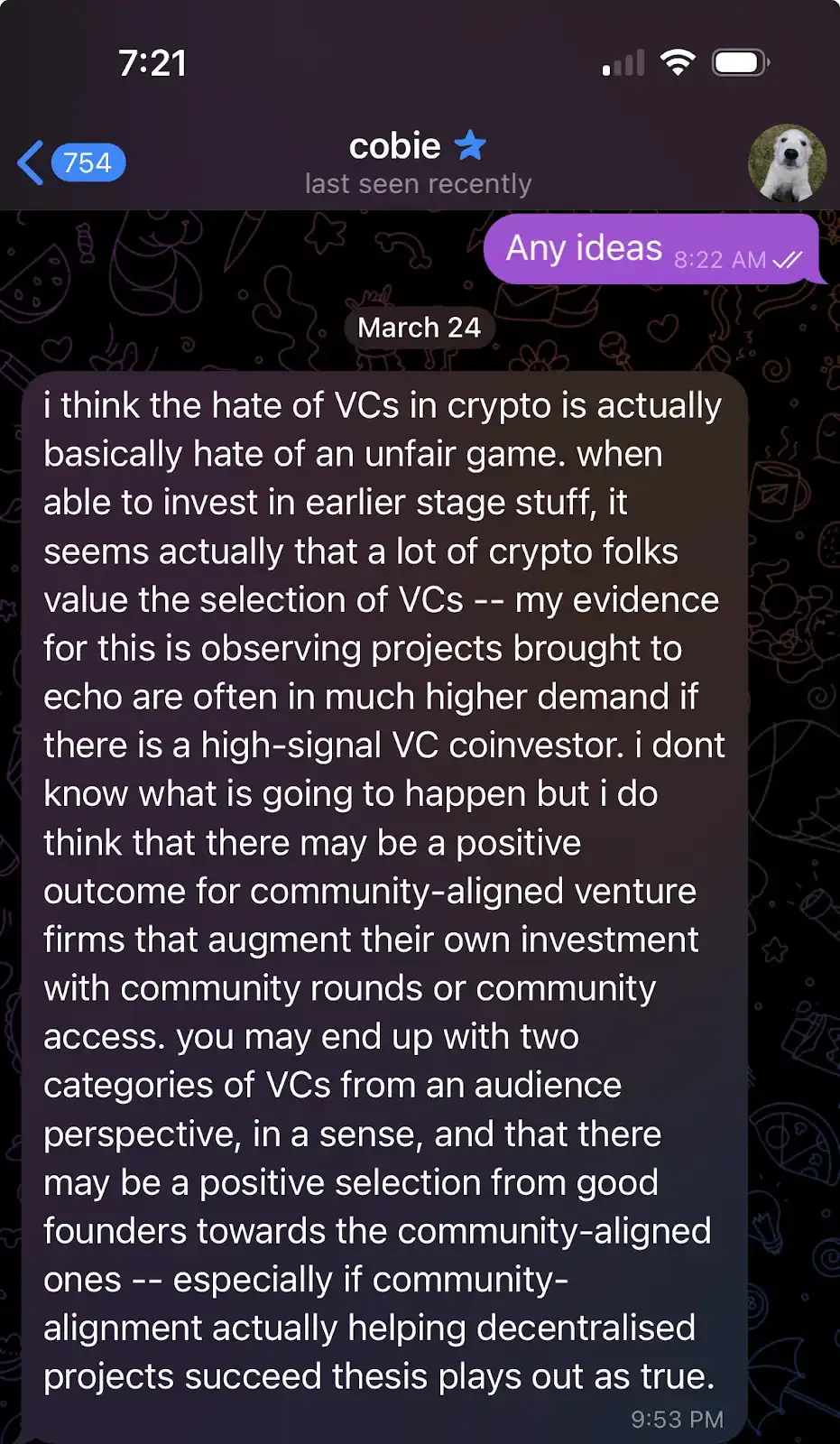
Furthermore, the conversation between Pack and Echo's founder Cobie highlighted the purpose of Echo. Cobie believes that the current cryptocurrency community's aversion to venture capitalists "VCs" is actually an aversion to unfair games. When individuals are able to invest at an early stage, projects invested in by high-signal VC firms usually have higher demand. Cobie believes that there may be a VC model that is community-friendly, which will strengthen its investment through a community round or community access. When community alignment can indeed help blockchain projects succeed, VCs will enable the community to positively select from good founders aligned with the community.
This undoubtedly resonates with Pack's ideology, as he stated on Twitter that he entered the cryptocurrency field 11 years ago because he believed that cryptocurrency could democratize the channels of tech investment. In the early stages of his career, he participated in the crowdfunding platform AngelList and became their first analyst, helping AngelList legalize crowdfunding through the CROWDFUND Act in 2012. However, it did not meet Pack's expectations, as regulatory complexities hindered progress along with the fact that most Web2 founders and venture capitalists did not see the value in bringing their "community" into the funding rounds.
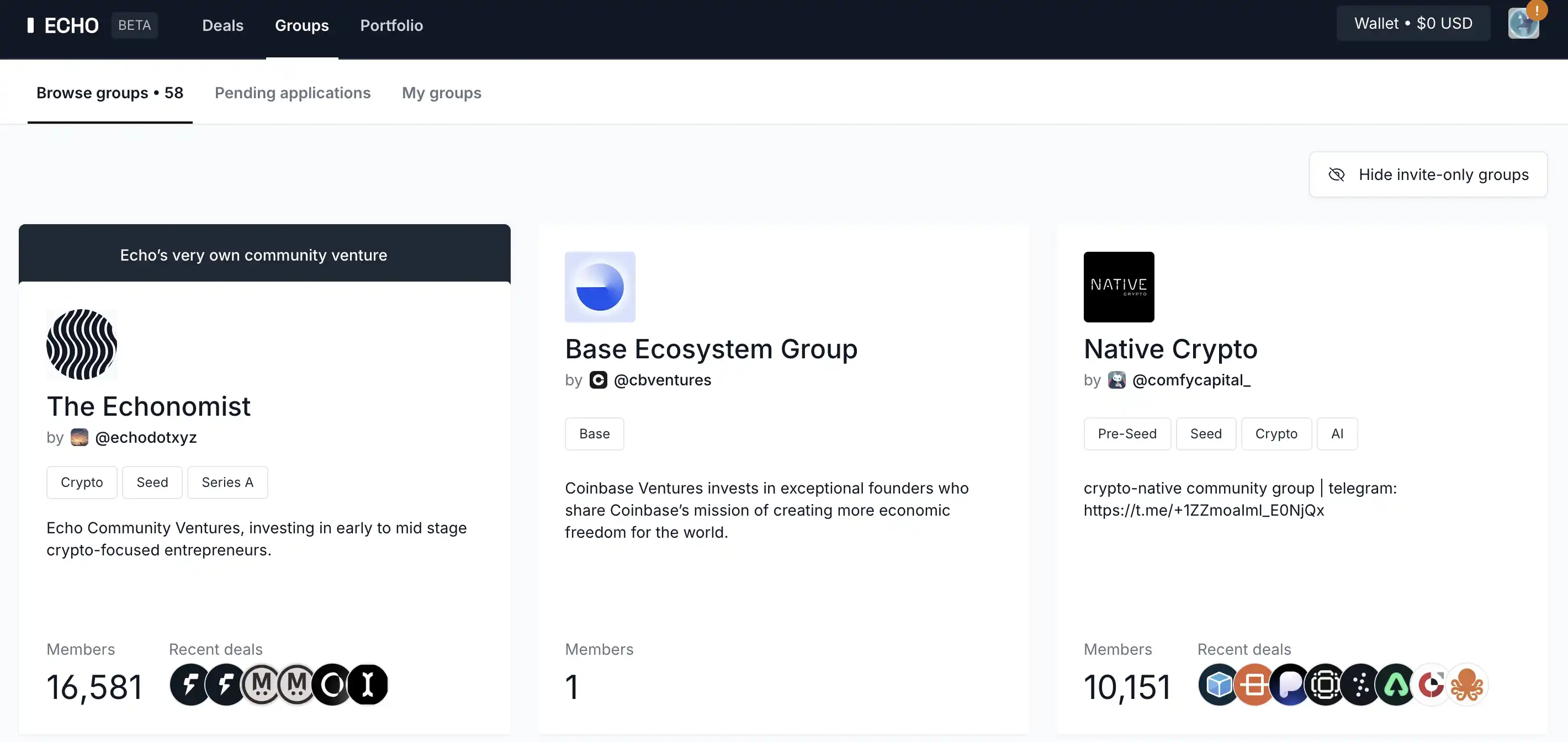
On the other hand, Echo's model is indeed different from traditional ICO platforms. Echo was founded by crypto KOL Cobie "@echodotxyz" in March 2024. Cobie was formerly the growth lead at Lido and hosted the popular Web3 podcast UpOnly. Echo's core revolves around the "Lead Investment Recommendation Mechanism," where users can act as lead investors to create investment communities, share projects with members, and earn a share of the returns.
Compared to the established ICO platform CoinList's model, where investors directly support projects to facilitate rapid fundraising, and investors receive token rights, Echo's business model focuses on facilitating the "token economy" through community capital formation. It allows native on-chain users to collectively invest in startups. The process involves lead investors creating investment groups, and group members can choose to follow the investment, with the investment flowing indirectly to the company through an intermediary investment tool. The investment not only involves token rights but may also include company equity. In simple terms, CoinList invests in the tokens of the company/project, while Echo directly invests in the company through intermediaries.
Since its launch, over 30 crypto projects have raised funds through Echo, including Ethena, Morph, Usual, Hyperlane, Dawn, Monad, Initia, MegaETH, and other well-known crypto projects. A total of $1 billion was raised within a year, with MegaETH completing two $10 million fundraisings through the Echo platform in December 2024. The first raise of $4.2 million was completed in 56 seconds, and the second raise of $5.8 million was completed in 75 seconds.
This model is similar to the "Investor Syndicate" of crypto investors, which tends to choose high-potential projects recognized by a small circle. Figures like The Block's CEO Larry Cermak and Aave founder Marc Zeller have created their own Echo communities. To join, users must first answer some questions and undergo identity KYC verification. Additionally, some communities have specific criteria for certain investment opportunities. Currently, 58 community leaders have created communities on Echo.
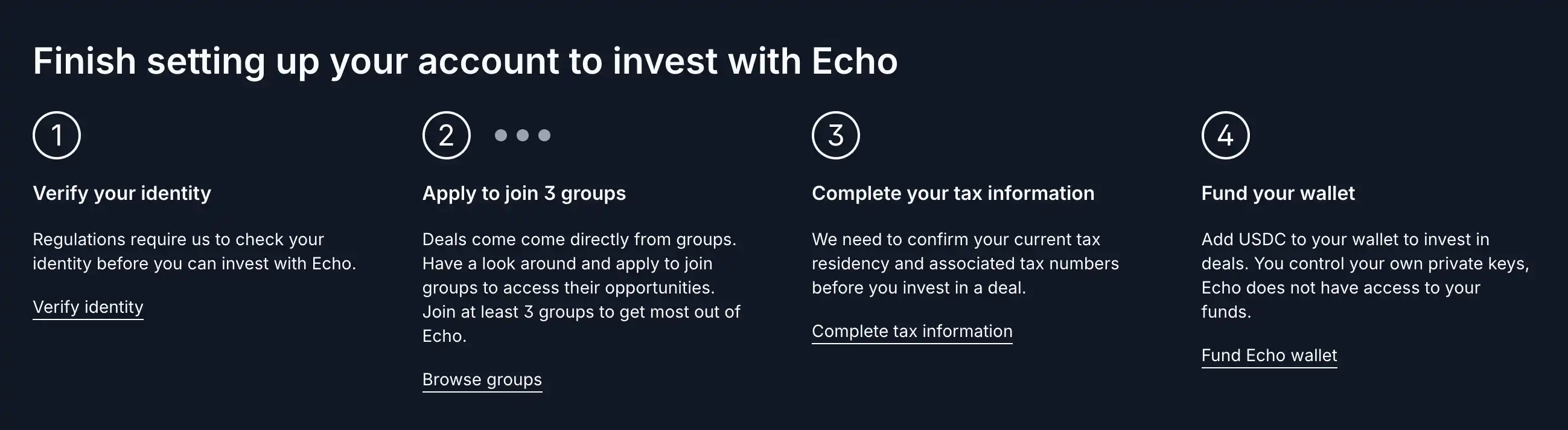
In this community-driven model, investment is managed through smart contracts to ensure that lead investors do not have access to user funds. Users can decide when to sell tokens. If a lead investor's investment is successful, they receive a percentage of the profits from co-investors, incentivizing high-quality project sharing. While the elite-oriented nature makes its user base relatively niche, this screening mechanism ensures project quality, attracting investors who value trust.
In a statement, Coinbase's VP of Corporate Development Shan Aggarwal and Base founder Jesse Pollak said, "On-chain investing allows eligible investors to participate in ways previously impossible, while enabling founders to access a broader, more vibrant capital base. We are excited to expand Base's capital channels for builders, allowing more people to participate in the next wave of innovation."
Some industry experts suggest that the more lenient regulatory environment in the United States may lead to a resurgence of public sales. Another hot ICO platform at the moment, Legion, co-founder Matt O'Connor, stated, "Once ICOs regain vitality, they may shift focus away from the memecoin craze." Currently, there are fewer products being genuinely developed, with wealth increasingly accumulating behind the scenes.
HackVC's Initial Venture with the Community
Hack VC has launched the Echo group, deciding to open up core project resources to screened high-quality community members through a private access mechanism, while also implementing a first-year zero performance fee policy. In addition, invested companies are required to set a community fundraising round and implement a "Community Priority Protection" principle in the valuation system, meaning that if it is the first investment, the community round valuation must be lower than the concurrent institutional round; if not the first, it must be lower than the latest VC entry valuation, ensuring a price advantage for the community through structural design.
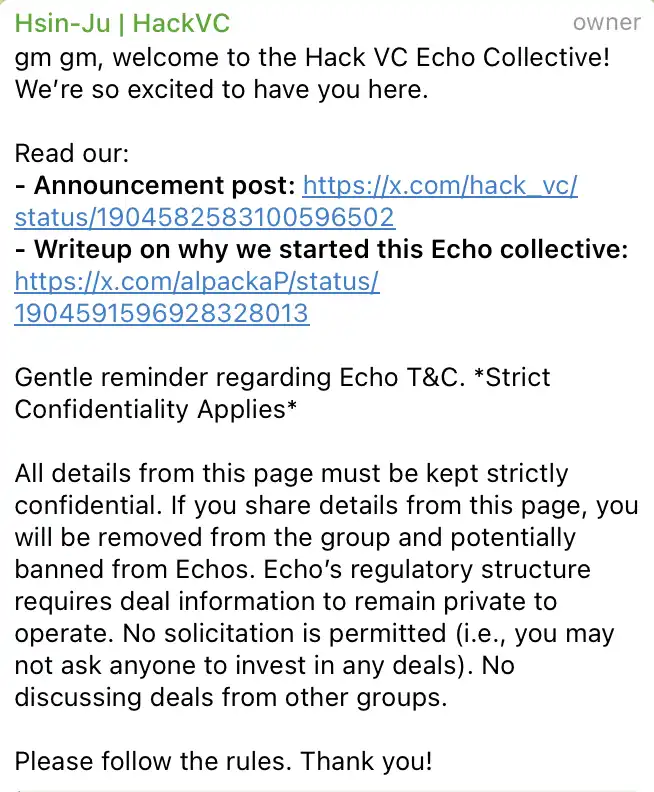
Although there are still many concerns in the community about this model not having a "governance token" or being a "Dao," regardless of the outcome of Hack VC's attempt this time, it has set a precedent for the future collaboration between VCs and communities. The evolutionary history of cryptocurrency fundraising models is a process of continuous innovation in community coordination mechanisms, from the Bitcoin PoW mechanism opening the era of fair mining, to Ethereum's $18 million crowdfunding in 2014 pioneering on-chain fundraising, to the ICO boom in 2017, community-driven approaches have always been at the core.
Then, the ICO era explored two paths, with centralized platforms like CoinList successfully operating projects like Solana but facing scalability limits, while on-chain airdrops and yield farming, although reducing barriers to entry, faced challenges of user commitment.
Today, against the backdrop of mature compliance frameworks and on-chain infrastructure, Echo is restructuring the crowdfunding process through a non-custodial Syndicate model, and Legion is introducing an on-chain reputation system to optimize investor screening, marking the next stage in community fundraising. It inherits the open genes of ICOs, balances efficiency and fairness through technological means, and a new golden age of compliance and precision operation may be on the horizon.
You may also like

CoinGecko Report: Surge of 346% vs Dip of 20.8%, The Wild Rise of DEX

a16z: The Real Opportunity of Stablecoins Lies Not in Disruption but in Filling Gaps

Mining Exodus: Someone Holds $12.8 Billion AI Order

March 6 Market Key Intelligence, How Much Did You Miss?

a16z: The True Opportunity of Stablecoins is in Complementing, Not Disrupting

Predict LALIGA Matches, Shoot Daily & Win BTC, USDT and WXT on WEEX
The WEEX × LALIGA campaign brought together football excitement and crypto participation through a dynamic interactive experience. During the event, users predicted matches, completed trading tasks, and took daily shots to compete for rewards including BTC, USDT, WXT, and exclusive prizes.

Ray Dalio Dialogue: Why I'm Betting on Gold and Not Bitcoin

Who Took the Money in the AI Era? A Must-See Investment Checklist for HALO Asset Trading
Wall Street Bears Target Ethereum: Vitalik In the Know Takes Flight, Tom Lee Remains Bullish

Pump.fun Hacker Steals $2 Million, Receives 6-Year Prison Sentence, Opts for 'Self-Detonation'

6% Annual Percentage Yield as Musk Declares War on Traditional Banks
36 years, 4 wars, 1 script: How does capital price the world in conflict?

Mining Companies' Great Migration: Some Have Already Secured $12.8 Billion in AI Orders
What Is Vibe Coding? How AI Is Changing Web3 & Crypto Development
What is vibe coding? Learn how AI coding tools are lowering the barrier to Web3 development and enabling anyone to build crypto applications.
The parent company of the New York Stock Exchange strategically invests in OKX: The intentions behind the $25 billion valuation

WEEX P2P update: Country/region restrictions for ad posting
To improve ad security and matching accuracy, WEEX P2P now allows advertisers to restrict who can trade with their ads based on country or region. Advertisers can select preferred counterparty locations for a safer, smoother trading experience.
I. Overview
When publishing P2P ads, advertisers can now set the following:
Allow only counterparties from selected countries or regions to trade with your ads.
With this feature, you can:
Target specific user groups more precisely.Reduce cross-region trading risks.Improve order matching quality.
II. Applicable scenarios
The following are some common scenarios:
Restrict payment methods: Limit orders to users in your country using supported local banks or wallets.Risk control: Avoid trading with users from high-risk regions.Operational strategy: Tailor ads to specific markets.
III. How to get started
On the ad posting page, find "Trading requirements":
Select "Trade with users from selected countries or regions only".Then select the countries or regions to add to the allowlist.Use the search box to quickly find a country or region.Once your settings are complete, submit the ad to apply the restrictions.
When an advertiser enables the "Country/Region Restriction" feature, users who do not meet the criteria will be blocked when placing an order and will see the following prompt:
If you encounter this issue when placing an order as a regular user, try the following solutions.
Choose another ad: Select ads that do not restrict your country/region, or ads that allow users from your location.Show local ads only: Prioritize ads available in the same country as your identity verification.
IV. Benefits
Compared with ads without country/region restrictions, this feature provides the following improvements.
Aspect
Improvement
Trading security
Reduces abnormal orders and fraud risk
Conversion efficiency
Matches ads with more relevant users
Order completion rate
Reduces failures caused by incompatible payment methods
V. FAQ
Q1: Why are some users not able to place orders on my ad?
A1: Their country or region may not be included in your allowlist.
Q2: Can I select multiple countries or regions when setting the restriction?
A2: Yes, multiple selections are supported.
Q3: Can I edit my published ads?
A3: Yes. You can edit your ad in the "My Ads" list. Changes will take effect immediately after saving.

What are the key highlights of this year's Ethereum's most important upgrade, the Glamsterdam upgrade?

March 6 Key Market Update You Can't Miss! | Alpha Morning Report
CoinGecko Report: Surge of 346% vs Dip of 20.8%, The Wild Rise of DEX
a16z: The Real Opportunity of Stablecoins Lies Not in Disruption but in Filling Gaps
Mining Exodus: Someone Holds $12.8 Billion AI Order
March 6 Market Key Intelligence, How Much Did You Miss?
a16z: The True Opportunity of Stablecoins is in Complementing, Not Disrupting
Predict LALIGA Matches, Shoot Daily & Win BTC, USDT and WXT on WEEX
The WEEX × LALIGA campaign brought together football excitement and crypto participation through a dynamic interactive experience. During the event, users predicted matches, completed trading tasks, and took daily shots to compete for rewards including BTC, USDT, WXT, and exclusive prizes.


 App
App