
- Buy Crypto
- Markets
 Futures
- Spot
- Copy Trade
- Earn
- More
How Do Tariffs Impact Cryptocurrency Prices?

Original Title: How Could Tariffs Affect Cryptocurrency Prices?
Original Source: crypto.com
Original Translation: Plain Blockchain
On the global economic stage, the policy of one area often acts like a stone thrown into water, causing unexpected ripples. Tariffs, as a long-standing tool to regulate international trade, have long been familiar in the traditional financial markets. But with the emergence of cryptocurrency as this "new player," what is the relationship between trade policy and digital asset prices?
In early February 2025, U.S. President Trump announced new tariffs on Canada and Mexico, causing an immediate "dip" in the cryptocurrency market. This dip sparked discussions: how exactly does the government's trade policy affect these originally intended "independent" cryptocurrency assets?
This article will take you on a journey to explore how tariffs are "linked" to cryptocurrency prices and the underlying intricacies.
What Are Tariffs?
Simply put, tariffs are the "tolls" a country imposes on imported goods and services. If a country imposes tariffs on a certain imported good, the importer must pay additional money to that country's government. This additional cost often ends up being passed on to consumers, causing prices to rise.
The government imposes tariffs for several main purposes:
· Generate Revenue for the Government: Before income taxes became common, tariffs were a primary source of government revenue.
· Protect Domestic Business: By making imported goods more expensive, people are more inclined to buy domestically produced goods.
· Use as Negotiating Leverage: Countries use tariffs in trade negotiations to secure favorable conditions for themselves or to pressure other countries to change their policies.
· Balance Imports and Exports: If a country is importing significantly more than it is exporting, tariffs may be imposed to reduce this "trade deficit."
Despite tariffs seeming straightforward, the economic impact they bring can be quite complex, affecting the value of money, stock market fluctuations, consumer spending behavior, and even how a country manages its finances (monetary policy).
How Do Tariffs Cause a Stir?
To understand how tariffs impact cryptocurrency, we first need to understand how they operate within the entire economic system. Once the government announces a tariff, here's how things unfold:
· Announcement: The government announces which imported goods or services will be taxed, with the rate usually based on a percentage of the goods' value.
· Collection: When these goods subject to tariffs enter the country, importers must pay the customs duty.
· Price Increase: Importers won't bear this cost themselves; instead, they'll add it to the goods' prices, making them more expensive for consumers when sold.
· Consumer Choices: When consumers see that imported goods are pricier, they may opt for domestic alternatives or reduce their purchases.
· Chain Reaction: Changes in consumer behavior can affect domestic producers, other industries related to these sectors, and eventually the entire economy.
For example, if the U.S. imposes a 25% tariff on imported steel, American buyers will have to pay an extra 25%. This benefits U.S. steel manufacturers as their products become more competitive. However, U.S. companies using steel as a raw material may suffer due to increased costs.
These economic shifts don't occur in isolation. The financial market reacts to tariff announcements based on expectations regarding company profits, economic growth, inflation, and potential retaliatory measures by other countries.
How Have Tariffs Previously Impacted the Traditional Financial Market?
There is a significant historical record of the traditional financial market's response to tariff policies. Examining past examples can help us understand how the cryptocurrency market might react.
· Stock Market Rollercoaster: Following the announcement of significant tariff policies, the stock market typically becomes highly volatile. During the 2018-2019 U.S.-China trade tensions, whenever there was news of new tariffs, the U.S. S&P 500 Index saw significant single-day declines multiple times. Industries directly affected by tariffs, such as manufacturing, agriculture, and retail, often experienced the most significant stock price fluctuations.
· Currency also "changes faces": Tariffs often lead to changes in the value of different countries' currencies. If a country imposes a lot of tariffs, its currency may appreciate in the short term because the demand for foreign goods decreases. However, if other countries also start imposing tariffs in retaliation, the currency of the country that initially imposed tariffs may depreciate because its goods cannot be sold. For example, during the 2018 trade war, the Chinese Yuan depreciated against the US Dollar, which to some extent offset the impact of US tariffs on Chinese exports, making Chinese goods relatively cheaper even with tariffs.
· Bonds become a "safe haven": During a trade dispute, government bonds, considered a relatively safe asset, become more popular as people rush to buy them as a "safe haven." This usually leads to a decrease in bond yields of countries deemed economically stable.
· Prices may rise: Tariffs directly increase the cost of imported goods, leading to price hikes, i.e., inflation. This may prompt the central bank to take measures such as raising interest rates to control inflation—and an interest rate hike typically impacts all financial markets.
Understanding the historical reactions of traditional markets to tariffs can provide insights into how the cryptocurrency market might react.
How Might Tariffs Affect the Cryptocurrency Market?
The relationship between tariffs and cryptocurrency prices is quite complex and constantly evolving. While cryptocurrencies were initially designed to escape government control, increasing evidence suggests that cryptocurrencies are not entirely immune to macroeconomic influences.
Recent Market Reactions
As mentioned earlier, in late February to early March 2025, when President Trump confirmed new tariffs on Canada and Mexico, the cryptocurrency market experienced a downturn. Although this news came out on February 1st, the actual implementation was delayed until March 4th.
Upon the announcement, the price of Bitcoin notably dropped, triggering a series of market liquidations. This indicates that while cryptocurrencies initially aimed to be independent of government influence, investors are increasingly considering traditional macroeconomic policies when making trading decisions.
At the time, Trump stated that the US was being taken advantage of in trade by its partners, which is why tariffs were being imposed. However, the immediate market response tells us that cryptocurrency investors are now highly sensitive to these macroeconomic policies.
Possible Impact Channels
Tariffs may impact the price of cryptocurrency in the following ways:
· Deterioration of Risk Sentiment: Tariffs bring economic uncertainty, causing investors to perceive the risk as too high and to be hesitant to hold assets such as cryptocurrency, which they consider relatively risky. Although some hope that Bitcoin can act as "digital gold" and retain its value during economic turmoil, the market performance indicates that many still view it as a high-risk asset and sell off at the slightest hint of trouble.
· Stronger Dollar, Weaker Coins: Historical data shows that the price trend of Bitcoin and many other cryptocurrencies is somewhat inversely related to the US dollar. If tariffs cause the dollar to strengthen in the short term (which sometimes happens), the price of cryptocurrencies often declines.
· Reduced Global Fund Flows: Trade restrictions may lead to a decrease in global economic activity and fund flows. When there is less money in the entire financial system, speculative investments like cryptocurrency may also experience a decrease in demand.
· Mining Costs May Increase: For cryptocurrencies like Bitcoin that require "mining," if a country imposes tariffs on computer hardware (especially specialized mining chips ASIC), the cost of mining will directly increase. Miners may not be profitable or even shut down their operations, potentially reducing the overall security of the Bitcoin network and indirectly affecting Bitcoin's price.
· Tighter Government Regulations: During times of trade tension, governments typically enforce stricter regulations across many areas. Investors may worry that countries involved in trade wars may subject cryptocurrencies to tighter controls.
Different Cryptocurrencies, Different Responses
Different cryptocurrencies may respond differently to tariffs:
· Bitcoin: As the largest cryptocurrency by market capitalization, and with an increasing number of institutions investing in Bitcoin, it is becoming more like a traditional risky asset when the market is unfavorable. This means that if trade tensions escalate, the price of Bitcoin may decrease.
· Stablecoins: During trade disputes, "stablecoins" pegged to currencies like the US dollar may become more popular as traders may want to hold an asset with price stability but do not want to entirely exit the cryptocurrency market, making it convenient to re-enter later.
· Utility Token: Cryptographic assets linked to a specific blockchain application, which may be more influenced by regulatory policies affecting their respective industry rather than overall market sentiment.
Summary
The relationship between tariffs and cryptocurrency asset prices represents an intriguing intersection between traditional economic policies and emerging financial technologies. While the original design of cryptocurrency assets aimed to be independent of government monetary policies, market evidence increasingly suggests that they are still impacted by various macroeconomic forces, including trade policies.
One clear example occurred in February 2025 when the market reacted to President Trump's announcement of imposing tariffs on Canada and Mexico. Therefore, cryptocurrency investors should closely monitor global macroeconomic policies. Despite the numerous unique advantages of cryptocurrency assets compared to traditional assets, they are still interconnected with the global financial system and are sensitive to changes in global macroeconomic policies.
You may also like

Social Capital CEO: How Equity Tokenization is Reshaping Capital Markets from US Stocks to SpaceX?

CoinGecko Report: Surge of 346% vs Dip of 20.8%, The Wild Rise of DEX

a16z: The Real Opportunity of Stablecoins Lies Not in Disruption but in Filling Gaps

Mining Exodus: Someone Holds $12.8 Billion AI Order

March 6 Market Key Intelligence, How Much Did You Miss?

a16z: The True Opportunity of Stablecoins is in Complementing, Not Disrupting

Predict LALIGA Matches, Shoot Daily & Win BTC, USDT and WXT on WEEX
The WEEX × LALIGA campaign brought together football excitement and crypto participation through a dynamic interactive experience. During the event, users predicted matches, completed trading tasks, and took daily shots to compete for rewards including BTC, USDT, WXT, and exclusive prizes.

Ray Dalio Dialogue: Why I'm Betting on Gold and Not Bitcoin

Who Took the Money in the AI Era? A Must-See Investment Checklist for HALO Asset Trading
Wall Street Bears Target Ethereum: Vitalik In the Know Takes Flight, Tom Lee Remains Bullish
Pump.fun Hacker Steals $2 Million, Receives 6-Year Prison Sentence, Opts for 'Self-Detonation'

6% Annual Percentage Yield as Musk Declares War on Traditional Banks
36 years, 4 wars, 1 script: How does capital price the world in conflict?

Mining Companies' Great Migration: Some Have Already Secured $12.8 Billion in AI Orders
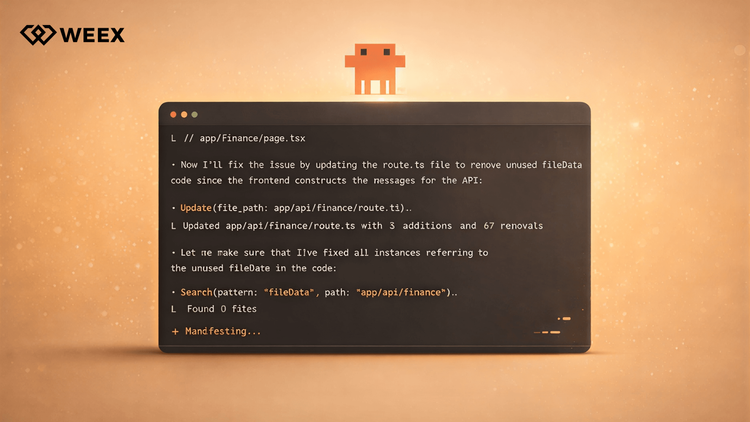
What Is Vibe Coding? How AI Is Changing Web3 & Crypto Development
What is vibe coding? Learn how AI coding tools are lowering the barrier to Web3 development and enabling anyone to build crypto applications.
The parent company of the New York Stock Exchange strategically invests in OKX: The intentions behind the $25 billion valuation

WEEX P2P update: Country/region restrictions for ad posting
To improve ad security and matching accuracy, WEEX P2P now allows advertisers to restrict who can trade with their ads based on country or region. Advertisers can select preferred counterparty locations for a safer, smoother trading experience.
I. Overview
When publishing P2P ads, advertisers can now set the following:
Allow only counterparties from selected countries or regions to trade with your ads.
With this feature, you can:
Target specific user groups more precisely.Reduce cross-region trading risks.Improve order matching quality.
II. Applicable scenarios
The following are some common scenarios:
Restrict payment methods: Limit orders to users in your country using supported local banks or wallets.Risk control: Avoid trading with users from high-risk regions.Operational strategy: Tailor ads to specific markets.
III. How to get started
On the ad posting page, find "Trading requirements":
Select "Trade with users from selected countries or regions only".Then select the countries or regions to add to the allowlist.Use the search box to quickly find a country or region.Once your settings are complete, submit the ad to apply the restrictions.
When an advertiser enables the "Country/Region Restriction" feature, users who do not meet the criteria will be blocked when placing an order and will see the following prompt:
If you encounter this issue when placing an order as a regular user, try the following solutions.
Choose another ad: Select ads that do not restrict your country/region, or ads that allow users from your location.Show local ads only: Prioritize ads available in the same country as your identity verification.
IV. Benefits
Compared with ads without country/region restrictions, this feature provides the following improvements.
Aspect
Improvement
Trading security
Reduces abnormal orders and fraud risk
Conversion efficiency
Matches ads with more relevant users
Order completion rate
Reduces failures caused by incompatible payment methods
V. FAQ
Q1: Why are some users not able to place orders on my ad?
A1: Their country or region may not be included in your allowlist.
Q2: Can I select multiple countries or regions when setting the restriction?
A2: Yes, multiple selections are supported.
Q3: Can I edit my published ads?
A3: Yes. You can edit your ad in the "My Ads" list. Changes will take effect immediately after saving.



 App
App