
IOSG: From Hot Storage to Cold Memory, Decentralized Storage Amidst the AI Era's Storage Boom

 Prefer us on Google

Original Title: "IOSG|From Hot Storage to Cold Memory: Decentralized Storage Amidst the AI Era's Storage Boom"
Original Author: Jacob Zhao, IOSG Ventures
Recently, Changxin Storage, known as the "first domestic storage stock," officially landed on the ChiNext and exploded with a staggering 500% increase. Although the storage sector as a whole is still affected by recent market corrections, AI storage is being wildly reassessed by capital in the current wave of technological narrative. Meanwhile, decentralized storage in the Web3 space has fallen into a long period of silence and loss. Why does the market show such a stark contrast despite both being labeled as "storage"? The fundamental answer lies in the complete divergence of underlying value functions.
The reassessment of storage in the AI era is essentially a celebration of "hot data efficiency", aimed at maximizing computational utilization and commercial monetization; whereas decentralized storage adheres to the value proposition of "cold data trustworthiness", defending data fairness, censorship resistance, and the long-term memory of human civilization. The former is an efficiency system for hot data, while the latter is a trust system for cold data. The current capital market undoubtedly firmly stands on the side of "efficiency," but human civilization ultimately still requires an immutable memory foundation. The long-term value of trustworthy cold storage has never disappeared; it merely lies dormant in the dark side of cycles, waiting to be repriced by the times.
Why Storage Has Re-emerged as the Focus of the AI Industry Chain
In the traditional IT era, storage was a "capacity business." CIOs focused on unit capacity costs, hard drive reliability, disaster recovery plans, archiving strategies, and equipment update cycles lasting 3 to 5 years. Storage was viewed as an accessory following server purchases.
This round of storage boom is not a revival of traditional cycles but a repricing of data flow capabilities driven by AI. In the era of large models, the logic of storage has transformed from "capacity-first" to "efficiency-first," focusing on extreme metrics such as GPU feeding rates, Checkpoint writes, and RAG ultra-low latency. This marks a leap in storage value from being "the final resting place of data" to "the high-speed channel for data entering computation."
The evolution of resource bottlenecks in AI infrastructure is essentially a battle to fill the "barrel effect." The true utilization rate of computational power is not a linear addition of single assets but a stringent multiplicative effect: True computational utilization rate = GPU × HBM × DRAM × SSD × Network × File System. Any shortcoming in one link will lead to an overall collapse of computational utilization. In the AI era, storage has transformed for the first time from a "cost center" to an "efficiency engine." This is the fundamental logic behind the repricing of storage.
AI Storage Architecture Overview: From HBM Bandwidth Organs to Data Lake Foundations
AI storage is not merely a pile of single hardware but a tightly coupled, hierarchically scheduled complex system. In this system, industrial value and capital focus are highly concentrated on HBM, enterprise-grade SSDs, SSD controllers, NVMe/CXL protocols, and high-performance storage systems. To clearly dissect its value flow, we categorize the AI storage architecture into four core levels from top to bottom:
· Compute Proximity Memory Layer (Bandwidth Core): Dominated by HBM, supplemented by DRAM and CXL memory pooling technology. This layer directly interfaces with GPU/CPU packaging or buses, aiming to break the "memory wall," and is the first checkpoint determining whether computational power can be fully unleashed.
· High-Speed Persistent Storage Layer (IO Hub): The core logic is enterprise-grade SSD = NAND chips + SSD controllers + NVMe/PCIe data pathways. This layer undertakes high-frequency Checkpoint writes, massive training set loads, and RAG hot data caching, serving as the most explicit persistent storage increment for AI data centers.
· Low-Cost High-Capacity Storage Layer (Capacity Foundation): Composed of HDDs, cold storage, and data lake archiving systems. In the face of exponentially expanding multimodal raw data, historical logs, and compliance backups, this layer still provides an irreplaceable TCO (Total Cost of Ownership) advantage.
· AI Storage Systems and Data Software (Scheduling Brain): Includes high-performance parallel file systems, distributed object storage, vector databases, and RAG data governance layers. What AI truly consumes is not bare hardware but the data availability efficiently organized, indexed, and authorized by the software stack.
· As an ecological extension, decentralized storage does not directly engage in the millisecond-level race of AI hot data but anchors on public dataset certification, AI training data provenance, and long-term cold memory archiving, establishing its unique ecological niche as a "trustworthy cold layer."
HBM: The "Bandwidth Organ" Closest to Computational Power in the AI Storage Chain
High Bandwidth Memory (HBM) is not traditional storage but a high-bandwidth memory layer near the GPU. Its core mission is not to store data but to continuously "feed" data to computational power at extremely high bandwidth. HBM is the closest and most deterministic link in the AI storage chain, directly determining whether the GPU can be "fed" adequately, making it the current core supply chain bottleneck.
The core architecture of HBM is "3D DRAM stacking + 2.5D advanced packaging": through TSV vertical stacking and CoWoS heterogeneous integration, it achieves extreme compression of storage-computation distance, resulting in a generational leap in bandwidth. Its industrial barriers are not just DRAM design but also the system engineering of DRAM manufacturing processes, TSV, ultra-thin stacking, packaging, heat dissipation, testing, and customer certification. Any flaw in yield in any link will lead to the scrapping of the entire HBM stack.
Currently, only SK Hynix, Samsung, and Micron can stably mass-produce, establishing a triple moat of top-tier DRAM manufacturing processes, packaging capabilities, and NVIDIA/AMD customer certifications.
DRAM and CXL: System Memory Foundation and Memory Pooling Engine
HBM addresses the extreme bandwidth near the GPU, DRAM solidifies the server's system memory foundation, and CXL attempts to break physical boundaries to reconstruct the organization of memory resources in data centers.
· DRAM: Primarily carries CPU-side caches, data preprocessing, intermediate state storage, and system operations, serving as the most basic system memory layer for servers. The global DRAM market is highly concentrated among the three giants SK Hynix, Samsung, and Micron; Changxin Storage (CXMT) is a core variable in China's DRAM domestic substitution.
· CXL (Compute Express Link): A next-generation cache coherence interconnect protocol for data centers, aiming to break the limitations of traditional DIMM slots, local memory capacity, and server memory resource islands, promoting the evolution of memory architecture towards expansion, pooling, and sharing. Currently, CXL is still in the early stages of transitioning from platform support to large-scale deployment, with high mid-to-long-term architectural value; core companies include Astera Labs and Lanqi Technology.
Enterprise-grade SSD: The Data Hub Built from NAND, Controllers, and NVMe
Enterprise-grade SSDs are the most critical high-throughput persistent increments for AI data centers, continuously "feeding" data to GPUs with extremely high throughput, low latency, and stable QoS, spanning the entire lifecycle of training data loading, Checkpoint writing, RAG retrieval, inference caching, and log backflow.
In the AI storage architecture, SSDs are not isolated hardware but a highly coupled system, which can be distilled into the industrial formula: enterprise-grade SSD = NAND chips + SSD controllers + NVMe/PCIe data pathways. The three layers represent independent links in the industrial chain:
· NAND Chips (Raw Material Layer): Determine storage density and unit cost, while controllers manage performance release and lifespan. Representative companies include Samsung, SK Hynix (Solidigm), Micron, Kioxia, Western Digital, and Yangtze Memory Technologies.
· SSD Controllers (Performance Empowerment Layer): Determine performance release, data error correction, QoS stability, and wear leveling. Representative companies include Phison, Silicon Motion, Marvell, and Maxio.
· NVMe/PCIe (Data Pathway Layer): Determine the efficiency of data transfer from storage to computation. Combined with GPUDirect Storage technology, it reduces CPU memory bounce buffer and CPU involvement, significantly alleviating I/O bottlenecks. Representative companies include Broadcom, Marvell, and Astera Labs.
-- Price
HDD / Cold Storage / Archiving: The Low-Cost Foundation of AI Data Lakes
AI will not eliminate HDDs. With the increasing demand for video and image data from multimodal large models, as well as the exponential growth of enterprise compliance logs and historical datasets, the need for low-cost cold data storage is surging simultaneously. In AI storage architecture, SSDs and HDDs collaborate in a layered manner based on business value: SSDs handle hot data and high throughput, while HDDs are responsible for low-cost and long-term storage. Representative companies include Seagate, Western Digital, and Toshiba.
AI Storage Software Stack: The Scheduling Hub of Data Availability
What AI truly consumes is not bare disks, but the "data services" meticulously organized by the software stack. This architecture transforms underlying hardware into knowledge assets that AI can directly access, divided into four layers:
· High-Performance Storage Systems (Supply Systems): Focused on concurrent throughput and low latency, it addresses the "data hunger" problem of GPU clusters through parallel file systems, ensuring rapid flow of training and inference. Representative companies: VAST Data, WEKA, Pure Storage.
· Object Storage (Raw Data Lakes): Centered on Object, Key, and Metadata management, it supports massive amounts of unstructured data. It does not pursue extreme low latency but builds a capacity base with low cost and cloud-native characteristics. Representative company: AWS S3.
· Vector Databases (Semantic Index Layer): Vector databases are responsible for storing, indexing, and retrieving vectors generated by embedding models, allowing AI to accurately locate relevant content from vast knowledge. Representative companies: Pinecone, Milvus.
· RAG Data Layer (Knowledge Invocation Layer): Going beyond simple retrieval, it encompasses data slicing, cleaning, permission control, and citation tracing, ensuring that enterprise data can be safely, accurately, and traceably invoked by large models. Representative company: Databricks.
From AI Hot Storage to Decentralized Cold Memory: Maximizing Efficiency vs. Maximizing Trust
AI storage is an extremely efficiency-driven system, with its value function focused on maximizing computational output. HBM bandwidth determines whether GPUs can be fed adequately, SSD throughput determines the read and write efficiency of datasets and checkpoints, and low latency is crucial for real-time experiences in RAG and inference. These metrics ultimately converge into GPU utilization and unit token costs, directly determining the commercial profitability of AI applications. The ultimate goal of AI storage is not preservation, but acceleration, serving productivity.
In contrast, the value function of decentralized storage is entirely different. It questions whether data will still exist in ten years, whether it has been tampered with, and whether it can withstand single-point censorship. Through cryptographic proof and distributed networks, it builds a public data foundation that is open for access and permanently preserved. Its ultimate goal is to defend the absolute truth and sovereign independence of data, serving fairness, anti-censorship needs, and civil memory.
AI storage is the "hot storage" that fuels future productivity, while decentralized storage is the "cold memory" that preserves irremovable historical records of human civilization. The former serves efficiency, pursuing extreme speed; the latter serves trust, defending silent memories. The former determines how fast models run, while the latter determines whether memories will be erased. Currently, market mechanisms reward the efficiency of productivity, placing AI storage at the forefront, while decentralized storage seems to be experiencing valuation collapse and a narrative drain.
The Vision and Reality of Decentralized Storage
There are many decentralized storage projects, but based on industry mindset and ecological sedimentation, the core representatives remain Filecoin and Arweave. Although both belong to "decentralized storage," their underlying architectural philosophies are almost two completely different paths— the former approaches AWS's elasticity through market contracts, while the latter approaches the eternity of libraries through one-time social contracts.
· Filecoin: It has built the most complete verifiable economic system through PoRep and PoSt. It should not continue to compete with AWS on consumer-grade cloud storage but should shift towards AI data provenance, public dataset hosting, and compliance archiving, providing verifiable chains for model auditing and copyright proof. The necessary path is to encapsulate it as an S3-compatible API and support fiat payments, upgrading from a "cheap storage market" to a "verifiable computing infrastructure."
· Arweave: With the narrative of "one-time payment, permanent storage," it incentivizes miners to save and quickly access as much, especially scarce, historical data as possible through Blockweave and SPoRA mechanisms. Its best position is as a foundation for human public memory— preserving human rights records, war crime evidence, cultural classics, archiving legal and financial history, and providing AI agents with permanently accessible long-term memory. The value of Arweave lies not in speed, but in its capacity to carry civil memory across cycles.
The dilemmas faced by decentralized storage projects like Filecoin and Arweave do not stem from incorrect value propositions, but from long-term mismatches in productization, retrieval experience, real demand, and token incentives. This reveals a significant gap from geek ideals to mainstream commercial applications:
· Supply-Demand Incentive Mismatch: Early networks represented by Filecoin rapidly expanded through tokens but did not build a sufficiently strong demand side, resulting in huge capacity but insufficient utilization and payment conversion. They rewarded "I can store" rather than "I need to store."
· Lack of Enterprise-Level Service Capability: AWS's barrier is not hard drives, but a "data operating system" composed of APIs, SLAs, permission management, compliance auditing, and technical support. Enterprises purchase "peace of mind," not experimental infrastructure that requires them to handle keys and node selection themselves.
· Retrieval Experience Shortcomings: "Storing in" does not equal "stably and low-latency retrieving out." Node dispersion, complex topology, and lack of unified SLA make it difficult to support AI hot data workflows, making it more suitable for trustworthy cold archiving and data provenance.
· Insufficient Privacy Compliance: Enterprise private data cannot simply be written into a public permanent network; the right to delete and permanent immutability are inherently in conflict. Decentralized storage is more suitable for public data and long-term archives, rather than indiscriminately accommodating core private data.
· Token Economy Amplification Cycle: Bull market financialization obscures insufficient demand, while bear market miner ROI decline exposes commercialization shortcomings. Tokens can cold-start supply but cannot automatically create demand and sustainable revenue.
Other decentralized storage projects tend to focus on specific ecosystems or niche tracks: Storj/Sia's cross-cycle industry mindset and Web3 narrative influence are weaker than Filecoin/Arweave; BNB Greenfield/Walrus is tied to specific public chain ecosystems like BNB or SUI; Celestia/EigenDA belong to the data availability (DA) layer, serving Rollup transaction confirmations rather than long-term archiving; projects like 0G that mix AI/DA narratives attempt to integrate storage, data availability, computation, and AI agent settlement into a set of AI-native modular infrastructure, but their real demand, developer adoption, and commercialization loops still need verification.
Future Opportunities for Decentralized Storage: The Long-Term Pendulum of Efficiency and Trust
During the explosive period of technological dividends, capital frantically chases efficiency, with assets like GPUs and HBM assigned extremely high premiums, naturally marginalizing decentralized storage advocating "trust and fairness." However, the pendulum of history will not remain forever on the efficiency side. Events such as unreasonable bans and content deletions by super platforms, the outbreak of AI copyright lawsuits forcing data source proofs, geopolitical conflicts leading to data sovereignty disputes, data monopolies causing the disappearance of public archives, and regulatory pressures on compliance of model training data could all brew a revaluation of "trustworthy storage," and the future opportunities for decentralized storage may still reflect unique value in the following directions:
· AI Data Provenance: Building "data lineage proof" in response to regulatory and auditing pressures through cryptographic proof.
· Public Datasets and Civil Archives: Anchoring censored archives and cultural heritage, constructing irreplaceable and irremovable memories.
· Trustworthy Archiving and Compliance Evidence: Achieving trustworthy self-evidence through Hash evidence, providing high-level digital notarization.
· Integration of ZK/TEE/DID Technologies: Resolving privacy tensions, upgrading from a single "storage protocol" to "trustworthy data infrastructure."
· Invisible Product Routes: Providing S3-compatible APIs and fiat billing, allowing users to directly purchase "trustworthy archiving" services.
AI storage and decentralized storage, one pursuing extreme efficiency to fuel our journey into the future; the other defending silent memories, safeguarding our right to look back at the past. Currently, the market rewards efficiency without reservation, making decentralized storage seem silent or even collapsing; but as the AI era further amplifies data monopolies, copyright disputes, and the fragility of historical memory, decentralized storage may welcome a revaluation of value in the form of "trustworthy cold layers." Memories that cannot be easily erased by platforms, companies, or any single power may transform from romantic idealism and marginal beliefs into necessary infrastructure.
Original link
This content is provided for general informational purposes only and doesn't constitute financial, investment, legal, or tax advice. Any events, rewards, online promotions, or related information mentioned herein should not be considered a recommendation, solicitation, or invitation to purchase, sell, trade, or otherwise deal in any crypto assets. Crypto assets are highly volatile and may result in loss. The availability of WEEX services, products, and related events may vary by region. You are responsible for ensuring that your participation is in accordance with applicable local laws and regulations.
You may also like

3 Altcoins with High Growth Potential in the DePIN Sector to Keep an Eye On!

The NFT party is over and everybody now owes storage rent

Sheldon Diedericks Focuses on Cryptocurrency Trading Ranges

WEEX Exclusive:Bitcoin Falls to $77,000; FOMC in Focus This Week | WEEX TradFi Daily (September 14, 2026)

Bitcoin Falls to $77,000; FOMC in Focus This Week | WEEX TradFi Daily (September 14, 2026)
Ahead of the September 14 open, global markets are focused on this week’s FOMC. After hotter-than-expected August inflation, odds of a September 16 hike rose above about 85%. Bitcoin broke below $77,000 to about $76,700–$76,800, with Ethereum near $2,500. In Friday’s session, communication services and industrials outperformed, while Apple closed up about 1.75%. CrowdStrike (CRWD) drew attention after unveiling AI-agent protection products at Fal.Con, and investors are also waiting for this week’s key CLARITY Act procedural vote and the rate decision.

What are NFTs and do non-fungible tokens still matter in 2026?

Who Oversees When AI Agents Hire Each Other?

Hacker Who Leaked GTA 6 Created a Coin, Soared 20 Times in a Day

From Hot Storage to Cold Memory: Decentralized Storage in the AI Era
Web3 Decentralized Storage Explained: IPFS, Filecoin, Arweave, Reconstructing the Underlying Infrastructure of Digital Data
XRP holders can now earn fees from Kraken’s DeFi customers, but there is a catch

Can Celestia Turn the Tide with AI Payments After a 97% Drop?

Why is it difficult for meme coins to break the $50,000 market cap? This market is draining retail investors' funds

QCP: AI Credit Risk Heats Up, Bitcoin May Face Range Breakthrough

BlackRock wants tokenized funds to back traditional Wall Street trades

The New PayPal Mafia: 10 Interns, $100 Billion

Variant Investment Partner: In the Second Half of the Bull Market, Which Two Camps Are Marginal Dollars Flowing To?
BNB Chain claims 42.6% of tokenized stock market, beating Ethereum and Solana
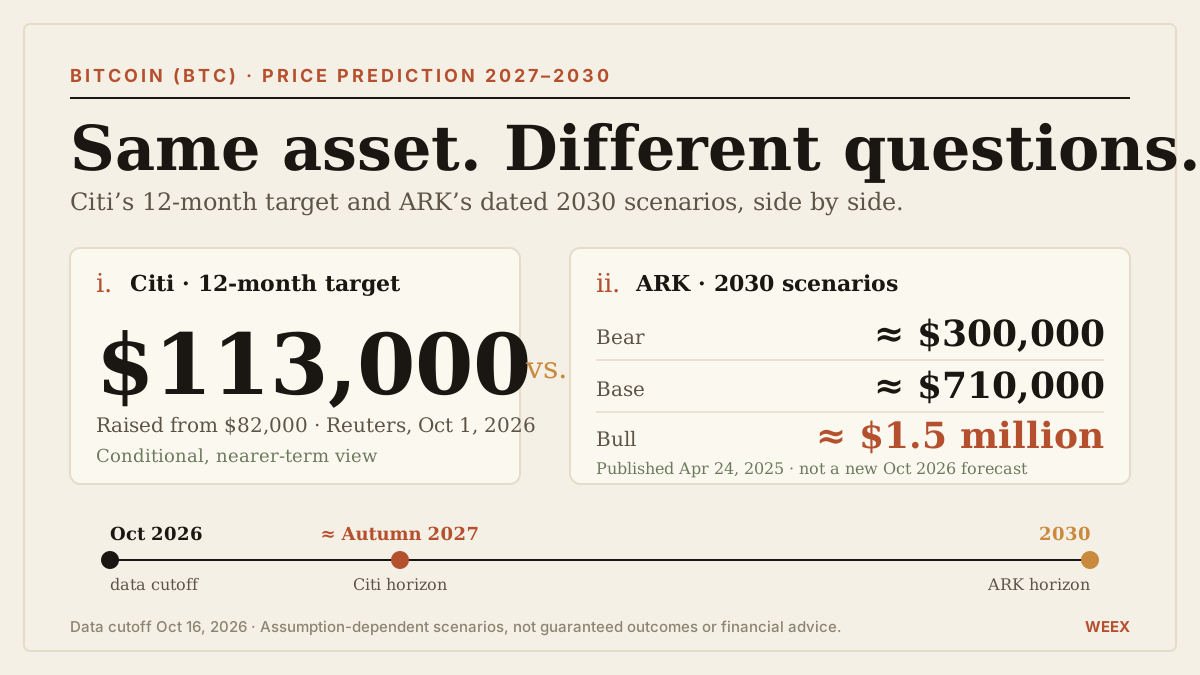
Bitcoin (BTC) Price Prediction 2027–2030: Citi’s $113,000 Target vs. Cathie Wood’s ARK Scenarios
Bitcoin price prediction for 2027–2030: compare Citi’s $113,000 target with ARK’s dated scenarios, demand assumptions, valuation math and key risks.

XRP (XRP) Price Prediction: Can BarriC’s $750 Target Pass the Market-Cap Test?
XRP price prediction: examine BarriC’s $750 target, market-cap math, next-bull-run scenarios, token demand and what could support a recovery to $5.

Musk Says He Will Give “One of My SpaceX Shares to Every Kid in America”: What the Post Says and What Is Still Unclear
Elon Musk said on October 19, 2026 that he will give one of his SpaceX shares to every kid in America next year. The post gave no details on delivery, eligibility or which shares. Estimates put the cost near $10 billion at recent SPCX prices, and a link to Trump Accounts remains unconfirmed.

Perp DEX Generates $125 Million in Fees Monthly, Who Really Gets Rewarded?
Freezing and Confiscation of Cryptos: Europe Strengthens Cooperation Against Criminal Networks

Hedera vs Algorand: Which Network is More Suitable?

Saudi Vrtx Raises $3.6 Million to Develop Its Integrated Financial Technology Infrastructure
Programmable Trading Arrives: How Hook Becomes the 'Brain' of the Trading Pool?

Tiger Research: The Second Growth Curve of the Korean Crypto Market - RWA and Compliant Stablecoins

TRON Industry Weekly Report: Stagflation May Lead BTC to Test $80,000 Support Again, Detailed Explanation of Building Chain Abstract Web3 Experience Infrastructure Newton

Yuga Labs Tells a New TCG Story, Generously Distributing NFT Community Card Packs—Will the Market Respond?

What Is the Market Expecting From Tesla Q3 Earnings Now?
3 Altcoins with High Growth Potential in the DePIN Sector to Keep an Eye On!
The NFT party is over and everybody now owes storage rent
Sheldon Diedericks Focuses on Cryptocurrency Trading Ranges
WEEX Exclusive:Bitcoin Falls to $77,000; FOMC in Focus This Week | WEEX TradFi Daily (September 14, 2026)
Bitcoin Falls to $77,000; FOMC in Focus This Week | WEEX TradFi Daily (September 14, 2026)
Ahead of the September 14 open, global markets are focused on this week’s FOMC. After hotter-than-expected August inflation, odds of a September 16 hike rose above about 85%. Bitcoin broke below $77,000 to about $76,700–$76,800, with Ethereum near $2,500. In Friday’s session, communication services and industrials outperformed, while Apple closed up about 1.75%. CrowdStrike (CRWD) drew attention after unveiling AI-agent protection products at Fal.Con, and investors are also waiting for this week’s key CLARITY Act procedural vote and the rate decision.
What are NFTs and do non-fungible tokens still matter in 2026?
Contents
Latest articles





Latest coin listings on WEEX


