
XRP (XRP) Price Prediction: Can BarriC’s $750 Target Pass the Market-Cap Test?

 Prefer us on Google



XRP (XRP) reaching $750 would imply approximately $47.35 trillion in circulating market capitalization using the supply observed on October 16, 2026. That makes it an extraordinary long-term scenario, not a reasonable default forecast for the next bull run. More useful XRP price predictions should first evaluate the conditions required for $3, $5, and $10, while distinguishing network adoption from sustained demand for the token.
Our assessment is that the viral $750 target is more useful as a valuation stress test than as a trading objective. Repeating a historical percentage gain does not explain why today’s much larger asset should achieve the same multiple. The forecast needs a demand mechanism, a supply assumption, and a time horizon—not only a comparison with an earlier cycle.
WEEX has a dedicated XRP (XRP)/USDT Futures page and an XRP (XRP)/USDT Spot page. Futures are the relevant destination for contract exposure, while spot is the route for direct buying and selling. The futures page returned incomplete quotes and a restriction message during this review, so confirm current order availability before attempting execution.
By WEEX SEO Team | Data cutoff: October 16, 2026
Where Did the $750 XRP (XRP) Price Prediction Come From?
An October 6 report by 24/7 Wall St. attributed the $750 scenario to crypto commentator BarriC and described it as a comparison with XRP’s dramatic 2017–2018 rally.
The article presents the idea as a repeat of an approximately 500-fold historical increase. However, its explanation also pairs a recent price of $1.38 with the $750 target. Those figures do not multiply consistently: $1.38 × 500 is $690, whereas $1.50 × 500 is $750. This is a problem in the secondary report’s presentation; it does not establish what the original social-media post said.
The arithmetic correction matters, but it is not the main investment issue.
Even a perfectly calculated 500-fold projection would still need to explain why the earlier return is economically repeatable. An asset moving from a tiny base to broader market recognition is not in the same position as an asset already valued in tens of billions of dollars.
A historical analogy can identify a possibility to investigate. It does not provide a probability.
The forecast also needs a deadline. A price supposedly achievable during the next bull run is a different claim from a price that might occur after decades of inflation, changes in financial infrastructure, and expansion of the overall digital-asset market.
Without a defined horizon, almost any distant target becomes difficult to evaluate or falsify.
What Is XRP (XRP) Worth at $3, $5, $10, and $750?
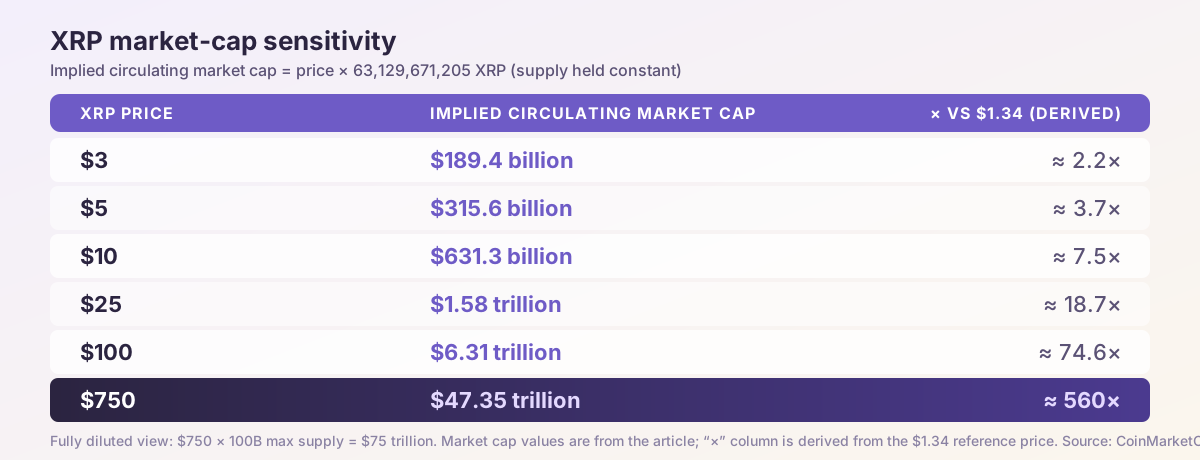
The XRP market-data page reviewed for this article showed a price of approximately $1.34, circulating supply of 63,129,671,205 XRP, and max supply of 100 billion XRP.
Using that circulating supply produces the following valuation ladder.
| XRP Price | Implied Circulating Market Capitalization |
|---|---|
| $3 | $189.4 billion |
| $5 | $315.6 billion |
| $10 | $631.3 billion |
| $25 | $1.58 trillion |
| $100 | $6.31 trillion |
| $750 | $47.35 trillion |
Calculations hold circulating supply constant. Actual future circulation could differ.
The difference between $5 and $750 is not a small adjustment to the same thesis. It is a shift from a large cryptoasset valuation to a valuation of global financial significance.
Fully diluted valuation adds another perspective. Multiplying $750 by the 100 billion max supply gives $75 trillion.
That does not mean all tokens would be available for sale at once. It shows the scale implied when the target is applied to the maximum token count.
A serious forecast should state whether it uses circulating supply, total supply, or max supply. Switching denominators between calculations can make an ambitious target appear less demanding than it is.
Why XRP (XRP) Market Capitalization Is Not the Same as Required Cash Inflows
A $47.35 trillion market capitalization does not mean exactly $47.35 trillion must be deposited into XRP.
Market capitalization is calculated by multiplying the observed marginal price by the circulating token count. It is an accounting measure of market value, not a ledger of cumulative net investment.
A relatively small transaction can change the last traded price. Applying that new price to every circulating token changes the reported market capitalization even though most tokens did not trade.
However, this does not make the valuation irrelevant.
Maintaining a high price in an actively traded asset requires buyers to absorb sellers at that level. The deeper and more persistent the selling pressure, the more substantial the supporting demand must be.
The correct conclusion lies between two misleading extremes.
It is wrong to say that a $47 trillion valuation requires precisely $47 trillion in new cash. It is equally wrong to say that market capitalization can be ignored because prices are set at the margin.
For the $750 thesis, the useful question is: What economic demand would make holders willing to retain XRP, and new buyers willing to purchase it, at that valuation?
A forecast that cannot answer that question has not moved beyond an aspirational number.
-- Price
Does XRP Ledger Adoption Automatically Increase XRP (XRP) Value?
Network usage and token appreciation are related only through specific economic mechanisms.
XRP Ledger transactions incur XRP-denominated transaction costs, and the transaction cost is destroyed rather than paid as a reward to another participant. This creates a connection between network activity and the token, but it is not equivalent to a dividend or a claim on business profits.
The size of the connection matters.
A network can process more activity while keeping transaction costs low. That may be desirable for users but means investors cannot assume a one-for-one relationship between transaction growth and token-price growth.
Payment use introduces another consideration: holding time.
In a simplified example, a system processing $1 billion per day does not necessarily require $1 billion permanently invested in a bridge asset. If the same inventory can be reused repeatedly, the required stock of that asset may be much smaller than the daily payment flow.
Operational buffers, settlement constraints, volatility, and market depth can increase the inventory requirement. But the relationship must be modeled, not assumed.
This is why statements such as “a large percentage of global payments will use the network” are incomplete valuation arguments.
They need to explain how those payments use XRP, how long participants hold it, and what liquidity must remain committed.
Tokenized Assets Do Not All Represent XRP Purchases
An asset represented on a blockchain is not automatically converted into the chain’s native token at its full face value.
A tokenized deposit or other issued asset can have its own value and ownership structure. XRP may be involved in transaction costs, reserves, trading, or routing, but those roles must be identified separately.
The face value of assets recorded on a network should therefore not be inserted directly into XRP’s market capitalization.
For price prediction, the key issue is value capture: how much lasting demand accrues to XRP itself as the surrounding ecosystem expands?
XRP (XRP) Price Prediction for the Next Bull Run
A next-bull-run forecast should define what would constitute a stronger market rather than treating the phrase as a guaranteed event.
For XRP, the constructive case would involve persistent demand, improving liquidity, and a market structure capable of sustaining higher prices after the initial rally. The weaker case would be a sharp speculative move followed by rapid loss of participation.
The ranges below are editorial scenarios. They are not measured technical levels or probability-weighted forecasts.
| Scenario | Illustrative Price Zone | What Would Need to Happen |
|---|---|---|
| Weak recovery | $1–$2 | Confidence improves, but demand remains insufficient for a major revaluation |
| Stronger recovery | $3–$5 | Sustained participation and a broader reassessment of XRP’s prospects |
| Exceptional bull phase | $5–$10 | Much larger demand, deep liquidity, and continued acceptance of a high valuation |
| Extreme speculative thesis | $25 and above | A substantially different market scale and stronger economic justification |
The $3–$5 zone is a more useful research focus than $750 because it can be connected to nearer-term evidence and a more manageable valuation question.
That does not mean $3 or $5 is guaranteed. At the current supply assumption, even $5 implies a market value above $300 billion.
A $10 scenario is more demanding again. It requires investors to support approximately $631 billion in circulating market value.
The progression should be evaluated one step at a time. The fact that a market might support $3 does not establish that it will support $10, and neither validates $750.
XRP (XRP) Price Prediction Over the Next Three Years
A three-year forecast from the October 2026 cutoff extends to approximately October 2029. It should not be confused with a calendar-year-end 2030 prediction.
Over that horizon, a useful framework asks whether adoption, token demand, and market valuation converge.
In a disappointing outcome, ecosystem development could continue while token demand falls short of expectations. XRP could then trade below the current reference price or remain in an extended consolidation.
In a constructive outcome, stronger participation and clearer evidence of economic utility could support a move toward the $3–$5 valuation range.
An exceptional outcome could bring $5–$10 into consideration, but that would require a substantially stronger market and a willingness to assign XRP several hundred billion dollars in circulating value.
These are conditional valuation paths, not a claim that prices will move smoothly between annual checkpoints.
A three-year investment can contain several severe drawdowns. A correct broad thesis can still be a poor trade if the entry price is excessive or the position cannot survive volatility.
The forecast should therefore be revisited when its assumptions change, rather than preserved merely because its deadline has not arrived.
What Chart Evidence Would Strengthen an XRP (XRP) Recovery?
A price target becomes more useful when paired with a method for assessing progress.
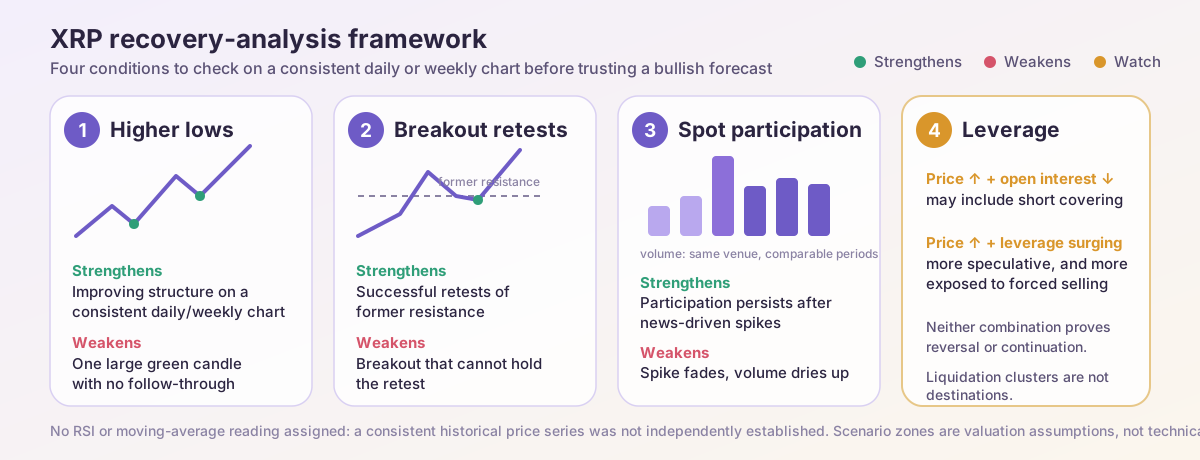
For a sustained recovery, look for improving structure on a consistent daily or weekly chart. Higher lows, successful retests of former resistance, and participation that persists after news-driven spikes would provide stronger evidence than a single large green candle.
Volume should be compared on the same venue and over comparable periods. A global volume figure and a single-exchange chart do not measure the same thing.
Derivatives positioning requires similar care. Rising price with falling open interest can indicate that short covering contributes to the move. Rising price with rapidly expanding leverage may indicate stronger speculative participation, but also greater vulnerability to forced selling.
Neither combination automatically proves a reversal or continuation.
A liquidation cluster is also not a destination the market must reach. Such estimates depend on assumptions about positions and margin, and they can change as traders adjust exposure.
This article does not assign a current RSI reading or moving-average crossover because a consistent historical price series was not independently established for that purpose.
The scenario zones above are valuation assumptions, not substitutes for a properly sourced technical chart.
Trading XRP (XRP) Futures on WEEX Without Turning a Target Into a Guarantee
A forecast about a future bull market does not determine a safe leverage level.
Start with the WEEX XRP/USDT Futures page and confirm whether orders are currently enabled. Then check the contract’s current specifications, funding terms, margin settings, and position controls.
The WEEX XRP/USDT Spot page is the alternative route for direct exposure. An unleveraged spot purchase does not carry liquidation risk from borrowed exposure, but its value can still fall sharply.
For a leveraged position, the distance between entry and liquidation can matter more than a distant bullish target.
A trader may ultimately be correct that XRP appreciates over several years and still lose the position during an interim decline. That is a mismatch between investment horizon and instrument design.
Position sizing should begin with a maximum acceptable loss and a defined invalidation point. The headline target should not determine the margin commitment.
No active XRP-specific promotion or fee discount was verified at the cutoff. Accordingly, the analysis does not assume a promotional reduction in trading costs.
FAQ
1. Can XRP Reach $750?
A $750 price is mathematically expressible but economically extraordinary. It implies approximately $47.35 trillion in circulating market value at the supply used here. The available historical analogy does not establish a credible probability or deadline.
2. Is BarriC’s $750 Prediction Guaranteed?
No. The reviewed secondary report describes a historical-return scenario. The original social-media post was not independently established here, and a repeated historical multiple is not a guaranteed forecast.
3. Can XRP Reach $10 in the Next Bull Run?
It is an ambitious bullish scenario. At the current supply assumption, $10 implies approximately $631 billion in circulating market capitalization. It would require much stronger demand and sustained market acceptance.
4. Does XRP Need $47 Trillion in New Investment to Reach $750?
Not exactly. Market capitalization is price multiplied by circulating supply, not cumulative cash invested. Nevertheless, maintaining such a valuation would require an exceptional demand and liquidity environment.
5. Does More XRP Ledger Activity Guarantee a Higher XRP Price?
No. Investors must examine transaction costs, inventory requirements, holding periods, and the specific ways activity creates demand for XRP. Network growth and token appreciation are not interchangeable.
WEEX View: XRP (XRP) Forecasts Need a Demand Model, Not a Repeated Multiple
The weakness in the $750 argument is not simply that the number is large. It is that repeating a past percentage return does not explain the future economic demand needed to sustain the resulting valuation.
A more useful forecast begins with $3, $5, and $10, calculates the implied market value, and specifies the evidence that would justify each step.
Our position is that $750 should remain an extreme stress-test scenario. It should not be presented as the expected outcome of the next bull market or used to rationalize a leveraged position.
Sources: 24/7 Wall St. report on BarriC’s forecast, October 6, 2026; CoinMarketCap XRP market data; XRP Ledger transaction-cost documentation; official WEEX XRP futures and spot pages.
This content is provided for general informational purposes only and doesn't constitute financial, investment, legal, or tax advice. Any events, rewards, online promotions, or related information mentioned herein should not be considered a recommendation, solicitation, or invitation to purchase, sell, trade, or otherwise deal in any crypto assets. Crypto assets are highly volatile and may result in loss. The availability of WEEX services, products, and related events may vary by region. You are responsible for ensuring that your participation is in accordance with applicable local laws and regulations.
You may also like

Variant Investment Partner: In the Second Half of the Bull Market, Which Two Camps Are Marginal Dollars Flowing To?

CITIC Securities: Market Overestimation of CoreWeave Concerns, New Cloud Providers' Short-Term Funding Gap 'Still Manageable'

Financing Weekly Report | Fission Completes $10 Million Series A Financing Led by Pantera Capital; DeepSeek Plans to Raise Approximately 100 Billion Yuan in New Financing

The Six-Year Tug of War Between Privacy and Regulation

Goldman Sachs Throws Out 'Chilling Chart': Either the Bond Market is 'Overly Pessimistic' or the Stock Market is 'Too Optimistic'

Ethereum Staking Outflows May Exceed New Inflows

Bitcoin or Dollar Returns: Same Strategy, Opposite Results

BitTorrent Ushers in Next-Gen Web3 Infrastructure with Strategic Rebrand and Inaugural BTT Burn

Cysic Cross-Chain Bridge Attacked, Hacker Minted 10 Million CYS

Bank of America’s Hartnett: Sell Signal Ends, Tech Stocks Return to Focus on Semiconductor Prices

Kraken's New Leader, After Acquiring European Bank, Aims to Disrupt the Crypto Market?

Mr&强 Discusses the Interconnection of Five Major Assets in the Global Financial Market

唐华斑竹 Analyzes Market Trends, BTC Futures Open Interest Remains High
BitTorrent Brand Upgrade and BTT First Phase Buyback and Burn Launch Together, Dual Core Drives a New Era of Web3 Infrastructure

Arthur Hayes Reveals Altcoin Selection Logic, Emphasizes Accumulating Bitcoin
Vitalik, Tom Lee, Arthur Hayes and Others Share Views on Cryptocurrency and AI

Multiple Theft Incidents Fund Flow into ZEC, Attackers Use It to Transfer Stolen Funds

[CoreWeave, AI Crisis Trigger ③] Lessons from the 2008 Financial Crisis
Pago Móvil Reaches 63% of Transactions in Venezuela, Competing with USDT

Analysts Bullish on MicroStrategy, Target Price Raised to $240

Bank of America Report Shows $39 Billion Inflow into US Stocks in One Week, Strategists Prefer Risk Aversion
MSCI New Rules Implemented, 14 Crypto Companies Enter Potential Impact List

What Do the New Tesla Roadster Specs Mean for Tesla (TSLA) Stock?
Explore the new Tesla Roadster specs, reservation payments and 2028 production plan, plus what the reveal could mean for Tesla stock and future profits.
Quant (QNT) Price Prediction 2026–2030: Can Bank Adoption Drive a Return to $500?

Spout raises $2M to offer 0% interest loans on Solana

RWA Weekly: Ant Group and HSBC Test Agent Tokenized Payments; Robinhood Explores Tokenized Actively Managed ETFs

BlackRock CEO Larry Fink Flags a Different AI Risk, and It Isn’t the Bubble
Shanghai Supports International Data Center Construction to Facilitate Cross-Border Data Flow
Shanghai Advances National Blockchain Network Construction, Strengthens Cross-Chain Service Capabilities

When Will AI Investments Pay Off? JPMorgan Optimistic About Google and Amazon
Variant Investment Partner: In the Second Half of the Bull Market, Which Two Camps Are Marginal Dollars Flowing To?
CITIC Securities: Market Overestimation of CoreWeave Concerns, New Cloud Providers' Short-Term Funding Gap 'Still Manageable'
Financing Weekly Report | Fission Completes $10 Million Series A Financing Led by Pantera Capital; DeepSeek Plans to Raise Approximately 100 Billion Yuan in New Financing
The Six-Year Tug of War Between Privacy and Regulation
Goldman Sachs Throws Out 'Chilling Chart': Either the Bond Market is 'Overly Pessimistic' or the Stock Market is 'Too Optimistic'
Ethereum Staking Outflows May Exceed New Inflows
Contents
Latest articles


Latest coin listings on WEEX


