
- Buy Crypto
- Markets
 Futures
- Spot
- Copy Trade
- Earn
- More
meme Coin Crashes 50% Across the Board, Did Binance Pull an April Fools' Day Prank on the Market?

On April 1st, Binance had a rough April Fools' Day, and the market fell victim to a costly joke. First, $GUN was suspected by the community to be engaging in rug pulling or whale dumping, but this matter has yet to be conclusively resolved. Following one announcement, a more serious chain reaction crash occurred later that night. What kind of joke did Binance play on us this April Fools' Day?
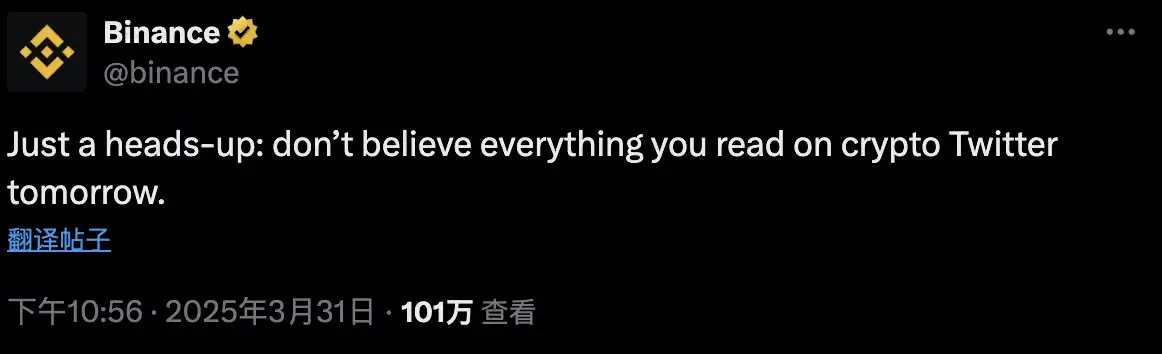
Announcement Turmoil
Initial Announcement
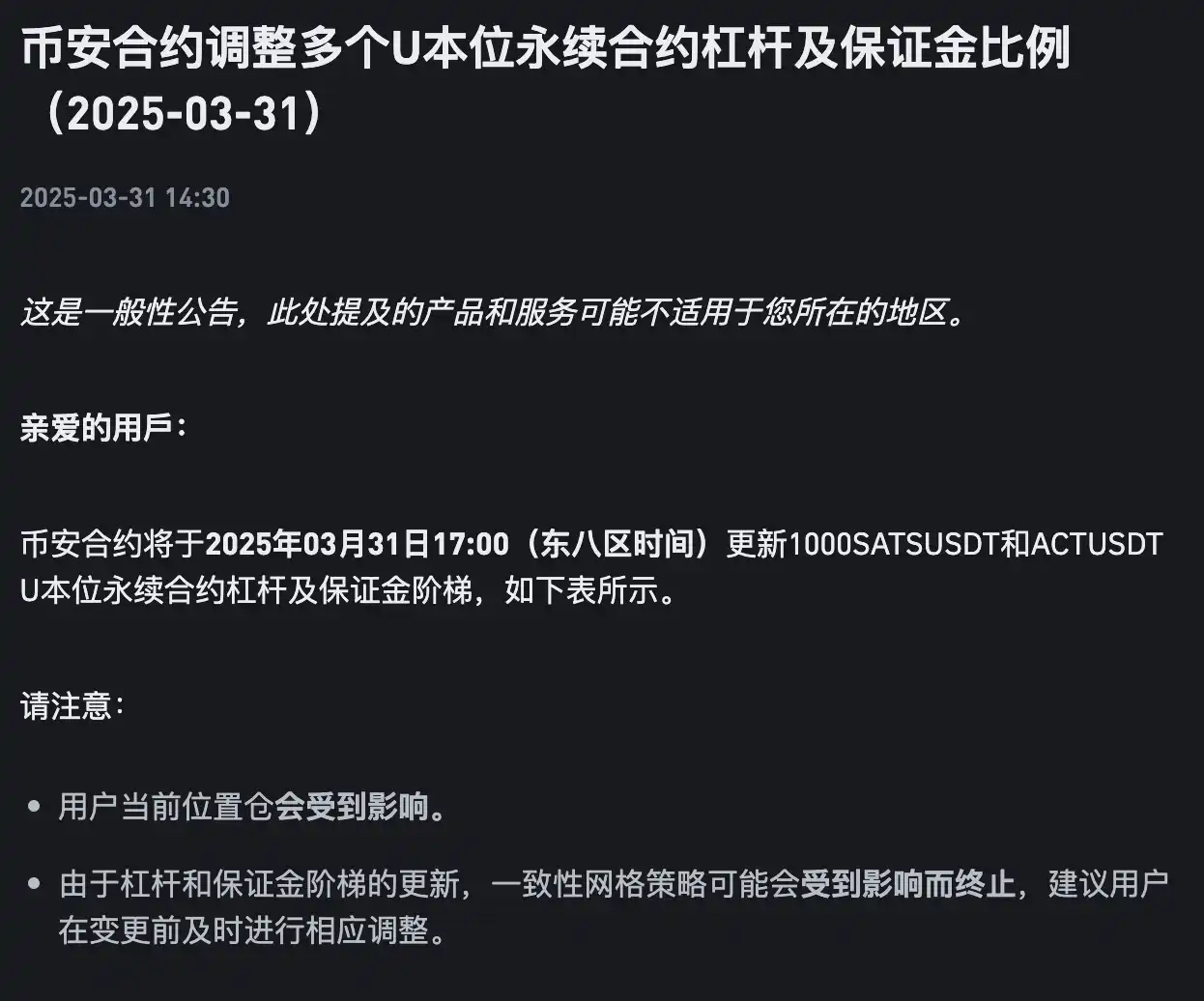
The genesis of this plummet can be traced back to an announcement made yesterday. On March 31st at 14:30, Binance released the announcement "Binance Futures will update 1000SATSUSDT and ACTUSDT U perpetual contract leverage and margin tier at 17:00 on the same day," warning users that their current position might be affected and that due to the leverage and margin tier update, the consistency grid strategy may be terminated. Users were advised to make necessary adjustments promptly before the change.
Subsequent Amendment Announcement
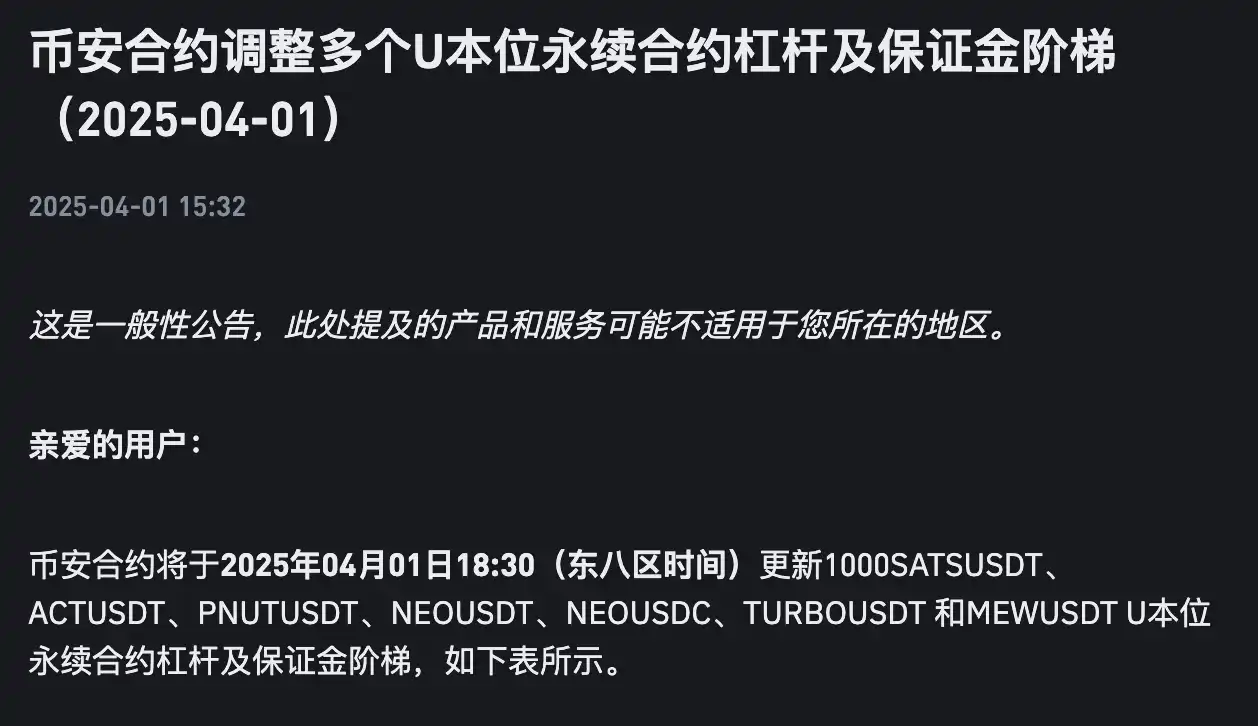
Just one day later, on April 1st at 15:32, Binance once again issued an announcement stating, "Binance Futures will update 1000SATSUSDT, ACTUSDT, PNUTUSDT, NEOUSDT, NEOUSDC, TURBOUSDT, and MEWUSDT U perpetual contract leverage and margin tier on April 1, 2025, at 18:30". This announcement not only further modified the previous day's newly updated $ACT position limit "by further reducing the lower leverage position limit by 50%," but also gave users less than a 3-hour reaction time.
Marketwide Meltdown
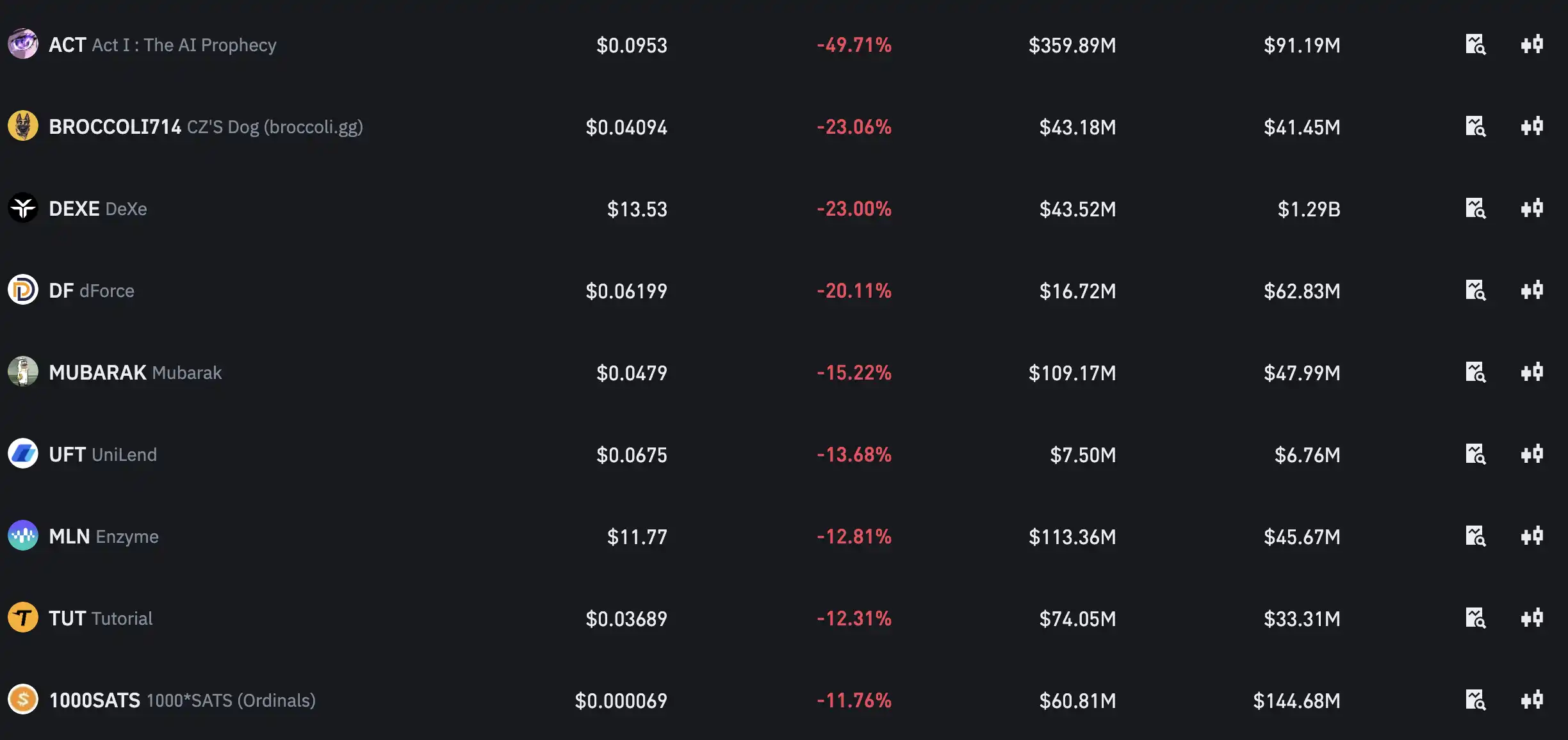
Several tokens such as ACT, DEXE, HIPPO, BANANAS31, TST, PNUT, and others experienced nearly simultaneous drops of up to 50%. Within a span of just 5 minutes from 18:30 to 18:35, the total value of ACT contract holdings on the Binance platform plummeted by 76.53%, dropping from $94.1286 million to $22.0932 million. This instantly ignited the community, clearly indicating that the impact of Binance's rule changes far exceeded everyone's expectations, leading to widespread speculation about the cause of the crash.
Liquidity Provider Suspicion
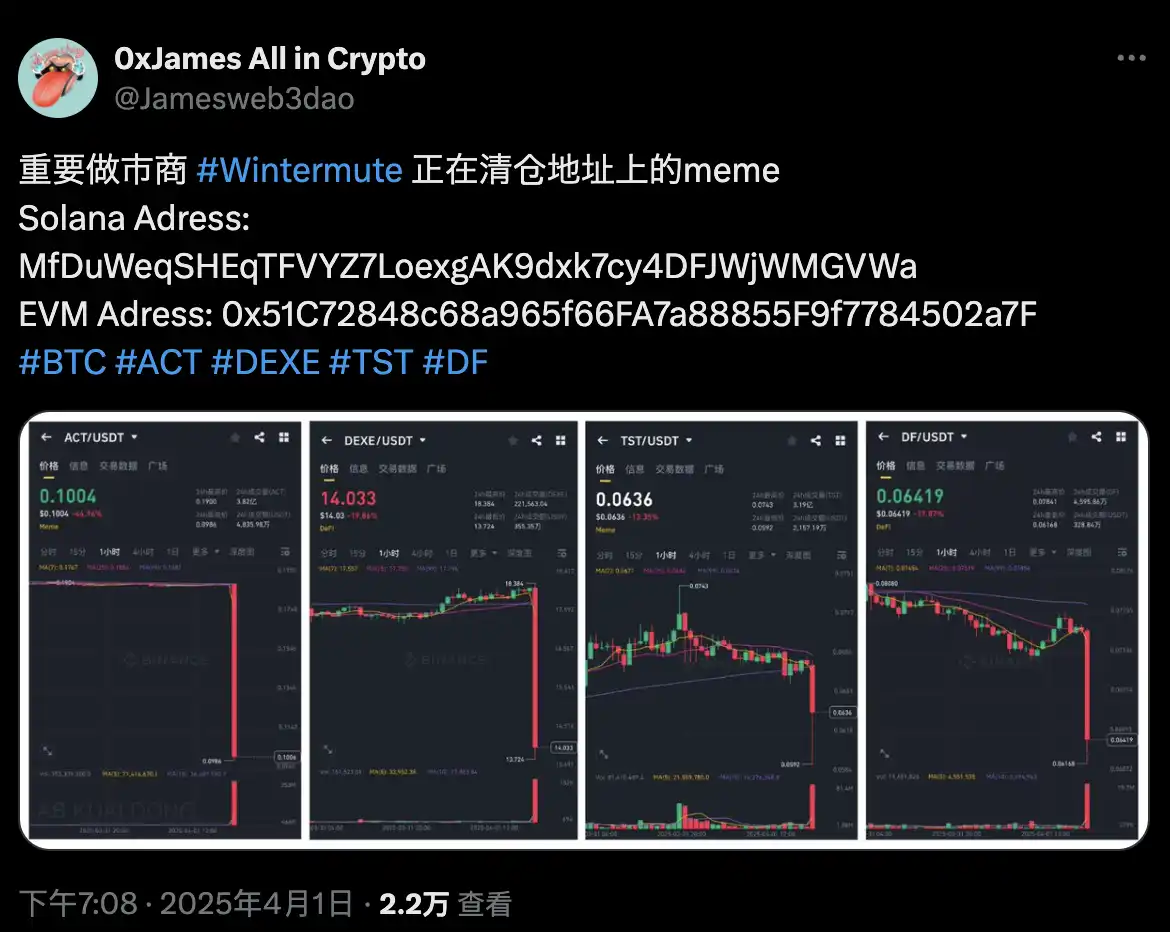
The first to be suspected was the liquidity provider, with WinterMute as the liquidity provider for the biggest loser $ACT and multiple MemeCoins thrust into the spotlight. Twitter KOL 0xJames observed addresses related to WinterMute were liquidating their Meme positions on-chain. Wintermute dumped approximately $250,000 worth of ACT tokens in half an hour through Raydium.
Liquidity Provider Clarification
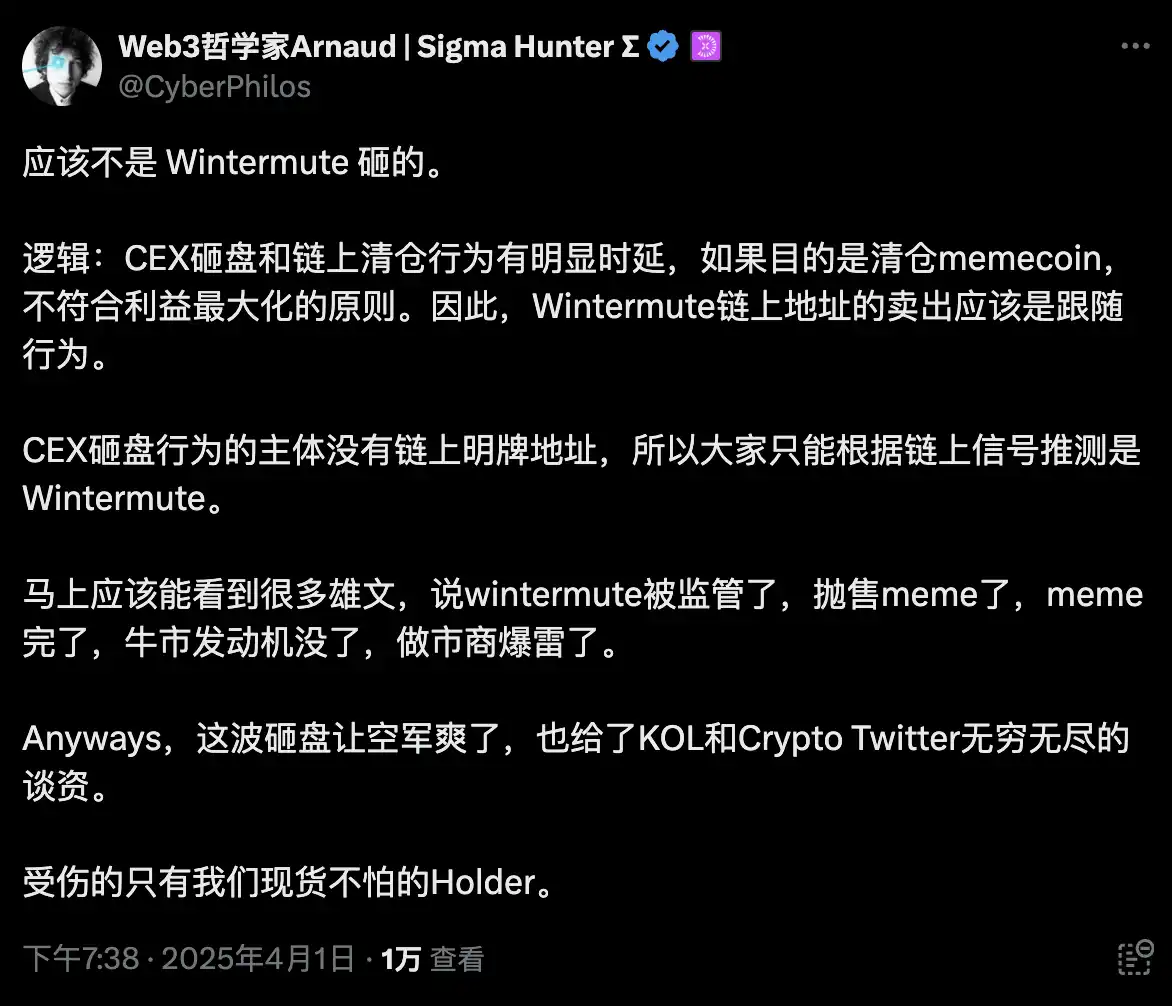
However, some people, after analyzing the situation, don't believe this to be the case. A Web3 philosopher stated, "There is a clear time delay between CEX dumping and on-chain liquidation behavior. If WinterMute wanted to liquidate Meme, it would not align with the principle of maximizing profits."
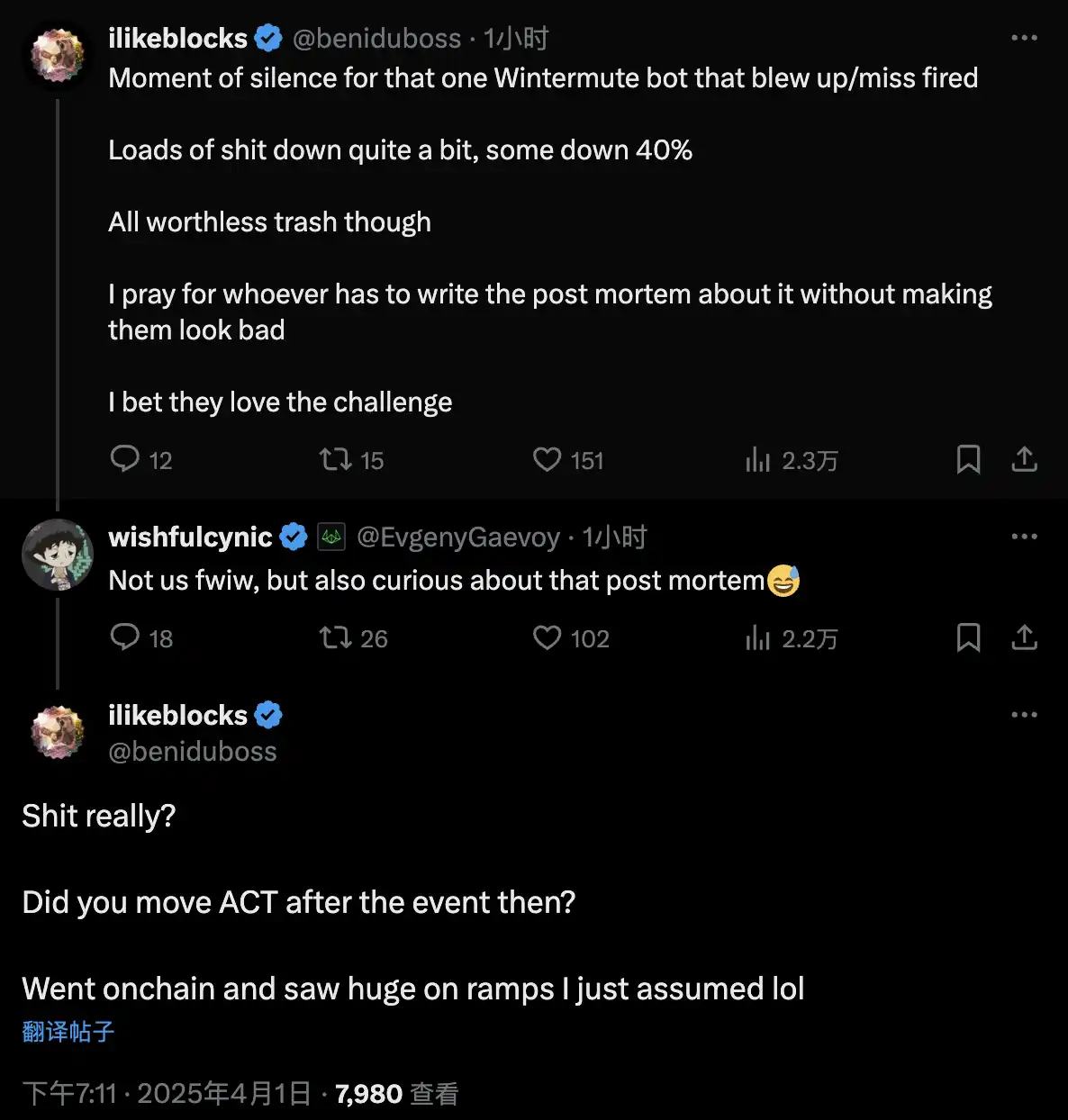
WinterMute's founder and CEO, Evgeny Gaevoy, later responded to a skeptic and left a remark saying, "It's not our thing, and we are also curious about the post-mortem analysis of what actually happened," indicating that the on-chain selling behavior was a reaction to drastic token price fluctuations and automated arbitrage in the AMM pool.
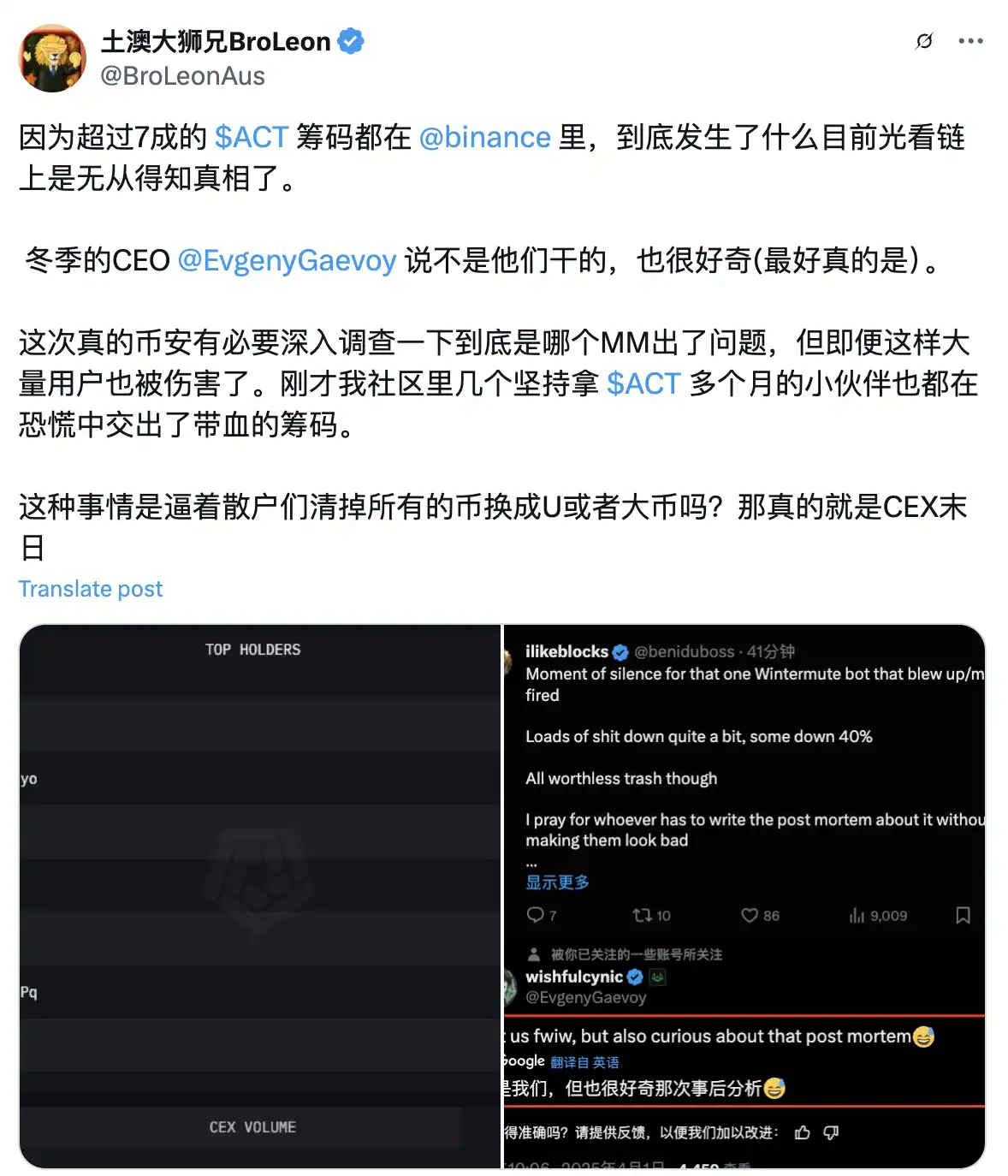
Australian lion BroLeon expressed skepticism towards Gaevoy's explanation, mentioning that 70% of $ACT chips are on exchanges, and the truth cannot be ascertained only from on-chain data. He hopes Binance can conduct a thorough investigation and provide a satisfactory answer; otherwise, it will have a highly negative impact on the market.
Binance Rule Change Factor
Of course, some also believe it was not a liquidity provider dumping but a change in Binance's rules. Firstly, the rule adjustment directly affected market liquidity. Binance adjusted the contract's position limit and leverage multiplier to reduce market risk. However, this had a significant impact on liquidity providers. The lowered position limit forced them to reduce their holdings, even leading to forced liquidation. The reduced leverage also compelled them to decrease leveraged positions. Liquidity providers typically hold spot and contract positions to hedge risks. If their holdings exceed the new limit or if funds are insufficient after leverage reduction, the system forcibly liquidates, selling in the contract market and reducing the contract price.
As the spot and contract price spreads continued to widen, coupled with arbitrage bots buying low in the contract market and selling high in the spot market, profiting from the narrowing spread, the bots sold extensively in the spot market, further depressing the spot price. As the liquidity providers were liquidated, causing the contract price to fall, coupled with arbitrage bots causing the spot price to drop, the overall market sentiment turned to panic, with retail investors following suit, leading to a chain reaction crash, resulting in a complete collapse of the Memecoin market.
Crypto KOL and former FTX Community Partner Benson Sun commented on this, saying, "Before Binance changes the rules, it should first assess how many positions will be liquidated. If the position of a market maker is large, they should also be notified in advance. As an industry leader, I hope Binance can handle this incident properly."
The Truth Remains a Mystery
After experiencing suspicions from the market regarding market makers, Binance rule mistakes, and even internal misconduct, KOL Zishi stated that none of this is related and only stated the facts. Meanwhile, He Yi commented with a sigh under this tweet, showing his helplessness.
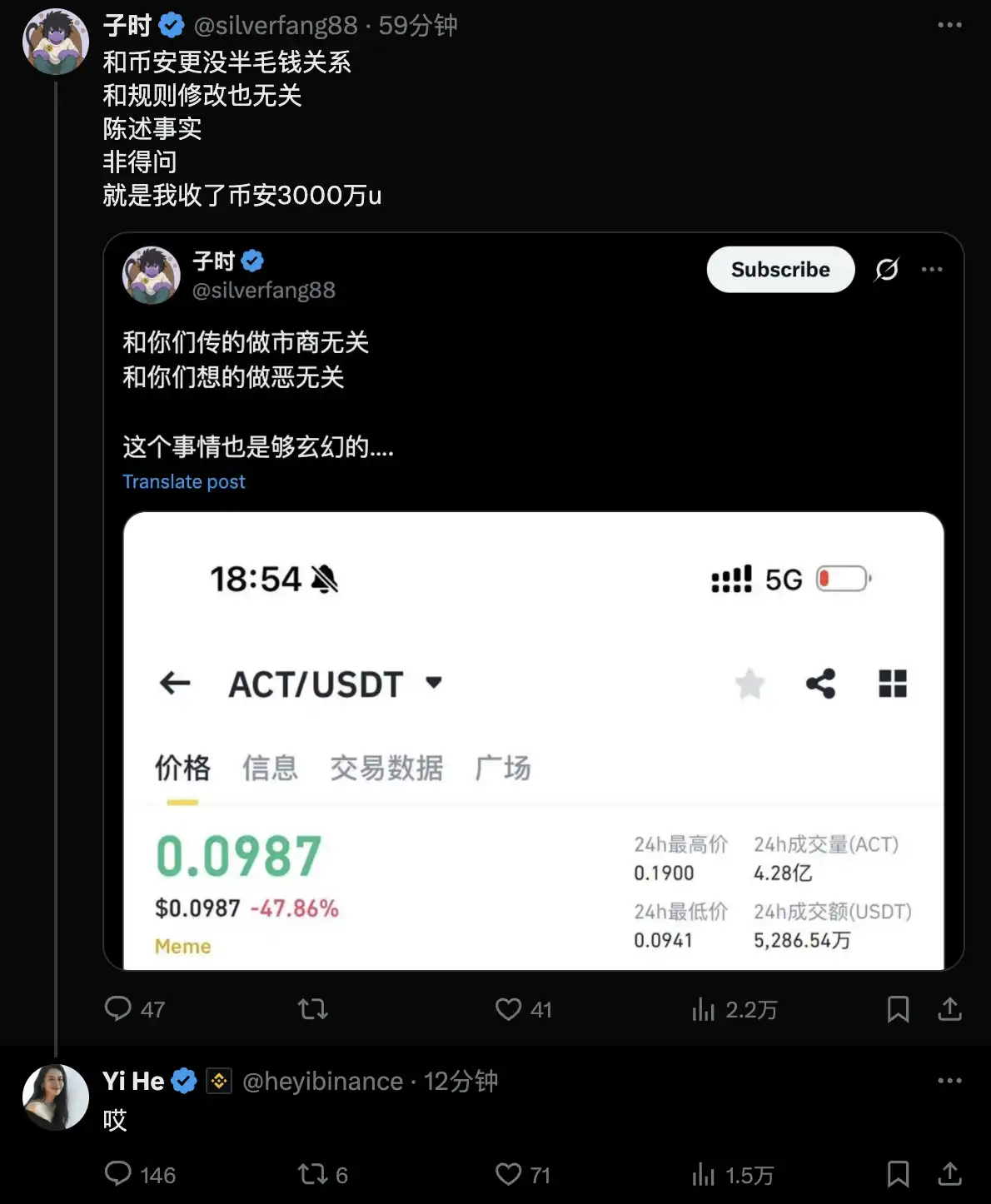
At the time of publication, He Yi tweeted that the corresponding team is preparing a detailed response, and it is still impossible to make a judgment at present. Recently, the beleaguered Binance has indeed encountered some issues that need to be addressed. BlockBeats will continue to follow this matter and report on it.
You may also like

Social Capital CEO: How Equity Tokenization is Reshaping Capital Markets from US Stocks to SpaceX?

CoinGecko Report: Surge of 346% vs Dip of 20.8%, The Wild Rise of DEX

a16z: The Real Opportunity of Stablecoins Lies Not in Disruption but in Filling Gaps

Mining Exodus: Someone Holds $12.8 Billion AI Order

March 6 Market Key Intelligence, How Much Did You Miss?

a16z: The True Opportunity of Stablecoins is in Complementing, Not Disrupting

Predict LALIGA Matches, Shoot Daily & Win BTC, USDT and WXT on WEEX
The WEEX × LALIGA campaign brought together football excitement and crypto participation through a dynamic interactive experience. During the event, users predicted matches, completed trading tasks, and took daily shots to compete for rewards including BTC, USDT, WXT, and exclusive prizes.

Ray Dalio Dialogue: Why I'm Betting on Gold and Not Bitcoin

Who Took the Money in the AI Era? A Must-See Investment Checklist for HALO Asset Trading
Wall Street Bears Target Ethereum: Vitalik In the Know Takes Flight, Tom Lee Remains Bullish
Pump.fun Hacker Steals $2 Million, Receives 6-Year Prison Sentence, Opts for 'Self-Detonation'

6% Annual Percentage Yield as Musk Declares War on Traditional Banks
36 years, 4 wars, 1 script: How does capital price the world in conflict?

Mining Companies' Great Migration: Some Have Already Secured $12.8 Billion in AI Orders
What Is Vibe Coding? How AI Is Changing Web3 & Crypto Development
What is vibe coding? Learn how AI coding tools are lowering the barrier to Web3 development and enabling anyone to build crypto applications.
The parent company of the New York Stock Exchange strategically invests in OKX: The intentions behind the $25 billion valuation
WEEX P2P update: Country/region restrictions for ad posting
To improve ad security and matching accuracy, WEEX P2P now allows advertisers to restrict who can trade with their ads based on country or region. Advertisers can select preferred counterparty locations for a safer, smoother trading experience.
I. Overview
When publishing P2P ads, advertisers can now set the following:
Allow only counterparties from selected countries or regions to trade with your ads.
With this feature, you can:
Target specific user groups more precisely.Reduce cross-region trading risks.Improve order matching quality.
II. Applicable scenarios
The following are some common scenarios:
Restrict payment methods: Limit orders to users in your country using supported local banks or wallets.Risk control: Avoid trading with users from high-risk regions.Operational strategy: Tailor ads to specific markets.
III. How to get started
On the ad posting page, find "Trading requirements":
Select "Trade with users from selected countries or regions only".Then select the countries or regions to add to the allowlist.Use the search box to quickly find a country or region.Once your settings are complete, submit the ad to apply the restrictions.
When an advertiser enables the "Country/Region Restriction" feature, users who do not meet the criteria will be blocked when placing an order and will see the following prompt:
If you encounter this issue when placing an order as a regular user, try the following solutions.
Choose another ad: Select ads that do not restrict your country/region, or ads that allow users from your location.Show local ads only: Prioritize ads available in the same country as your identity verification.
IV. Benefits
Compared with ads without country/region restrictions, this feature provides the following improvements.
Aspect
Improvement
Trading security
Reduces abnormal orders and fraud risk
Conversion efficiency
Matches ads with more relevant users
Order completion rate
Reduces failures caused by incompatible payment methods
V. FAQ
Q1: Why are some users not able to place orders on my ad?
A1: Their country or region may not be included in your allowlist.
Q2: Can I select multiple countries or regions when setting the restriction?
A2: Yes, multiple selections are supported.
Q3: Can I edit my published ads?
A3: Yes. You can edit your ad in the "My Ads" list. Changes will take effect immediately after saving.



 App
App