
No Matter Whether Warsh Raises Rates or Not, He is Definitely One of Us

 Prefer us on Google



Written by: Frank, MSX Maitong
Just 100 days after replacing Powell, the new Federal Reserve Chairman personally selected by Trump has begun discussing "rate hikes."
On August 28, Kevin Warsh made his debut at Jackson Hole, clearly reiterating that the 2% inflation target is "unwavering," and that the data does not sufficiently prove that there has been a "meaningful improvement" in inflation trends.
As soon as the "hawkish" tone was set, the market quickly repriced.
As of the time of writing, the probability of a 25bp rate hike on September 16 has surged to about 56%, up from just over 30% prior to this.
Interestingly, Trump has not publicly criticized Warsh as he did with Powell in the past; instead, he has rarely stated that he "respects Warsh very much" and that "he will do what he must do."
This raises a more intriguing question: Is Warsh's current hawkish stance preparing him to part ways with Trump?
The answer may be quite the opposite.
1. The More "One of Us" You Are, the Less You Can Act Like One of Us
Looking solely at Warsh's speech at Jackson Hole, it is hard to link him to the "low-rate Federal Reserve Chairman that Trump wants."
He not only emphasized that inflation remains too high but also proposed an extremely hawkish reconstruction of the Federal Reserve's operational paradigm over the past twenty years: Unconventional policies like QE should only be used in true crises, and the Fed should reduce its "feeding" communication to the market.
For a long time, Wall Street has been accustomed to closely monitoring dot plots, press conferences, and whispers, then guessing whether the next meeting will result in a rate hike or cut.
Warsh is clearly very averse to this.
In his view, when the market waits every day for the Fed to reveal "how to make the next trade," and the Fed in turn judges the economy based on market prices, the entire system has devolved into a self-reinforcing "Hall of Mirrors."
Ultimately, Warsh served as a Fed governor twenty years ago, and compared to the highly technical bureaucrats who have relied heavily on economic models, dot plots, and forward guidance since the Bernanke era, he is more like a reformer trying to reshape the central bank's operational logic from the outside.
From this perspective, Warsh's current "hawkish" stance is clearly aimed at quickly restoring his policy credibility at the beginning of his term.
After all, for a chairman personally chosen by Trump, once the market begins to trade on the "loss of Fed independence," soaring long-term Treasury yields and uncontrollable inflation expectations will quickly backfire on the economy.
Similarly, for Trump, a chairman who can first prove he is "disobedient" is more capable of genuinely cutting rates in the future.
In fact, as early as last year, the MSX Maitong Research Institute discussed Warsh when analyzing candidates for Fed Chairman.
His ability to emerge from the candidate list is due to his resume being recognized by both traditional Wall Street and the Fed system, as well as having a close relationship network with Trump (see further reading "The Reversal of the Fed's 'Successor': From 'Loyal Dove' to 'Reformer', Has the Market Script Changed?").
Warsh's father-in-law, Ronald Lauder, head of the Estée Lauder family, has known Trump since their time at Penn and has maintained a long-term personal relationship, making him one of Trump's important allies in the political and business circles.
Looking further up, Warsh and current U.S. Treasury Secretary Yellen share an interesting common market-oriented ideological source:
Stanley Druckenmiller.
Yellen has worked for Soros Fund for a long time and has been deeply influenced by Druckenmiller, while Warsh has maintained a very close relationship with Druckenmiller after leaving the Fed and has even become his business partner.
Strictly speaking, the two are not traditional "brothers" in the sense of being from the same school, but the two most important positions in U.S. monetary and fiscal policy today happen to be held by two individuals who are both deeply influenced by Druckenmiller's market philosophy, which is undoubtedly very interesting.
Today, Trump can still publicly say, "I respect him," which indicates that, at least for now, Warsh still belongs to the category of those who are allowed to "act independently."
From another perspective, the more he can prove he is not Trump's puppet, the more room he will have when true easing is needed in the future.
2. "Clear Hawk, Hidden Dove": Can AI Rewrite the Traditional Rate Cut Script?
Therefore, one way to understand Warsh is as "hawkish in the short term, but retaining the option for easing in the long term."
The so-called "clear hawk, hidden dove" does not mean that Warsh has already decided to cut rates in the future; there is currently no evidence to support such a judgment.
More accurately, Warsh has thrown out a new possibility regarding AI, stating, "The potential for substantially higher growth is on the rise," meaning that if the U.S. economy maintains higher growth while allowing inflation to fall, the Fed does not need to wait until the economy clearly weakens before cutting rates.
This is the truly interesting aspect of "clear hawk, hidden dove," and this path can be broken down into three steps.
1. First, Restore Inflation Credibility
The biggest constraint Warsh faces now is still inflation above the 2% target. In such an environment, rash easing could not only stimulate demand again but also lead to a rise in long-term inflation expectations.
Therefore, regardless of whether there is indeed a rate hike in September, Warsh must first make the market believe that 2% is not just a slogan, and that if necessary, the Fed really dares to raise rates again.
This is why September 16 is particularly important.
Before that, employment data and the CPI released on September 11 will determine whether Warsh has enough reason to truly translate the hawkish language from Jackson Hole into policy action.
If inflation continues to be sticky while employment remains resilient, then a rate hike in September is not unimaginable; conversely, if the data weakens rapidly, Warsh can completely choose not to hike.
Only by establishing this credibility first can future rate cuts be more easily understood as "normal easing allowed by inflation," rather than "political rate cuts under pressure from the White House."
2. Wait for Supply-Side to Truly Open Up Rate Cut Space
Next, what is truly worth observing is whether AI productivity can transition from a narrative to macro data.
This is also the keyword that is most easily overlooked in Warsh's speech at Jackson Hole: AI.
Warsh devoted a considerable amount of time discussing whether AI is becoming a new factor of production and whether it can ultimately lead to sustained productivity improvements.
The underlying logic is actually very important.
If AI, capital expenditure, energy expansion, and regulatory relaxation truly enhance the supply capacity of the U.S. economy, then a combination of economic conditions that Trump most hopes to see may emerge—growth remains strong, but inflation begins to decline.
This is completely different from rate cuts driven by past recessions; for the stock market, this may even be a more comfortable environment than traditional rate cuts, meaning EPS continues to grow while discount rates begin to decline.
If PCE falls, 2-year Treasury yields decline, and the economy and employment do not collapse significantly, then the market's trading will shift from "economic recession → rate cut" to "productivity improvement → inflation decline → soft landing or even no landing easing."
3. Fiscal and Monetary Policy: A New Division of Labor
This is also a line worth paying attention to between Warsh and Yellen.
The ultimate goals of the two may have significant overlap, which is that neither wants the long-term financing costs in the U.S. to spiral out of control.
However, their methodologies are not entirely consistent.
Yellen is more willing to actively influence the long-term financing environment through the Treasury's repurchase of long-term government bonds and adjusting market structures; Warsh, on the other hand, clearly believes more in market pricing and opposes the Fed's long-term intervention in the bond market through large-scale balance sheet operations.
Therefore, rather than understanding it as a conspiracy between the two to "lower rates," it is better to understand it as a new division of policy labor, where the Treasury handles the structure and liquidity of the long-term Treasury market more, while the Fed tries to reclaim its main policy tools to short-term rates.
If this combination really holds, then the U.S. may even usher in a very different easing cycle from the past decade: first maintaining inflation and long-term bond market credibility, then lowering short-term policy rates when conditions are ripe, while keeping the Fed's balance sheet relatively restrained.
This may be the real place where "clear hawk, hidden dove" is worth trading.
Today's hawk does not mean a hawk forever; conversely, the bolder one is today, the more the market may be willing to believe him when he truly needs to turn dovish in the future.
3. If the Logic Holds, What Should U.S. Stocks Trade?
For us, whether Warsh is truly one of Trump's "own people" is not that important.
What matters is, if his macro logic gradually comes to fruition, where will the money go first, and then where?
The MSX Maitong Research Institute believes that rather than simply dividing the market into three scenarios of "rate hike / no rate hike / rate cut," it is better to understand it as three potential trading phases that may occur sequentially.
First, trade AI's "profits" first.
At this stage, interest rates are still very high, and the Fed is even discussing rate hikes again. The most comfortable assets are not those companies that hope the Fed will cut rates as soon as possible.
Instead, it is those companies that can digest valuation pressure through their own profit growth even if high interest rates persist.
This is why the first phase is still worth focusing on high-quality AI leaders and the infrastructure chain formed around AI Factory.
Including AI chips, hyperscalers, data centers, networks, storage, power, and energy infrastructure, their biggest commonality is that profit growth is fast enough to offset the valuation pressure brought by high discount rates.
So at this stage, the market is really trading on EPS revisions; as long as AI CapEx can be truly converted into revenue, profit, and free cash flow, it will be easier to continue attracting funds in a "Higher for Longer" environment.
Conversely, those long-term growth companies that only have distant stories and have not formed stable profits will still be suppressed by high interest rates.
This also means that there will continue to be differentiation within AI, with profitable AI and unprofitable growth stories increasingly becoming different types of assets.
Second, trade AI's "valuation" next.
Here, we can focus on PCE falling + 2Y Treasury yields breaking down + Fed rate hike probabilities declining rapidly.
If these three signals appear simultaneously, and employment and economic activity do not collapse significantly, the market will likely begin to believe that the economy is still doing well, corporate profits are still rising, but inflation has allowed the Fed to stop tightening and even prepare to turn towards easing.
At this stage, the AI leaders that have already risen in the first phase may welcome a second revaluation, as the previous rise was mainly based on EPS ↑, while now it begins to transform into EPS ↑ + discount rate ↓.
Profit revisions + PE expansion may be the most comfortable segment in the entire AI trading.
Because corporate profits have not undergone large-scale downward revisions typical of traditional recession cycles, but the valuation side has begun to receive support from declining interest rates.
Of course, from this perspective, AI leaders are not just assets of the first phase; they may very well span both the first and second phases.
The money made in the first phase from profits can be made again in the second phase from valuations.
Third, it's time for "easing Beta"
When interest rates clearly confirm a downward trend, funds may then spread from AI leaders to the periphery, and the assets that have been most obviously suppressed by high funding costs over the past few years will undoubtedly gain greater valuation elasticity.
Including Russell 2000 (IWM), REITs (XLRE), residential builders (XHB, ITB), biotechnology (XBI), some regional banks (KRE), and high Beta Crypto (COIN, MSTR), etc.
The biggest difference between these assets and the first phase is that they do not simply rely on economic growth; they need funding costs to truly decline.
For example, small-cap stocks are more dependent on bank loans and capital market financing; REITs and the residential industry chain are highly sensitive to financing costs; biotechnology is a typical long-duration asset; high Beta Crypto is particularly sensitive to changes in dollar liquidity and risk appetite.
Conversely, if Warsh continues to be hawkish and the dollar and real interest rates strengthen, they will also become one of the most sensitive assets to changes in liquidity.
Ultimately, not all "rate cuts" are worth buying the same batch of assets. If the future scenario is "AI productivity improvement → growth remains resilient → inflation declines → Fed gains room for rate cuts," this is the most ideal "good rate cut."
At this time, it is possible for AI leaders to continue to be strong, while small caps, REITs, biotech, and Crypto Beta catch up, and the market breadth expands significantly.
But if the future is "sudden deterioration in employment → economic recession → inflation decline → Fed forced to cut rates," that is a completely different "bad rate cut."
At this time, even if the 2Y Treasury yield also falls rapidly, small-cap stocks, regional banks, and cyclical stocks may not immediately benefit, as the market may first trade on profit downgrades and credit risks.
These are two completely different scripts.
In Conclusion
Warsh is clearly not an "outsider."
He has served as a Fed governor, experienced the 2008 financial crisis, and has been immersed in Wall Street and U.S. policy circles for many years.
If the past 20 years of the Fed can be seen as an increasingly sophisticated machine that relies more on models, forward guidance, and market communication, then today's Warsh indeed resembles a disruptor ready to come in and shake things up.
Speak less, promise less, use less QE, and let the market reprice itself—except no one knows whether the outcome will be good or bad.
And for Trump, a Fed Chairman who can convince the bond market that he is "definitely not a political puppet" has the confidence to truly lower the benchmark interest rate in the future.
This is why the more Warsh appears to be a hawk now, the more space he has to maneuver his future cards.
From September 16 to the upcoming October 28 and December 9, we will soon reveal what the first complete script of the Warsh era looks like.
-- Price
This content is provided for general informational purposes only and doesn't constitute financial, investment, legal, or tax advice. Any events, rewards, online promotions, or related information mentioned herein should not be considered a recommendation, solicitation, or invitation to purchase, sell, trade, or otherwise deal in any crypto assets. Crypto assets are highly volatile and may result in loss. The availability of WEEX services, products, and related events may vary by region. You are responsible for ensuring that your participation is in accordance with applicable local laws and regulations.
You may also like
Wall Street Morning Brief: U.S. Treasury Sell-off Pauses, U.S. Stocks Rise, Software Stocks and Japanese Bond Auction Hide Concerns
MUFG and Progmat Begin Proof-of-Concept for Tokenized Investment Trusts in Real Environment
How Uniswap's Fee Switch Redefined Revenue

Current Status Ahead of Litecoin's Next Halving
Jobs, Warsh, and the FedWatch Reversal: What Comes Next for Bitcoin?
Kevin Warsh’s hawkish Jackson Hole speech has flipped the market’s September Fed expectations from “hold” toward a possible rate hike. With the August jobs report, CPI, and the FOMC decision arriving in quick succession, Bitcoin is entering a two-week macro stress test.
No Need to Switch Platforms or Move Funds: BiFu Allows Crypto Traders to Trade Gold and Forex Directly
Palantir CEO: AI Sovereignty Depends on Control of Application Layer

What Kind of Blockchain Does Finance Really Need When Throughput Is No Longer a Bottleneck?
From a Loss of 1.1 Million to a Profit of 10 Million in 10 Months: A Review of Hyperliquid Arbitrage by Two Individuals
H3 Max Turbo Released, Speed Increased by 2.5 Times, Price Reduced to $0.01 per Second

Debt Expansion and Currency Shuffle: The Biggest Beta Opportunity in the Crypto Market According to Hayes

Bitwise: Bitcoin Decouples from US Stocks, Officially Enters Digital Gold Pricing Cycle
Which Altcoins Benefit from the Popularity of Robinhood Chain Without Issuing Tokens?

Last Night, Silicon Valley Experienced a Battle of AI Titans
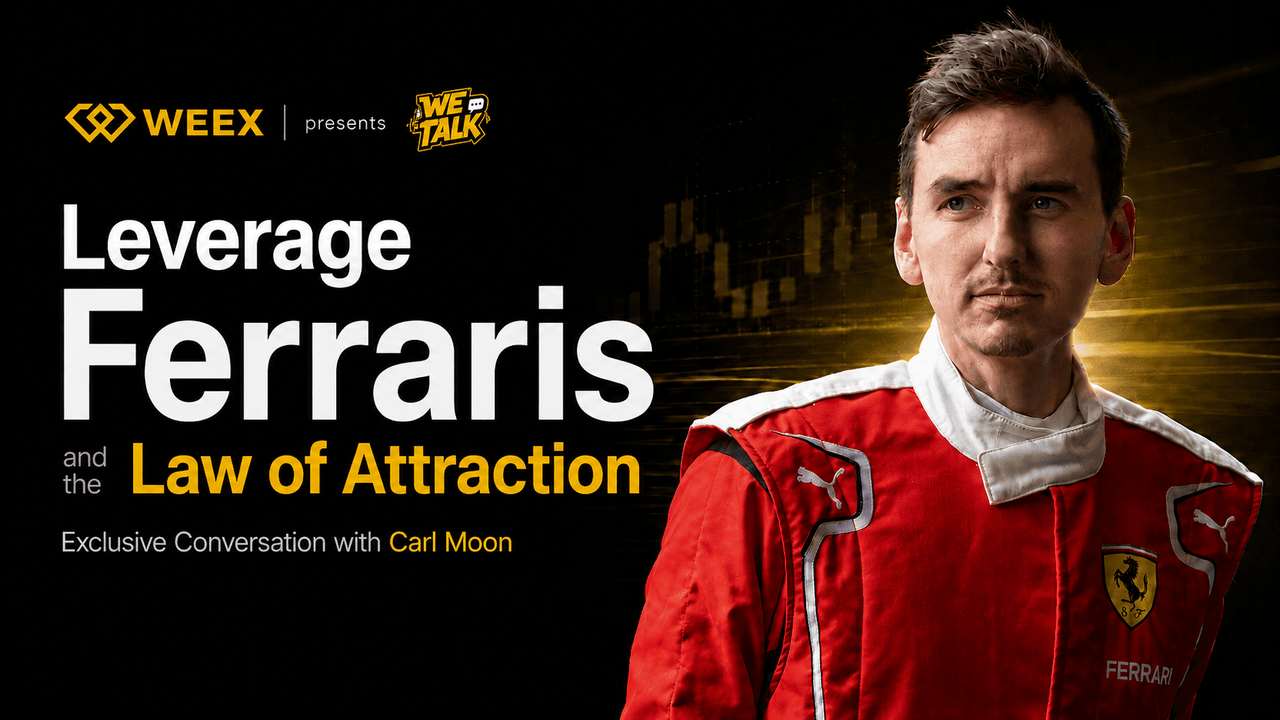
Leverage, Ferraris, and the Law of Attraction: Carl Moon’s "First Life" | WE TALK by WEEX
From a supermarket clerk in Northern Europe to a trader, racer, and musician who dictates his own destiny, Carl Moon’s story isn’t a simple get-rich-quick fantasy. It’s a long-term, self-driven game of goals, discipline, and risk control.
Kimi's Parent Company Moonlight Dark Side Launches Hong Kong IPO with Valuation of $50 Billion
What is 'Red September'? The Bitcoin Curse and Why Wall Street Can't Escape It

Hugging Face Founder Hopes Everyone Can Train Robots in the Future
A New Study Refutes the 'Bank Collapse Theory' in the Crypto Circle
U.S. Treasury Becomes a 'Shadow Central Bank', Eroding the Independence of Federal Reserve Monetary Policy

An AI Training Data Startup Just Became Y Combinator's Fastest-Ever Unicorn

Sam Price: The Impact of the Dollar on the Crypto Market

Magalu on Mercado Livre: What the Partnership Reveals About E-commerce
Wholesale Dollar Falls but Remains Above $1.510 as Market Anticipates Greater Pressures
The Best Decentralized AI Platforms in 2026
U.S. Treasury Market Trapped in Triple Storm of Inflation, Tightening, and Supply as Yields Surpass 4.8%

AI Security Becomes Billion-Dollar Market, Attracts $100 Million
Weak ADP and Rising Treasuries: What Changes for Investors

Injective Experiences $4.9 Million Attack, No New Blocks Produced for 4 Hours

Stripe's Bridge Acquisition: Stablecoin Volumes Quadrupled
Wall Street Morning Brief: U.S. Treasury Sell-off Pauses, U.S. Stocks Rise, Software Stocks and Japanese Bond Auction Hide Concerns
MUFG and Progmat Begin Proof-of-Concept for Tokenized Investment Trusts in Real Environment
How Uniswap's Fee Switch Redefined Revenue
Current Status Ahead of Litecoin's Next Halving
Jobs, Warsh, and the FedWatch Reversal: What Comes Next for Bitcoin?
Kevin Warsh’s hawkish Jackson Hole speech has flipped the market’s September Fed expectations from “hold” toward a possible rate hike. With the August jobs report, CPI, and the FOMC decision arriving in quick succession, Bitcoin is entering a two-week macro stress test.
No Need to Switch Platforms or Move Funds: BiFu Allows Crypto Traders to Trade Gold and Forex Directly