
- Buy Crypto
- Markets
 Futures
- Spot
- Copy Trade
- Earn
- More
On-Chain Data School (Part 6): A Brand New, Ark-Participated BTC Magical Pricing Methodology (I)

Original Title: "On-chain Data Academy (Part 6): A Brand New, Ark-Participated $BTC Magical Pricing Methodology (I)"
Original Author: Mr. Berg, On-chain Data Analyst
Cointime Price has advanced significantly compared to the previous five articles. If this is your first time reading this series of articles and you want to learn about on-chain knowledge, it is recommended to start by reading the first five articles.
Related Reading: "On-chain Data Academy (Part 5): How Many People Are Really Making Money? A Five-Minute Guide to the Objective Sentiment Index PSIP"
Reading a long article is not easy. Readers are advised to first select the content of interest based on the major headings.
If you want to directly understand the application part, you can read the second and third parts first.
TLDR
- The Cointime Price series consists of three articles, and this article is the first one.
- Introducing the basic principles and buy-the-dip application of Cointime Price
- Cointime Price is a new and efficient $BTC pricing method
- It is stricter than Realized Price and more sensitive than LTH-RP
1. Introduction to Cointime Price
The concept of Cointime Price originated on August 23, 2023, proposed by "Cointime Economics," a collaboration between Ark Invest and Glassnode.
The calculation logic of Cointime Price is relatively complex, and this article will try to explain the principle in a simple and clear manner.
Cointime Price = Pricing Model Designed for the Unique UTXO Structure of $BTC
In traditional pricing methods, when BTC, as a blockchain network, is involved in block creation or transaction transfers, it goes through a validation process. However, Cointime Price differs from traditional pricing methods by using a "time-weighted" calculation approach.
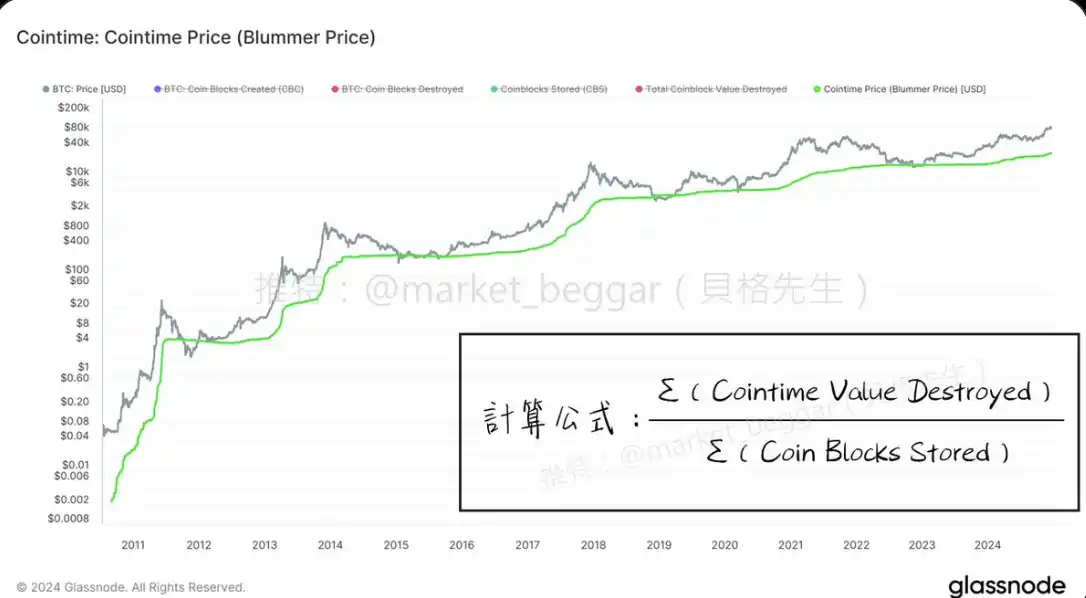
Cointime Price Calculation Logic (as shown in Figure 2, where the green line represents Cointime Price)
The Cointime Price calculation involves three key concepts:
· Coin Blocks Created (CBC):
CBC = The total circulating BTC supply when Block N is generated.
· Coin Blocks Destroyed (CBD):
When BTC is transferred, it is considered destroyed. The calculation is as follows: Transferred BTC amount × Holding time (number of blocks elapsed). This yields CBD (time-weighted BTC amount).
· Coin Blocks Stored (CBS):
CBS = CBC - CBD, which can be understood as the "total time-weighted BTC amount unspent."
In the formula calculation, the numerator's Cointime Value Destroyed is obtained by multiplying CBD by the BTC price at the time of transfer, resulting in the "BTC spent U-value at the time of transaction."
· Key Features of Cointime Price
· Time-weighted design: When long-term holders transfer large amounts of BTC (distribute), the Cointime Price change rate will accelerate.
· Buyer's perspective analysis: The numerator in the formula represents the "total time-weighted spending amount" in the market. Dividing it by CBS yields the market's time-weighted average cost of chips.
· Excluding lost chip impact: Since CBD calculates transfer behavior, BTC that has not been transferred is not counted, so it is not affected by ancient lost BTC.
II. Comparison with LTH-RP
In a previous article, I introduced LTH-RP (Long-Term Holder's Average Holding Cost). Readers interested in this topic can refer to the following post: [Introduction to LTH-RP](https://x.com/market_beggar/status/1864600434129948724)
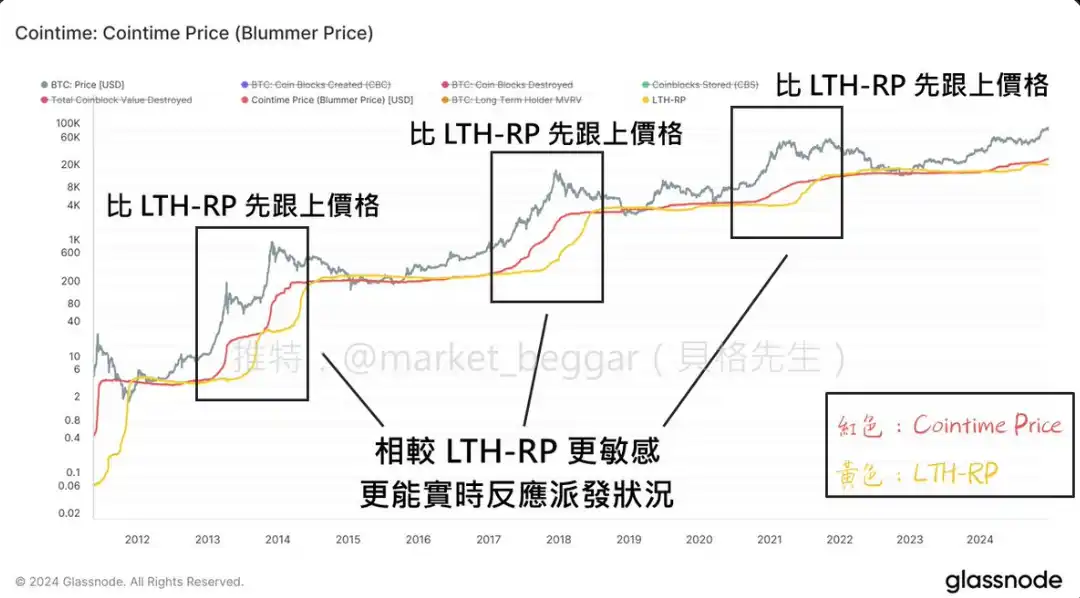
LTH-RP vs. Cointime Price
· Calculation Method of LTH-RP:
- Glassnode defines LTH as BTC held for>155 days
- LTH-RP = Average cost of these LTH BTC
- Limitation: Only for long-term holders, relatively rough definition.
· Calculation Method of Cointime Price:
- Considers the holding time each time BTC is transferred
- More precise and sensitive than LTH-RP
Performance of Cointime Price vs. LTH-RP in Market Trends
As shown in Chart Three, before each market uptrend, Cointime Price always reacts earlier than LTH-RP, better reflecting the real-time occurrence of supply distribution behavior.
Therefore, in my personal analysis, I tend to use Cointime Price for market judgment. The peak model I designed in my weekly market report also includes the Cointime Price indicator.
Application One: Bottom Fishing
Cointime Price = Time-weighted fair valuation of BTC, so when the market price falls below the Cointime Price, it means the market price is below the true value of BTC, usually a good bottom fishing opportunity.
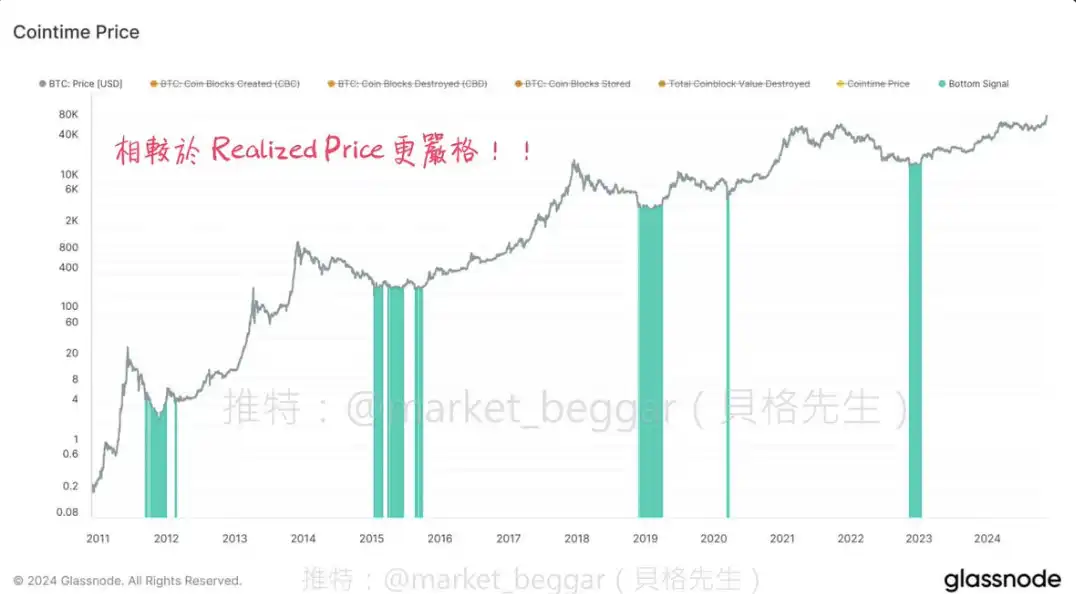
· Historical Data Validation
As shown in Chart Four, I marked the times when the BTC price was below the Cointime Price, and these moments were often good entry points.
Conclusion
This article is the first in the Cointime Price series, introducing the basic concept of Cointime Price and its bottom fishing application.
The next two articles will focus on the application of Cointime Price in Rug Pull scenarios, stay tuned
You may also like

Social Capital CEO: How Equity Tokenization is Reshaping Capital Markets from US Stocks to SpaceX?

CoinGecko Report: Surge of 346% vs Dip of 20.8%, The Wild Rise of DEX

a16z: The Real Opportunity of Stablecoins Lies Not in Disruption but in Filling Gaps

Mining Exodus: Someone Holds $12.8 Billion AI Order

March 6 Market Key Intelligence, How Much Did You Miss?

a16z: The True Opportunity of Stablecoins is in Complementing, Not Disrupting

Predict LALIGA Matches, Shoot Daily & Win BTC, USDT and WXT on WEEX
The WEEX × LALIGA campaign brought together football excitement and crypto participation through a dynamic interactive experience. During the event, users predicted matches, completed trading tasks, and took daily shots to compete for rewards including BTC, USDT, WXT, and exclusive prizes.

Ray Dalio Dialogue: Why I'm Betting on Gold and Not Bitcoin

Who Took the Money in the AI Era? A Must-See Investment Checklist for HALO Asset Trading
Wall Street Bears Target Ethereum: Vitalik In the Know Takes Flight, Tom Lee Remains Bullish
Pump.fun Hacker Steals $2 Million, Receives 6-Year Prison Sentence, Opts for 'Self-Detonation'

6% Annual Percentage Yield as Musk Declares War on Traditional Banks
36 years, 4 wars, 1 script: How does capital price the world in conflict?

Mining Companies' Great Migration: Some Have Already Secured $12.8 Billion in AI Orders
What Is Vibe Coding? How AI Is Changing Web3 & Crypto Development
What is vibe coding? Learn how AI coding tools are lowering the barrier to Web3 development and enabling anyone to build crypto applications.
The parent company of the New York Stock Exchange strategically invests in OKX: The intentions behind the $25 billion valuation

WEEX P2P update: Country/region restrictions for ad posting
To improve ad security and matching accuracy, WEEX P2P now allows advertisers to restrict who can trade with their ads based on country or region. Advertisers can select preferred counterparty locations for a safer, smoother trading experience.
I. Overview
When publishing P2P ads, advertisers can now set the following:
Allow only counterparties from selected countries or regions to trade with your ads.
With this feature, you can:
Target specific user groups more precisely.Reduce cross-region trading risks.Improve order matching quality.
II. Applicable scenarios
The following are some common scenarios:
Restrict payment methods: Limit orders to users in your country using supported local banks or wallets.Risk control: Avoid trading with users from high-risk regions.Operational strategy: Tailor ads to specific markets.
III. How to get started
On the ad posting page, find "Trading requirements":
Select "Trade with users from selected countries or regions only".Then select the countries or regions to add to the allowlist.Use the search box to quickly find a country or region.Once your settings are complete, submit the ad to apply the restrictions.
When an advertiser enables the "Country/Region Restriction" feature, users who do not meet the criteria will be blocked when placing an order and will see the following prompt:
If you encounter this issue when placing an order as a regular user, try the following solutions.
Choose another ad: Select ads that do not restrict your country/region, or ads that allow users from your location.Show local ads only: Prioritize ads available in the same country as your identity verification.
IV. Benefits
Compared with ads without country/region restrictions, this feature provides the following improvements.
Aspect
Improvement
Trading security
Reduces abnormal orders and fraud risk
Conversion efficiency
Matches ads with more relevant users
Order completion rate
Reduces failures caused by incompatible payment methods
V. FAQ
Q1: Why are some users not able to place orders on my ad?
A1: Their country or region may not be included in your allowlist.
Q2: Can I select multiple countries or regions when setting the restriction?
A2: Yes, multiple selections are supported.
Q3: Can I edit my published ads?
A3: Yes. You can edit your ad in the "My Ads" list. Changes will take effect immediately after saving.



 App
App