
- Buy Crypto
- Markets
 Futures
- Spot
- Copy Trade
- Earn
- More
Please have all trading platforms immediately cease promoting contract trial funding behavior to college students

Recently, ETHPanda and LXDAO co-founder Brucexu.eth revealed on social media that some cryptocurrency exchanges are offering so-called "Contract Experience Funds" to college students. This type of fund cannot be withdrawn directly; however, any profits made belong to the student. If there is a loss, there is no need to repay the fund, and sharing high returns on social media can even earn additional rewards.
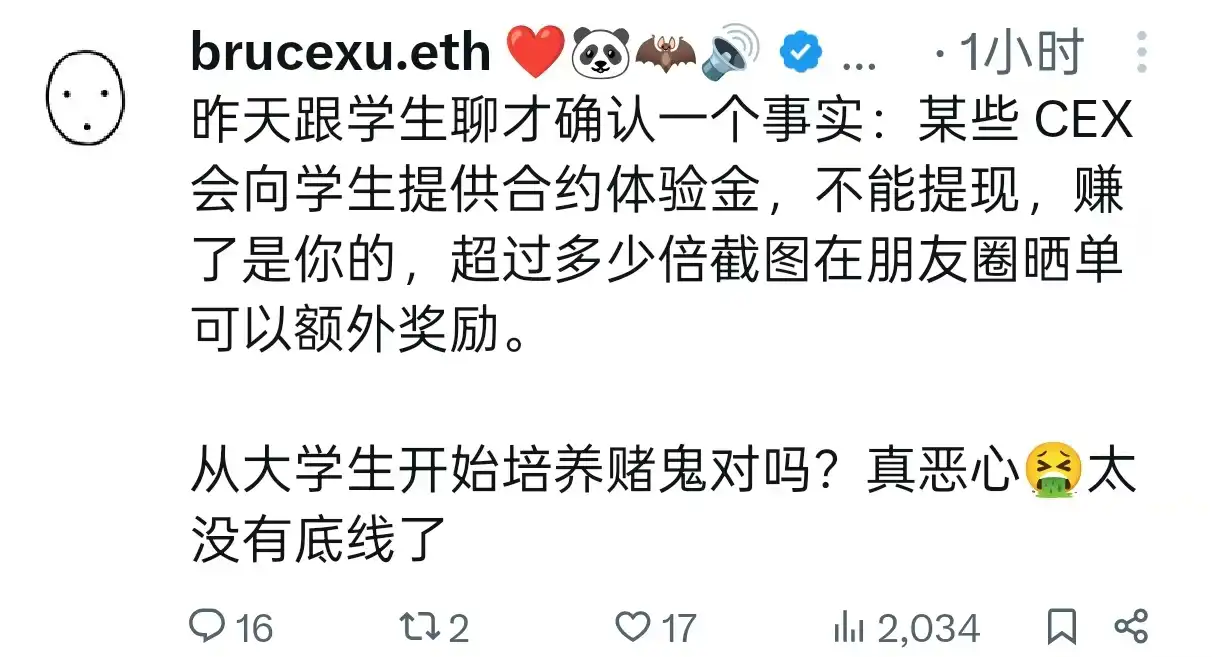
From providing the principal amount to leveraging incentives, and then to social splitting, this entire process is precisely targeting college students for harvesting. This behavior is essentially not about spreading contract knowledge or educating users but rather a gambling inducement disguised as "financial enlightenment," effectively preying on college students with weak risk awareness and inadequate fund management.
Even though the overall cryptocurrency trading platforms are facing a user growth bottleneck, this does not mean that targeting college students for business expansion is acceptable. Such behavior not only poses regulatory risks but also has a long-term negative impact on the industry's image.
High-Risk Financial Instruments Should Not Target College Students
After the integration of technology and finance, the "precise inducement" of young people has become a nearly global issue. Whether it is the structurally designed over-borrowing inducement in the U.S. student loan system or the proliferation of high-interest loans for young people in Internet financial products in Indonesia, the Philippines, and other countries, countless young people worldwide are trapped in debt.
In 2015, just as mobile payments were on the rise in China, consumerism among young people was quietly spreading. At the same time, a group of "Internet finance companies" represented by Qufenqi, Fenqile, and Aiyomi, under the guise of "advance consumption and credit growth," vigorously entered universities.
Qufenqi was the most representative player, penetrating campuses through offline promotion teams and collaborating with mobile phones, computers, and cosmetic vendors to hold "campus sales events" to attract students to use their platform for installment purchases. With just an ID card and student ID, one could "freeload" an iPhone with a monthly payment of less than 300 yuan.
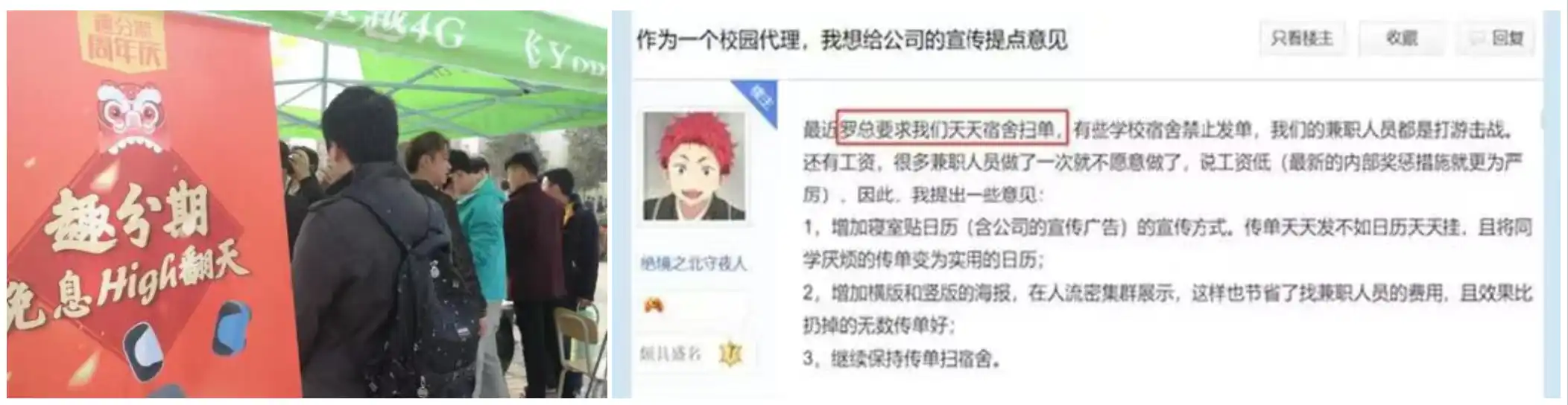
However, the frenzy of this "financial innovation" soon revealed its fangs. Issues such as opaque interest rates, high fees, and unreasonable repayment dates quickly pushed many students into the debt trap of advance consumption. To repay their debts, many students were forced to borrow from different platforms and create a snowball effect of debt.
Even worse, as the difficulty of collection increased, some platforms or underground collection organizations evolved extreme and oppressive methods such as "naked loans," demanding that female students provide indecent photos as "collateral," threatening to expose them if they default. When this event was exposed by the media, it caused shock in Chinese society.

From an ethical standpoint, this trend has completely crossed society's bottom line. Once a hot commodity, FunPay, even in later attempts to transform into a "installment e-commerce platform" and a "B2B financial technology service provider," still carried the label of "campus loan initiator" and faced widespread resistance.
FunPay, later renamed Qudian, launched an auto finance project in 2018, aiming to provide young people with car installment services through a "lease-to-own" model. It also faced resistance. In 2022, Qudian's founder, Luo Min, made a high-profile announcement to enter the market for pre-packaged meals and promoted it through platforms like Douyin (TikTok). However, due to its "campus loan" history attracting public scrutiny, Chinese celebrities who had partnerships with Qudian, such as Jia Nailiang and Fu Seoul, have distanced themselves.
This is a memory of an era and also a painful lesson. There was no clear regulation at that time, no one stood up to stop it, until millions of families paid the price, finally bringing it to an end.
Now, in the cryptocurrency field, contract experience funds are openly promoted to college students, which seems to be the beginning of another disaster—it's not using high-interest loans but rather cultivating a more secretive and harder-to-detect gambling addiction.
Contracts Are Neutral, But Greed Should Not Target Campuses
During this cycle, college students briefly became the focus of Web3 discourse, and many projects and VCs tended to recruit hardworking, eager-to-learn college students as interns. Even crypto exchanges launched campus ambassador referral programs, where students could apply to join and earn commission rewards for referring active users and receive benefits like job opportunities. However, shortly after the launch of this program, it was suspended due to community backlash, and the official platform no longer features this activity.
Today, some exchanges have escalated by directly using contract vouchers to lure college students into "joining the game." Compared to the campus loans of the past, this round of cryptocurrency contract promotion has not even touched basic regulatory red lines.
Many centralized exchanges have servers distributed across various countries, filled with disclaimers in their terms of service, and their employees are located globally. They often do not comply with full regulation from any single country but operate globally, especially expanding aggressively in countries and regions where financial education is not widespread.
In this vacuum, it's hard to expect short-term policies to effectively intervene. This means that public moral constraints and collective action by users are the most realistic and powerful "regulatory tools." Every user, every practitioner, should not remain silent about behaviors that lure college students into participating in contract trading.
As a financial instrument, smart contract transactions are justified, but distinctions must be made in different scenarios. The following three scenarios can be considered morally acceptable use cases:
First is risk hedging, which was the original design purpose of smart contracts. Institutions or sophisticated investors use contracts to hedge against spot price fluctuations, such as miners locking in mining rewards, traders managing position risk, etc. This is a professional practice based on clear assets and risk strategies.
Second is small-scale speculative entertainment by independent and self-responsible adults. Some individual users may use a tiny portion of their funds for short-term trading as a high-risk form of entertainment. The premise here is that they have a certain risk awareness, a complete financial safety net, and a clear understanding of the consequences they face.
Finally, there are the "gamblers" who engage in contract trading akin to visiting a casino in a two-way manner. This is the most common type of contract trading user at present—they do not hedge, do not analyze, and purely rely on gut feelings for trading. While this behavior is not encouraged, if adults are fully aware that they are "gambling," the trades they make on the platform can be seen as a "willing gamble."
However, college students are not gamblers.
They have not yet entered society, do not have sufficient income, risk awareness, or financial literacy. They should be developing their mindset on campus rather than being induced by platforms to build a leveraging logic. Any trading platform that extends its reach to college students is doing something extremely unethical.
Take Action and Pressure Centralized Exchanges (CEX)
Faced with the inducement of college students to participate in high-risk contract trading, the industry can no longer remain silent. This not only deviates from the original intention of financial technology inclusivity but also seriously damages the credibility of the entire crypto industry. Therefore, there must be clear and continuous social feedback to resist these behaviors that involve giving away demo funds, encouraging showing off gains, and guiding leverage operations.
Therefore, we must voice our refusal and draw a line through action:
We can—boycott CEX businesses conducting this type of inducement on social media platforms, refuse to register or deposit on such platforms, utilizing our absence of real money as a reminder that users are not ATMs;
We can—continuously exert public pressure on companies that are still implementing such marketing strategies;
We can—encourage industry KOLs and media personalities to publicly expose and sternly criticize these predatory tactics.
Only by doing so is it possible to pressure platforms into realizing that a regulatory gap does not equate to a moral gap, and the student population should not be the industry's recruitment breakthrough. If the industry genuinely seeks long-term development, it must first abandon growth tactics that come at the expense of destroying the future of a generation. This will not only fail to lead to industry growth or new highs in cryptocurrency prices but will further stigmatize the sector, hindering the industry's progress toward global regulatory compliance and deviating from the true vision of crypto.
This is not the first time we have seen the industry probing the boundaries of ethics. Today it's college student experience funds, tomorrow it could be "contract-based lending," or a personalized "low-value, high-frequency leverage recommendation system" tailored to newcomers to the world of cryptocurrency. There is always someone designing traps specifically for young people who have not yet developed risk awareness.
If we do not want to witness a "naked margin loan" disaster replaying in the crypto world, if we do not want to see young people being groomed into gamblers one by one, we must act from this moment on to resist this behavior. If platforms continue to turn a blind eye, we will unite more KOLs and media to continue exposing these practices until it is all put to an end.
You may also like

Wall Street Shorts ETH: Vitalik is aware and has front-run, while Tom Lee remains oblivious

Social Capital CEO: How Equity Tokenization is Reshaping Capital Markets from US Stocks to SpaceX?

CoinGecko Report: Surge of 346% vs Dip of 20.8%, The Wild Rise of DEX

a16z: The Real Opportunity of Stablecoins Lies Not in Disruption but in Filling Gaps

Mining Exodus: Someone Holds $12.8 Billion AI Order

March 6 Market Key Intelligence, How Much Did You Miss?

a16z: The True Opportunity of Stablecoins is in Complementing, Not Disrupting

Predict LALIGA Matches, Shoot Daily & Win BTC, USDT and WXT on WEEX
The WEEX × LALIGA campaign brought together football excitement and crypto participation through a dynamic interactive experience. During the event, users predicted matches, completed trading tasks, and took daily shots to compete for rewards including BTC, USDT, WXT, and exclusive prizes.

Ray Dalio Dialogue: Why I'm Betting on Gold and Not Bitcoin

Who Took the Money in the AI Era? A Must-See Investment Checklist for HALO Asset Trading
Wall Street Bears Target Ethereum: Vitalik In the Know Takes Flight, Tom Lee Remains Bullish
Pump.fun Hacker Steals $2 Million, Receives 6-Year Prison Sentence, Opts for 'Self-Detonation'

6% Annual Percentage Yield as Musk Declares War on Traditional Banks
36 years, 4 wars, 1 script: How does capital price the world in conflict?

Mining Companies' Great Migration: Some Have Already Secured $12.8 Billion in AI Orders
What Is Vibe Coding? How AI Is Changing Web3 & Crypto Development
What is vibe coding? Learn how AI coding tools are lowering the barrier to Web3 development and enabling anyone to build crypto applications.
The parent company of the New York Stock Exchange strategically invests in OKX: The intentions behind the $25 billion valuation

WEEX P2P update: Country/region restrictions for ad posting
To improve ad security and matching accuracy, WEEX P2P now allows advertisers to restrict who can trade with their ads based on country or region. Advertisers can select preferred counterparty locations for a safer, smoother trading experience.
I. Overview
When publishing P2P ads, advertisers can now set the following:
Allow only counterparties from selected countries or regions to trade with your ads.
With this feature, you can:
Target specific user groups more precisely.Reduce cross-region trading risks.Improve order matching quality.
II. Applicable scenarios
The following are some common scenarios:
Restrict payment methods: Limit orders to users in your country using supported local banks or wallets.Risk control: Avoid trading with users from high-risk regions.Operational strategy: Tailor ads to specific markets.
III. How to get started
On the ad posting page, find "Trading requirements":
Select "Trade with users from selected countries or regions only".Then select the countries or regions to add to the allowlist.Use the search box to quickly find a country or region.Once your settings are complete, submit the ad to apply the restrictions.
When an advertiser enables the "Country/Region Restriction" feature, users who do not meet the criteria will be blocked when placing an order and will see the following prompt:
If you encounter this issue when placing an order as a regular user, try the following solutions.
Choose another ad: Select ads that do not restrict your country/region, or ads that allow users from your location.Show local ads only: Prioritize ads available in the same country as your identity verification.
IV. Benefits
Compared with ads without country/region restrictions, this feature provides the following improvements.
Aspect
Improvement
Trading security
Reduces abnormal orders and fraud risk
Conversion efficiency
Matches ads with more relevant users
Order completion rate
Reduces failures caused by incompatible payment methods
V. FAQ
Q1: Why are some users not able to place orders on my ad?
A1: Their country or region may not be included in your allowlist.
Q2: Can I select multiple countries or regions when setting the restriction?
A2: Yes, multiple selections are supported.
Q3: Can I edit my published ads?
A3: Yes. You can edit your ad in the "My Ads" list. Changes will take effect immediately after saving.


 App
App