
- Buy Crypto
- Markets
 Futures
- Spot
- Copy Trade
- Earn
- More
Ray Dalio Decodes "Absurd Tariffs": This Is Just the Appetizer, Global Order Collapse Is the Main Event

Original Article Title: Don't Make the Mistake of Thinking That What's Now Happening is Mostly About Tariffs
Original Article Author: @RayDalio, Founder of Bridgewater Associates
Original Article Translation: zhouzhou, BlockBeats
Editor's Note: This article points out that the current global focus on tariffs is merely superficial, with the deeper issues revolving around the systemic breakdown of currency, politics, and geopolitical order. Global debt imbalances, domestic class divides, international hegemonic decline, frequent natural disasters, and technological disruption collectively propel the world into a major turning point. Understanding the interaction of these forces is more crucial than focusing on short-term news.
Below is the original content (slightly restructured for better readability):
Currently, everyone's attention is focused on the announced tariffs, which have indeed had a significant impact on the market and the economy, and that is understandable. However, at the same time, people rarely pay attention to the fundamental reasons that led to the imposition of these tariffs and the real issues that may cause even greater disruptions.
Let's not misunderstand—I am not saying these tariffs are unimportant; they are indeed significant events, and we all know that it was President Trump who drove these tariff policies. However, most people overlook the deeper background that got him elected as President and prompted him to take these actions.
More importantly, people are barely aware that a more profound force is driving all the changes, including tariffs—a comprehensive breakdown of the monetary system, political order, and geopolitical landscape. Such systemic breakdowns may occur only once in a lifetime, but they have indeed occurred multiple times in history, each time in similar unsustainable conditions.
More specifically:
1. The current monetary and economic order is disintegrating because the existing debt is too large, the pace of new debt is too fast, and the current capital markets and economic system rely on this unsustainable massive debt.
The root cause of this unsustainable debt lies in two huge imbalances: on one hand, debtors—countries like the United States with excessive debt burdens are continuously borrowing to sustain consumption beyond their means; on the other hand, creditors—countries like China hold too many debt assets and rely on exporting goods to these debtor nations to sustain their own economy. Various pressures are driving these imbalances to be corrected in some way, and the correction process will inevitably fundamentally alter the monetary order.
For example, in a deglobalized world, there still exists significant trade imbalance and capital imbalance, while major countries do not trust each other— the United States is concerned about other countries cutting off the supply of essential goods, and China is worried about the U.S. defaulting on debt or delaying payments— this itself is a contradiction. Both sides are in a kind of "warfare" situation, and self-reliance has become the most crucial matter. Those familiar with history know that in a similar background, this kind of risk has repeatedly led to issues similar to what we are facing now.
Therefore, that old monetary/economic order— where countries like China engage in low-cost manufacturing, export to the U.S., then use the proceeds to purchase U.S. bonds; while the U.S. borrows money to buy goods from these countries, accumulating massive debt— this model must change. This clearly unsustainable pattern further weakened the U.S. manufacturing sector, hollowed out jobs in the middle class, and made the U.S. increasingly reliant on a country it increasingly sees as an adversary. In a time of deglobalization, this imbalanced structure that highly interconnects trade and capital, in whatever form, must ultimately be reduced.
At the same time, the level of U.S. government debt and its ever-expanding speed is evidently unsustainable. (Refer to my new book "How Nations Go Bankrupt: The Big Cycle" for analysis.) Clearly, to address these imbalances and excessive expansions, the current monetary order will inevitably undergo significant, drastic changes, and we are at the early stage of this process. Its impact on the capital markets will be enormous, which will bring profound economic consequences, which I will delve into at another time.
2. At the same time, the domestic political order is also crumbling, due to the significant divides among people in education, opportunities, productivity, income and wealth, values, and the existing political system's incompetence in addressing these issues.
This situation is particularly evident in the "winner takes all" struggle between the populist forces of the left and right, vying for who will hold power and lead the country's direction. This situation is leading to the erosion of the democratic system itself because democracy requires compromise and adherence to the rule of law, and history has already shown that in times like ours, these mechanisms often fail.
History also shows that when the institutional barriers of democracy and the rule of law are removed, strong authoritarian leaders will emerge. Clearly, the current unstable political situation will also be influenced by other forces I mentioned, such as problems in the stock market and the economy often giving rise to political and geopolitical turmoil.
3. The international geopolitical order is disintegrating because the era of a dominant hegemon (namely the U.S.) setting the rules and other countries following has ended. The past multilateral, cooperative world order led by the U.S. is being replaced by a unipolar, might-makes-right new order. In this new order, the U.S. remains the world's most powerful country, but it is shifting towards a "America First" unilateral strategy. We can already see this shift manifested through U.S.-led trade wars, geopolitical conflicts, tech wars, and even regional military conflicts.
4. At the same time, the impact of natural factors (such as droughts, floods, and pandemics) is becoming increasingly severe.
5. Furthermore, the leapfrog progress in technology, especially the development of artificial intelligence, will also profoundly affect various aspects of life, including money, debt, and economic order, political order, international order (through its impact on economic and military interactions between nations), and the cost of dealing with natural disasters.
The changes in these forces and how they interact with each other are the real focus that deserves our attention.
Therefore, I strongly advise you not to be distracted by attention-grabbing but superficial news like "tariffs" and instead overlook the five deep-seated forces and their relationships – these are the true drivers of the "long wave cycle" changes. If you are distracted by these surface phenomena, you will:
1) Fail to see that behind these news events are the workings of these major forces.
2) Be unable to think deeply about how these surface events will, in turn, affect these major forces.
3) Be unable to consistently focus on this "long wave cycle" and its operational logic, which can actually tell you what is likely to happen in the future.
I also suggest you carefully consider the key relationships between these forces. For example, consider how Trump's actions on tariffs will affect the following:
1. Currency/market and economic order: It will disrupt this order;
2. Domestic political order: This could also lead to turmoil as it may weaken his domestic support base;
3. International geopolitical order: It will have impacts on many obvious levels, including financial, economic, political, and geopolitical aspects;
4. Climate issues: It will somewhat weaken the global capacity to effectively address climate change;
5. Technological development: It may have some positive effects for the U.S., such as encouraging more technology production to return to the U.S., but it could also have negative impacts, such as disrupting the capital markets that support technological development and countless other ripple effects.
As you ponder these questions, I recommend you keep in mind: everything happening now is just a contemporary manifestation of countless historical cycles. I encourage you to study how policymakers in similar historical contexts have responded in the past, thereby establishing a list of policies they might adopt, such as:
· Suspending the payment of debt interest to "hostile" countries,
· Implementing capital controls to prevent capital flight,
· Imposing a Special Tax, and so on.
Many policies that were once unimaginable may now become a reality. Therefore, we also need to learn how these policies operate.
In history, the breakdown of the monetary order, political order, and geopolitical order has often manifested in the form of economic depressions, civil wars, and world wars. After these conflicts, a new monetary and political order gradually emerges, redefining the interaction patterns within countries and internationally—until they break down again. This cyclical occurrence is a key issue that we need to deeply understand.
In my book "Principles for Dealing with the Changing World Order," I provide a detailed description of these topics, dividing the "long-term debt cycle" into six distinct stages that demonstrate how an old order transitions into a new order. The explanation is very systematic and clear, allowing you to easily compare the current situation with the typical historical evolution, thereby determining the stage we are currently in and what is most likely to happen next.
When I wrote that book and other works, I hoped (and still do) that:
1. I could help policymakers understand these deep-seated forces and make better responses based on them, thus formulating more effective policies and achieving better outcomes;
2. I could help individuals who, while unable to change policies on their own, can collectively influence the direction, better deal with these trends, and fight for better results for themselves and those they care about;
3. I could encourage smart people with different viewpoints to engage in open, rational, and in-depth discussions with me, working together to find the truth and consider how to respond.
The views expressed in this article are solely personal opinions.
You may also like

Wall Street Shorts ETH: Vitalik is aware and has front-run, while Tom Lee remains oblivious

Social Capital CEO: How Equity Tokenization is Reshaping Capital Markets from US Stocks to SpaceX?

CoinGecko Report: Surge of 346% vs Dip of 20.8%, The Wild Rise of DEX

a16z: The Real Opportunity of Stablecoins Lies Not in Disruption but in Filling Gaps

Mining Exodus: Someone Holds $12.8 Billion AI Order

March 6 Market Key Intelligence, How Much Did You Miss?

a16z: The True Opportunity of Stablecoins is in Complementing, Not Disrupting

Predict LALIGA Matches, Shoot Daily & Win BTC, USDT and WXT on WEEX
The WEEX × LALIGA campaign brought together football excitement and crypto participation through a dynamic interactive experience. During the event, users predicted matches, completed trading tasks, and took daily shots to compete for rewards including BTC, USDT, WXT, and exclusive prizes.

Ray Dalio Dialogue: Why I'm Betting on Gold and Not Bitcoin

Who Took the Money in the AI Era? A Must-See Investment Checklist for HALO Asset Trading
Wall Street Bears Target Ethereum: Vitalik In the Know Takes Flight, Tom Lee Remains Bullish
Pump.fun Hacker Steals $2 Million, Receives 6-Year Prison Sentence, Opts for 'Self-Detonation'

6% Annual Percentage Yield as Musk Declares War on Traditional Banks
36 years, 4 wars, 1 script: How does capital price the world in conflict?

Mining Companies' Great Migration: Some Have Already Secured $12.8 Billion in AI Orders
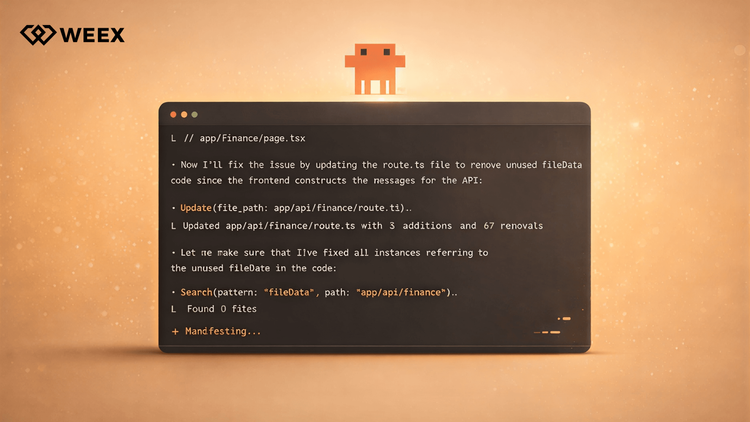
What Is Vibe Coding? How AI Is Changing Web3 & Crypto Development
What is vibe coding? Learn how AI coding tools are lowering the barrier to Web3 development and enabling anyone to build crypto applications.
The parent company of the New York Stock Exchange strategically invests in OKX: The intentions behind the $25 billion valuation

WEEX P2P update: Country/region restrictions for ad posting
To improve ad security and matching accuracy, WEEX P2P now allows advertisers to restrict who can trade with their ads based on country or region. Advertisers can select preferred counterparty locations for a safer, smoother trading experience.
I. Overview
When publishing P2P ads, advertisers can now set the following:
Allow only counterparties from selected countries or regions to trade with your ads.
With this feature, you can:
Target specific user groups more precisely.Reduce cross-region trading risks.Improve order matching quality.
II. Applicable scenarios
The following are some common scenarios:
Restrict payment methods: Limit orders to users in your country using supported local banks or wallets.Risk control: Avoid trading with users from high-risk regions.Operational strategy: Tailor ads to specific markets.
III. How to get started
On the ad posting page, find "Trading requirements":
Select "Trade with users from selected countries or regions only".Then select the countries or regions to add to the allowlist.Use the search box to quickly find a country or region.Once your settings are complete, submit the ad to apply the restrictions.
When an advertiser enables the "Country/Region Restriction" feature, users who do not meet the criteria will be blocked when placing an order and will see the following prompt:
If you encounter this issue when placing an order as a regular user, try the following solutions.
Choose another ad: Select ads that do not restrict your country/region, or ads that allow users from your location.Show local ads only: Prioritize ads available in the same country as your identity verification.
IV. Benefits
Compared with ads without country/region restrictions, this feature provides the following improvements.
Aspect
Improvement
Trading security
Reduces abnormal orders and fraud risk
Conversion efficiency
Matches ads with more relevant users
Order completion rate
Reduces failures caused by incompatible payment methods
V. FAQ
Q1: Why are some users not able to place orders on my ad?
A1: Their country or region may not be included in your allowlist.
Q2: Can I select multiple countries or regions when setting the restriction?
A2: Yes, multiple selections are supported.
Q3: Can I edit my published ads?
A3: Yes. You can edit your ad in the "My Ads" list. Changes will take effect immediately after saving.


 App
App