
- Buy Crypto
- Markets
 Futures
- Spot
- Copy Trade
- Earn
- More
Ray Dalio Deep Dive into Tariffs Impact: The Adjustment Process is Likely to Come with Severe and Unconventional Changes

Original Article Title: The Effects of Tariffs: How the Machine Works
Original Author: Ray Dalio, Founder of Bridgewater Associates
Original Translation: Deep in Motion
Editor's Note: The article systematically analyzes the multiple effects of tariffs: the basic level includes six major effects such as fiscal revenue, efficiency loss, inflation differentiation, and industry protection; the deep-level impact depends on each country's policy countermeasures, exchange rates, and the dynamic adjustment of monetary and fiscal policies. The article points out that global imbalances must be resolved through profound adjustments, and the long-term effects depend on market trust and national competitiveness. It especially discusses the debt reliance issue brought about by the U.S. dollar privilege, anticipates that the U.S. and China may reach a currency agreement through non-market means, triggering a complex policy chain reaction.
The following is the original content (reorganized for easier comprehension):
Tariffs are essentially a special type of tax, and their impact is mainly reflected in the following six fundamental aspects:
1) Revenue Generation: Shared by foreign producers and domestic consumers (the specific sharing ratio depends on the elasticity of demand on both sides), this dual tax base characteristic makes it an attractive fiscal tool
2) Efficiency Loss: Reduces global production efficiency
3) Inflation Differentiation: Creates stagflation pressures on the global economy, forms a deflationary effect on the taxed country, and exacerbates inflation in the taxing country
4) Industry Protection: Enhances the competitive strength of taxed country's enterprises in the domestic market, although it leads to efficiency loss, maintaining total demand through monetary and fiscal policies can improve business survival rates
5) Strategic Value: Key means to safeguard domestic production capacity during great power games
6) Balancing Act: Simultaneously improves the imbalance between the current account and the capital account, in simple terms, reducing reliance on foreign production capacity and capital—this is particularly crucial during global geopolitical conflicts
The above belongs to the first-level impact.
Subsequent developments depend on four major variables:
• Retaliatory measures by the taxed country
• Exchange rate fluctuations
• Monetary policy and interest rate adjustments by central banks of each country
• Fiscal policy responses by central governments
These constitute the second-level impact.
The specific transmission pathways include:
1) If retaliatory tariffs are imposed, it will lead to broader stagflation.
2) Countries under deflationary pressure usually adopt loose monetary policies, leading to a decrease in real interest rates and currency devaluation; while inflationary pressure countries tend to pursue tight policies, raising real interest rates and the currency exchange rate.
3) Fiscal policy will selectively implement stimulus in deflationary regions and contraction in inflationary regions to hedge against some price fluctuation effects.
Therefore, evaluating the market impact of large-scale tariffs needs to consider numerous dynamic factors, which have gone beyond the aforementioned six basic levels and require a comprehensive analysis combining the second-level policy feedback mechanism.
Three fundamental judgments always hold true:
1) Imbalances in production, trade, and capital (especially debt issues) must be resolved, as they are unsustainable on monetary, economic, and geopolitical dimensions—the current international order will inevitably be reshaped.
2) The adjustment process is likely to be accompanied by drastic and unconventional changes (as described in the book "This Time is Different: Eight Centuries of Financial Folly").
3) Long-term monetary, political, and geopolitical impacts ultimately depend on the credibility of debt and capital market wealth storage, the level of productivity in each country, and the attractiveness of the political system.
The current discussion about the U.S. dollar's status is worth noting:
• The advantage of the U.S. dollar as the primary reserve currency is its ability to create excess debt demand (although this privilege often leads to excessive borrowing).
• While a strong dollar is beneficial, market mechanisms will inevitably trigger privilege abuse, ultimately forcing us to take extreme measures to address debt reliance.
Of particular note, China and the U.S. may reach a yuan appreciation agreement through a summit meeting and other non-market adjustment measures, which will trigger the second-level chain reaction mentioned earlier. I will continue to monitor the developments and promptly analyze the impacts at all levels.
You may also like

Social Capital CEO: How Equity Tokenization is Reshaping Capital Markets from US Stocks to SpaceX?

CoinGecko Report: Surge of 346% vs Dip of 20.8%, The Wild Rise of DEX

a16z: The Real Opportunity of Stablecoins Lies Not in Disruption but in Filling Gaps

Mining Exodus: Someone Holds $12.8 Billion AI Order

March 6 Market Key Intelligence, How Much Did You Miss?

a16z: The True Opportunity of Stablecoins is in Complementing, Not Disrupting

Predict LALIGA Matches, Shoot Daily & Win BTC, USDT and WXT on WEEX
The WEEX × LALIGA campaign brought together football excitement and crypto participation through a dynamic interactive experience. During the event, users predicted matches, completed trading tasks, and took daily shots to compete for rewards including BTC, USDT, WXT, and exclusive prizes.

Ray Dalio Dialogue: Why I'm Betting on Gold and Not Bitcoin

Who Took the Money in the AI Era? A Must-See Investment Checklist for HALO Asset Trading
Wall Street Bears Target Ethereum: Vitalik In the Know Takes Flight, Tom Lee Remains Bullish
Pump.fun Hacker Steals $2 Million, Receives 6-Year Prison Sentence, Opts for 'Self-Detonation'

6% Annual Percentage Yield as Musk Declares War on Traditional Banks
36 years, 4 wars, 1 script: How does capital price the world in conflict?

Mining Companies' Great Migration: Some Have Already Secured $12.8 Billion in AI Orders
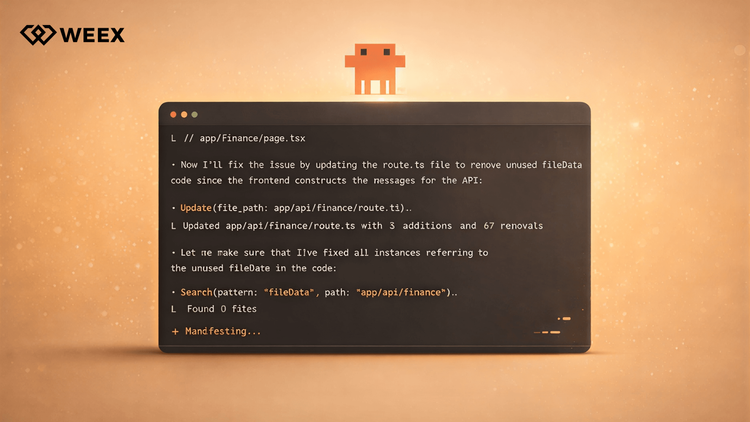
What Is Vibe Coding? How AI Is Changing Web3 & Crypto Development
What is vibe coding? Learn how AI coding tools are lowering the barrier to Web3 development and enabling anyone to build crypto applications.
The parent company of the New York Stock Exchange strategically invests in OKX: The intentions behind the $25 billion valuation

WEEX P2P update: Country/region restrictions for ad posting
To improve ad security and matching accuracy, WEEX P2P now allows advertisers to restrict who can trade with their ads based on country or region. Advertisers can select preferred counterparty locations for a safer, smoother trading experience.
I. Overview
When publishing P2P ads, advertisers can now set the following:
Allow only counterparties from selected countries or regions to trade with your ads.
With this feature, you can:
Target specific user groups more precisely.Reduce cross-region trading risks.Improve order matching quality.
II. Applicable scenarios
The following are some common scenarios:
Restrict payment methods: Limit orders to users in your country using supported local banks or wallets.Risk control: Avoid trading with users from high-risk regions.Operational strategy: Tailor ads to specific markets.
III. How to get started
On the ad posting page, find "Trading requirements":
Select "Trade with users from selected countries or regions only".Then select the countries or regions to add to the allowlist.Use the search box to quickly find a country or region.Once your settings are complete, submit the ad to apply the restrictions.
When an advertiser enables the "Country/Region Restriction" feature, users who do not meet the criteria will be blocked when placing an order and will see the following prompt:
If you encounter this issue when placing an order as a regular user, try the following solutions.
Choose another ad: Select ads that do not restrict your country/region, or ads that allow users from your location.Show local ads only: Prioritize ads available in the same country as your identity verification.
IV. Benefits
Compared with ads without country/region restrictions, this feature provides the following improvements.
Aspect
Improvement
Trading security
Reduces abnormal orders and fraud risk
Conversion efficiency
Matches ads with more relevant users
Order completion rate
Reduces failures caused by incompatible payment methods
V. FAQ
Q1: Why are some users not able to place orders on my ad?
A1: Their country or region may not be included in your allowlist.
Q2: Can I select multiple countries or regions when setting the restriction?
A2: Yes, multiple selections are supported.
Q3: Can I edit my published ads?
A3: Yes. You can edit your ad in the "My Ads" list. Changes will take effect immediately after saving.



 App
App