
- Buy Crypto
- Markets
 Futures
- Spot
- Copy Trade
- Earn
- More
Sam Altman's Latest Article: Fully Committed to AI Agent, Believing It Will Reshape the World Economy

Original Article Title: Three Observations
Original Article Author: Sam Altman
Original Article Compilation, Editing: AIGC Open Community
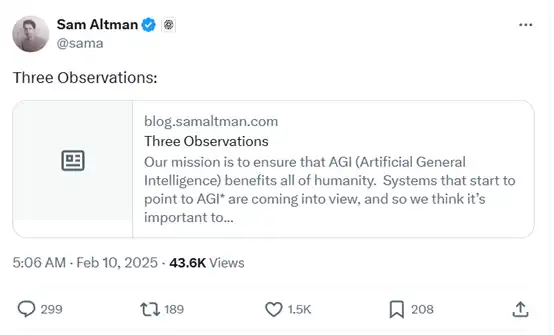
At 5 am this morning, Sam Altman, Co-Founder and CEO of OpenAI, published a deep article titled "Three Observations" on his personal blog.
The article mainly puts forward 3 observations about the AI world: the intelligence level of an AI model is roughly equal to the logarithm of the resources used to train and run it;
The cost of using AI at a specific level roughly decreases by a factor of 10 every 12 months, and lower prices lead to more usage; the societal and economic value created by linearly increasing intelligence is super-exponentially growing.
The article also emphasizes that OpenAI is fully deploying AI Agents, these thousands of intelligent entities will eventually be widely used, becoming virtual colleagues in various business scenarios. The performance of junior Agents may be somewhat lacking, but they will still permeate various fields reshaping the world economy.
The following is the original content:
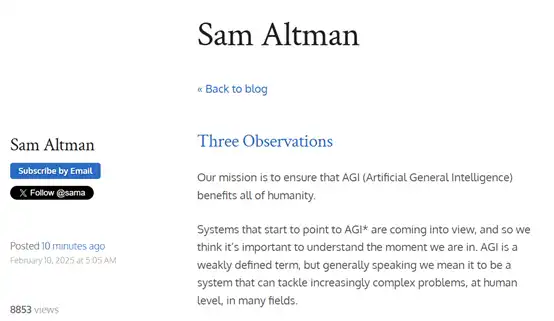
Our mission is to ensure that General AI (AGI) can benefit all of humanity.
The beginnings of systems pointing towards AGI are already visible; therefore, we feel it is necessary to understand the moment we are in. AGI is a somewhat ambiguous term, but generally, we define it as a system capable of solving increasingly complex problems at a human level across numerous domains.
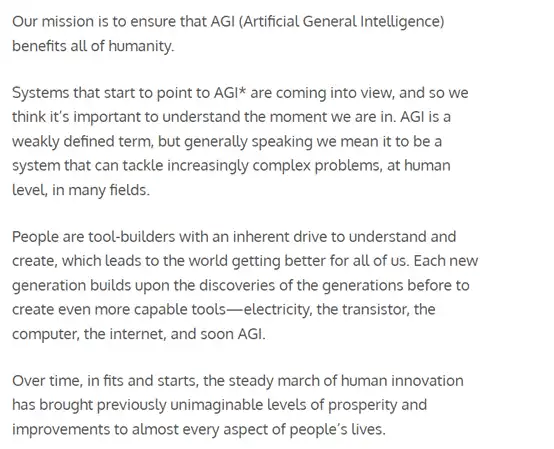
Humans are tool builders, inherently driven by exploration and creation, making the world progressively better. Each generation progresses on the discoveries of its predecessors, creating more powerful tools—electricity, transistors, computers, the internet, and the upcoming AGI.
In a sense, AGI is just another tool in the progression ladder collectively built by humans. But in another sense, the emergence of AGI marks a whole new beginning, making it hard not to feel like "this time it really is different." The economic growth in front of us looks astounding, and we can even envision a world that can cure all diseases, give people more time with family, and unleash creativity to its fullest.
Perhaps within a decade, everyone on Earth will have capabilities exceeding those of today's most influential people.
We continue to witness rapid progress in AI development. Here are three observations about the AI economy:
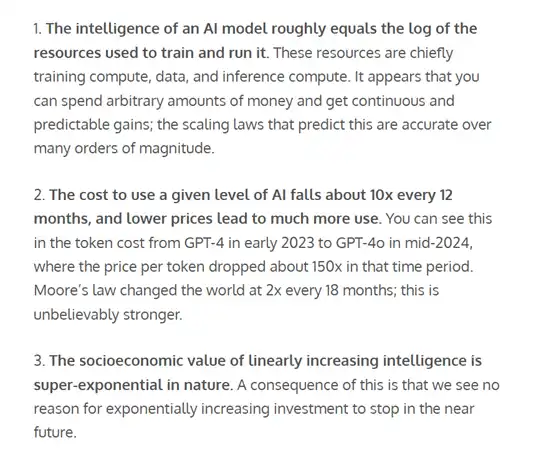
1. The intelligence level of an AI model is roughly equal to the logarithm of the resources used to train and run it. These resources mainly include training computational power, data, and inference computational power. It seems that as long as you are willing to invest any amount of funds, you can achieve continuous and predictable returns. The law of the scale of these returns is accurate across multiple orders of magnitude.
2. The cost of using AI at a certain level decreases by approximately 10 times every 12 months, and lower prices lead to more usage. You can see this in the token cost change from early 2023's GPT-4 to mid-2024's GPT-4o, where the price per token decreased by about 150 times over this year and a half.
Moore's Law doubled performance every 18 months, changing the world; however, the rate at which AI costs are dropping is even more incredible.
3. The socioeconomic value created by linear growth in intelligence is super-exponentially increasing. This result suggests that there is no immediate reason to expect that investment in exponential growth will stop in the near term.
If these three observations continue to hold true, their impact on society will be enormous.
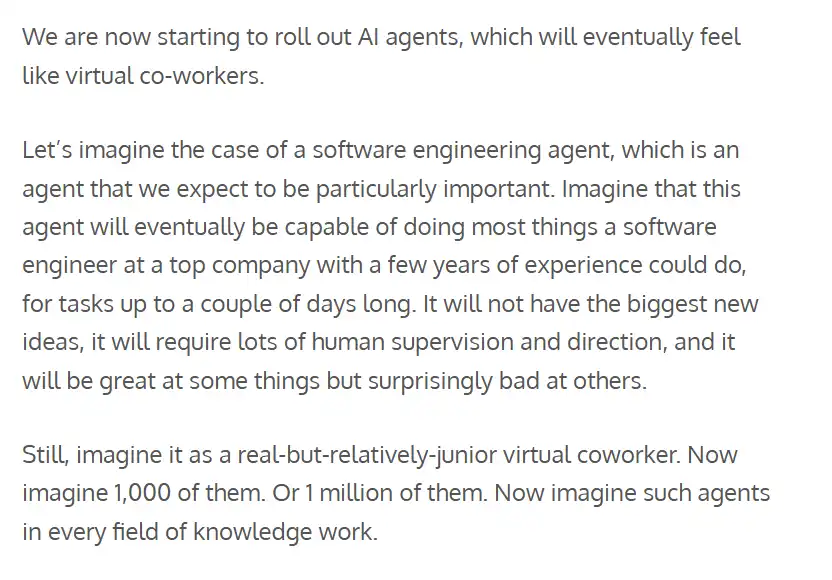
We are now introducing AI Agents that will eventually be widely used like virtual colleagues.
Let's take the example of a software engineering Agent, which we consider particularly important. Imagine that this Agent can eventually perform tasks most senior company software engineers with several years of experience can accomplish (tasks that can take up to several days). It may not come up with the greatest new ideas, requires significant human supervision and guidance, and excels in some aspects while may perform poorly in others.
But still, it can be envisioned as a real yet relatively junior virtual colleague. Now imagine having 1000 of such Agents. Or 1 million. Then imagine having such Agents in every knowledge work domain.
In a sense, AI may be economically similar to the transistor—a significant scientific discovery that can be massively scaled and permeate into every corner of the economy. We may not focus too much on transistors or transistor companies, but we will expect our computers, TVs, cars, toys, etc., to perform miraculous feats.
The world will not change overnight, it never has. In the short term, life will still be largely the same, with people in 2025 spending most of their time much like they did in 2024. We will still fall in love, start families, argue online, go hiking, etc.
But the future will come at us in an undeniable way, with massive long-term societal and economic changes. We will find new things to do, new ways to help each other, and new forms of competition, but these may be very different from today's jobs.
Autonomy, volition, and determination may become extremely important. Making the right decisions about what to do and how to navigate a changing world will be of immense value; resilience and adaptability will be skills worth cultivating. AGI will be the most potent lever of human intent, enabling individuals to have a greater impact than ever before, rather than a lesser one.
We expect the impact of AGI to be uneven. While some industries might see little change, scientific progress may accelerate beyond today, with this AGI impact outweighing everything else.
The prices of many goods may ultimately plummet (currently, cognitive and energy costs limit many things), while luxury goods and some inherently scarce resources (like land) may see more dramatic price increases.
From a technological standpoint, the path forward seems fairly clear. However, public policy and collective opinion are critical in how AGI is integrated into society. One reason we're launching products early is to give society and tech time to co-evolve.
AI will permeate every sector of the economy and society, with everything expected to become smarter. Many anticipate the need to afford people more control over tech than ever before, including more open sourcing, and accepting the need to balance security with personal empowerment.
While we never want to act recklessly, and there may be some unwelcome significant decisions and constraints related to AGI safety, directionally, as we get closer to AGI, we believe a trend toward more individual empowerment is critical. Another possible road we can see is AI being used by authoritarian governments to control their populations through extensive surveillance and autonomy deprivation.
Ensuring broad distribution of the benefits of AGI is crucial. Historical impacts of technological progress suggest that most of the metrics we care about (health outcomes, economic prosperity, etc.) tend to improve on average and in the long run, but increasing equality does not seem to be technology-driven, and achieving this properly may require new ideas.
In particular, the power balance between capital and labor may be disrupted, which may require early intervention. We are open to some seemingly strange ideas, such as allocating a certain "computational budget" to every person on Earth so they can harness significant AI capabilities. However, we can also see many ways to achieve the desired effects through continuously lowering the cost of intelligence.
By 2035, everyone should be able to access intelligence capabilities equivalent to the total intelligence of all people in 2025; everyone should be able to access unlimited wisdom and leverage it in any way they can imagine. Today, many talented individuals around the world do not have sufficient resources to fully express themselves. If we can change this, the world will create tremendous value, bringing enormous benefits to all of us.
You may also like

AI within artillery range
“The cloud” is a metaphor, but the data center isn’t.

March 4th Market Key Intelligence, How Much Did You Miss?

Taking Stock of Crypto's Washington Power Players: Who is Advocating for US Crypto Regulation?

DDC Enterprise Limited Announces 2025 Unaudited Preliminary Financial Performance: Record Revenue Achieved, Bitcoin Treasury Grows to 2183 Coins
On March 4, 2026, DDC Enterprise Limited (NYSE American: DDC) today announced preliminary, unaudited full-year financial performance for the year ended December 31, 2025. The company expects to achieve record revenue and record positive adjusted EBITDA, primarily driven by continued growth in its core consumer food business and overall margin improvement. The final audited financial report is expected to be released in mid-April 2026.
Revenue: Expected to be between $39 million and $41 million, reaching a new company high.
Organic Growth: Excluding the impact of the company's strategic contraction of its U.S. operations, core revenue is expected to grow 11% to 17% year over year.
Gross Profit Margin: Expected to be between 28% and 30%, reflecting continued operational efficiency improvements.
Adjusted EBITDA: The company expects to achieve a positive full-year result in 2025, a significant improvement from a $3.5 million loss in 2024, mainly due to rigorous cost controls and a higher-margin sales mix.
In 2025, DDC's core consumer food business maintained strong operational performance.
The company also disclosed Core Consumer Food Business Adjusted EBITDA, a metric that further excludes costs related to its Bitcoin reserve strategy and non-cash fair value adjustments related to its Bitcoin holdings from adjusted EBITDA to more accurately reflect the core business performance.
In 2025, Core Consumer Food Business Adjusted EBITDA is expected to be between $5.5 million and $6 million.
In the first half of 2025, DDC initiated a long-term Bitcoin accumulation strategy, holding Bitcoin as its primary reserve asset.
As of December 31, 2025: The company holds 1,183 BTC.
As of February 28, 2026: Holdings increased to 2,118 BTC
Today's additional purchase of 65 BTC brings the company's total holdings to 2,183 BTC
DDC Founder, Chairman, and CEO Norma Chu stated, "We are proud to have closed 2025 with record revenue and positive adjusted EBITDA, demonstrating the steady growth of the company's consumer food business and the ongoing improvement in profitability. We are building a disciplined, growth-oriented food platform and strategically allocating capital to Bitcoin assets with a long-term view, aligning with our core beliefs. We believe that this dual-track model of 'Steady Consumer Business + Strategic Bitcoin Reserve' will help DDC create lasting long-term value for shareholders."
For the full year 2025, the company defines "Adjusted EBITDA" (a non-GAAP financial measure) as: Net income / (loss) excluding the following items:· Interest expense· Taxes· Foreign exchange gains/losses· Long-lived asset impairment· Depreciation and amortization· Non-cash fair value changes related to financial instruments (including Bitcoin holdings)· Stock-based compensation
DDC Enterprise Limited (NYSE: DDC) is actively implementing its corporate Bitcoin Treasury strategy while continuing to strengthen its position as a leading global Asian food platform.
The company has established Bitcoin as a core reserve asset and is executing a prudent, long-oriented accumulation strategy. While expanding its portfolio of food brands, DDC is gradually becoming one of the public company pioneers in integrating Bitcoin into its corporate financial architecture.

Uncovering YZi Labs 229 Investment: Over 18% of the portfolio is already inactive, with an average project transparency score of 78

The business of crypto VC is becoming promising

China's AI Compute Power Counterstrike

Global Assets Plunge: Hormuz, Chips, and a South Korean Holiday

Bloomberg has reported twice, Hyperliquid once again in Wall Street's radar

Trump Backs Crypto Bill, SEC Halts Leveraged ETF, What Is the English-Speaking Crypto Community Talking About?

OpenClaw Floods Into Polymarket, Some Making Tens of Thousands Per Month
Understanding Trump's "Warfare Playbook": Ten Signals Investors Must Know

Iranian Missile Heading Toward UAE, Claude Also Within Range
Successive Core Team "Heroes" Depart, Has Aave's DAO Dream Crumbled?

Is This the Year of the Robot? A Deep Dive into Robotics Projects
When AI Takes Over Money: Bitcoin Becomes the "First Choice," Fiat Is Left Out

AI Trading in Live Markets: 4 Lessons From a WEEX Hackathon Top 10 Finalist
AI trading meets real markets. Explore 4 lessons from a WEEX Hackathon Top 10 finalist on surviving volatility, trusting AI models, and building smarter crypto trading systems.

MegaETH Co-founder: 48 Hours After Leaving Dubai, I Reassessed the Entire Crypto Space
AI within artillery range
“The cloud” is a metaphor, but the data center isn’t.
March 4th Market Key Intelligence, How Much Did You Miss?
Taking Stock of Crypto's Washington Power Players: Who is Advocating for US Crypto Regulation?
DDC Enterprise Limited Announces 2025 Unaudited Preliminary Financial Performance: Record Revenue Achieved, Bitcoin Treasury Grows to 2183 Coins
On March 4, 2026, DDC Enterprise Limited (NYSE American: DDC) today announced preliminary, unaudited full-year financial performance for the year ended December 31, 2025. The company expects to achieve record revenue and record positive adjusted EBITDA, primarily driven by continued growth in its core consumer food business and overall margin improvement. The final audited financial report is expected to be released in mid-April 2026.
Revenue: Expected to be between $39 million and $41 million, reaching a new company high.
Organic Growth: Excluding the impact of the company's strategic contraction of its U.S. operations, core revenue is expected to grow 11% to 17% year over year.
Gross Profit Margin: Expected to be between 28% and 30%, reflecting continued operational efficiency improvements.
Adjusted EBITDA: The company expects to achieve a positive full-year result in 2025, a significant improvement from a $3.5 million loss in 2024, mainly due to rigorous cost controls and a higher-margin sales mix.
In 2025, DDC's core consumer food business maintained strong operational performance.
The company also disclosed Core Consumer Food Business Adjusted EBITDA, a metric that further excludes costs related to its Bitcoin reserve strategy and non-cash fair value adjustments related to its Bitcoin holdings from adjusted EBITDA to more accurately reflect the core business performance.
In 2025, Core Consumer Food Business Adjusted EBITDA is expected to be between $5.5 million and $6 million.
In the first half of 2025, DDC initiated a long-term Bitcoin accumulation strategy, holding Bitcoin as its primary reserve asset.
As of December 31, 2025: The company holds 1,183 BTC.
As of February 28, 2026: Holdings increased to 2,118 BTC
Today's additional purchase of 65 BTC brings the company's total holdings to 2,183 BTC
DDC Founder, Chairman, and CEO Norma Chu stated, "We are proud to have closed 2025 with record revenue and positive adjusted EBITDA, demonstrating the steady growth of the company's consumer food business and the ongoing improvement in profitability. We are building a disciplined, growth-oriented food platform and strategically allocating capital to Bitcoin assets with a long-term view, aligning with our core beliefs. We believe that this dual-track model of 'Steady Consumer Business + Strategic Bitcoin Reserve' will help DDC create lasting long-term value for shareholders."
For the full year 2025, the company defines "Adjusted EBITDA" (a non-GAAP financial measure) as: Net income / (loss) excluding the following items:· Interest expense· Taxes· Foreign exchange gains/losses· Long-lived asset impairment· Depreciation and amortization· Non-cash fair value changes related to financial instruments (including Bitcoin holdings)· Stock-based compensation
DDC Enterprise Limited (NYSE: DDC) is actively implementing its corporate Bitcoin Treasury strategy while continuing to strengthen its position as a leading global Asian food platform.
The company has established Bitcoin as a core reserve asset and is executing a prudent, long-oriented accumulation strategy. While expanding its portfolio of food brands, DDC is gradually becoming one of the public company pioneers in integrating Bitcoin into its corporate financial architecture.


 App
App