
South Korea clears way for courts to seize and sell Bitcoin for unpaid debts under new November rules

 Prefer us on Google


South Korea has established procedures for courts to seize and sell debtors' cryptocurrency to satisfy civil claims.
On Oct. 12, the Supreme Court promulgated Rule 3280, introducing standardized procedures for freezing, transferring, and liquidating digital assets to recover unpaid debts. The regulations take effect on Nov. 1 and cover cryptocurrencies held on exchanges and in private wallets.
One provision allows court officers to take possession of directly held crypto before debtors receive formal notice of an attachment order, potentially limiting opportunities to move assets beyond creditors' reach.
The changes come as cryptocurrency holdings increasingly feature in South Korean debt-recovery proceedings, prompting authorities to establish consistent procedures for assets that can be transferred rapidly without relying on traditional financial intermediaries.
Crypto exchanges face new obligations under debt-recovery rules
Under the framework, creditors seeking repayment from cryptocurrency held on exchanges can obtain court orders attaching a debtor's right to receive those assets.
Once an attachment order is served, the exchange or other custodian must prevent the transfer of covered assets to the debtor, who is also prohibited from disposing of the claim or receiving the cryptocurrency.
Creditors can also ask courts to compel custodians to disclose information about the targeted holdings within one week of receiving the order.
The required information includes whether the custodian recognizes the debtor's claim, the type and quantity of cryptocurrencies held, and whether other creditors have existing claims or priority rights over the assets.
The disclosure obligation applies when creditors seek it through the prescribed court procedure, giving them a means to identify assets available for repayment and potential competing claims.
For cryptocurrencies held directly by debtors, courts can prohibit transfers and order the assets delivered to an enforcement officer.
The rules permit that transfer to occur before the attachment order is formally served on the debtor. If the officer receives the cryptocurrency first, the attachment becomes effective upon receipt.
However, enforcement against self-custodied assets could remain challenging where debtors control the private keys needed to authorize transfers.
Once creditors attach cryptocurrencies, they can seek additional court orders to recover their value.
Judges may authorize transfers to creditors at court-determined valuations or direct enforcement officers to arrange sales through virtual asset service providers.
For exchange-held crypto, the rules also permit sales through the existing custodian, transfers to accounts controlled by enforcement officers, or conversion into assets that can be more easily liquidated.
Sales must use the prevailing market price on the transaction date or another appropriate valuation, introducing a defined process for assets whose prices can fluctuate sharply during enforcement proceedings.
Debtors retain the ability to appeal decisions authorizing asset transfers or sales, which take effect only after becoming final. The regulations also establish procedures for restoring assets when enforcement is withdrawn or canceled.
The Supreme Court said the amendments are intended to improve legal certainty and consistency as courts handle a growing number of cryptocurrency-related enforcement cases.
The Nov. 1 implementation will also cover proceedings already before the courts, with existing attachment and preservation orders remaining valid. Exchanges and other custodians handling those cases will need to apply the new disclosure, transfer and sale procedures once the regulations take effect.
-- Price
This content is provided for general informational purposes only and doesn't constitute financial, investment, legal, or tax advice. Any events, rewards, online promotions, or related information mentioned herein should not be considered a recommendation, solicitation, or invitation to purchase, sell, trade, or otherwise deal in any crypto assets. Crypto assets are highly volatile and may result in loss. The availability of WEEX services, products, and related events may vary by region. You are responsible for ensuring that your participation is in accordance with applicable local laws and regulations.
You may also like

Bitcoin Recovery Faces Challenges as Exchange Reserves Rise and Spot Demand Turns Negative
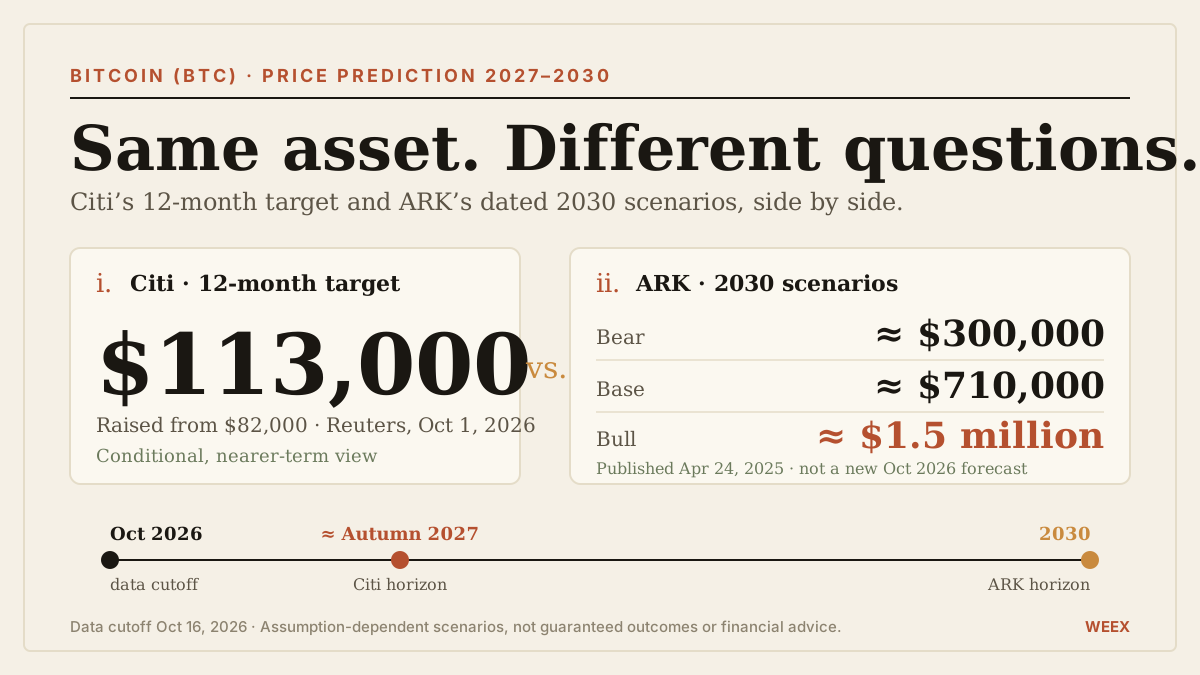
Bitcoin (BTC) Price Prediction 2027–2030: Citi’s $113,000 Target vs. Cathie Wood’s ARK Scenarios
Bitcoin price prediction for 2027–2030: compare Citi’s $113,000 target with ARK’s dated scenarios, demand assumptions, valuation math and key risks.

Mr&强 Analyzes BTC and ETH Short-Term Strategies

Bitcoin futures open interest declines, signaling weaker demand

Cathie Wood Predicts Long-Term Growth for Bitcoin Despite Dollar Strength

Peter Schiff Predicts Bitcoin Crash Over 99%
Liquidity in Cryptocurrency Market Approaches a Turning Point! Circle Aims to Enter 40 Emerging Markets

One dead, Qonto in flames, Nuñez resigns: why the streets worry crypto investors

Security Vulnerability Detected in ILITY Network, Cross-Chain Bridge Suspended

Bitcoin Spot ETF Sees Net Outflow of $229 Million Last Week, BlackRock's IBIT Leads with $165 Million Outflow

Morgan Stanley Recommends Up to 4% in Cryptocurrencies for Aggressive Portfolios

Deutsche Bank to Start Bitcoin and Ethereum Custody Within Weeks — Expansion to Asia by 2027

Bitcoin Ranges After Weekly Low Sweep| WEEX TradFi Daily(October 19, 2026)
Early on October 19, equity futures rebounded from last week’s chip selloff. Major indexes closed lower last week, the Nasdaq posted its worst week since June, the semiconductor ETF fell about 10%, and CoreWeave lost about 25%, while energy stocks were relatively resilient. Bitcoin traded near $82,000 after sweeping lows around $80,000, with markets watching the $79,800 and $83,600 zones.
WEEX Exclusive:Bitcoin Ranges After Weekly Low Sweep| WEEX TradFi Daily(October 19, 2026)

ECB: Lagarde defends rate hikes before the IMF and urges Brussels on digital euro

Sam Price Discusses Bitcoin Market Divergence

唐华斑竹 Analyzes Bitcoin Trends, Suggests Monitoring Support Levels

Saylor Envisions Bitcoin-Backed Stablecoin with Annual Yield of 6% to 8%

Strive CEO Emphasizes Going Long on Bitcoin and Short on USD, Claims Currency Depreciation is Irreversible

Bloomberg analyst warns BTC 50-week average decline may signal stock and metal downturns

Sam Price Focuses on Strategy Stock Price Drop and MSCI Index Adjustment

US Institutions See Net Inflows in Bitcoin as Demand for Dollar-Based Stablecoins Grows
Sam Price Focuses on the Hormuz Strait Tanker Incident, Crude Oil Prices Fluctuate
$4.8 Million Bitcoin Stolen from Scammer with Manipulated Ledger Wallet

Sazmining Offers Proto Hashboards at 4187 Dollars Each
Bitcoin or Dollar Returns: Same Strategy, Opposite Results
Bitcoin: AI Crash or Superabundance, Bitwise Sees Only One Winner

Bitcoin Mining Stocks Can Decline More Sharply Than Bitcoin

Crypto doesn’t need your party to win, just its candidates

Bitcoin’s Quantum Transition Won’t Stop at Bitcoin
Bitcoin Recovery Faces Challenges as Exchange Reserves Rise and Spot Demand Turns Negative
Bitcoin (BTC) Price Prediction 2027–2030: Citi’s $113,000 Target vs. Cathie Wood’s ARK Scenarios
Bitcoin price prediction for 2027–2030: compare Citi’s $113,000 target with ARK’s dated scenarios, demand assumptions, valuation math and key risks.
Mr&强 Analyzes BTC and ETH Short-Term Strategies
Bitcoin futures open interest declines, signaling weaker demand
Cathie Wood Predicts Long-Term Growth for Bitcoin Despite Dollar Strength
Peter Schiff Predicts Bitcoin Crash Over 99%
Contents
Latest articles




Latest coin listings on WEEX


