
- Buy Crypto
- Markets
 Futures
- Spot
- Copy Trade
- Earn
- More
South Korea's Crypto Exodus: Capital, Businesses, and Talent Drain

Original Title: Korea Exodus: The Migration of Capital, Talent, and Companies
Original Authors: Jay Jo, Yoon Lee, Tiger Research
Original Translation: Luffy, Foresight News
Key Points
· South Korea's cryptocurrency trading volume remains high, attracting global attention, but unclear regulation and a lack of guidance hinder industry development.
· The government prohibits opening cryptocurrency exchange real-name accounts for businesses. This restriction, coupled with a vague regulatory framework, has led to the outflow of talent, capital, and companies, weakening the competitiveness of the Web3 ecosystem.
· With the global Web3 industry poised for rapid growth under the Trump administration, South Korea must reform its regulatory policies to ensure the long-term sustainability of the industry.
1. Introduction
The inauguration of the "crypto-friendly president" Trump and the establishment of the Crypto 2.0 Task Force by the U.S. Securities and Exchange Commission (SEC) will accelerate the structural transformation of the global Web3 market. This is a key turning point. Talent, capital, and companies may migrate to countries with sound regulatory frameworks, while the outflow from jurisdictions with regulatory uncertainty will intensify.
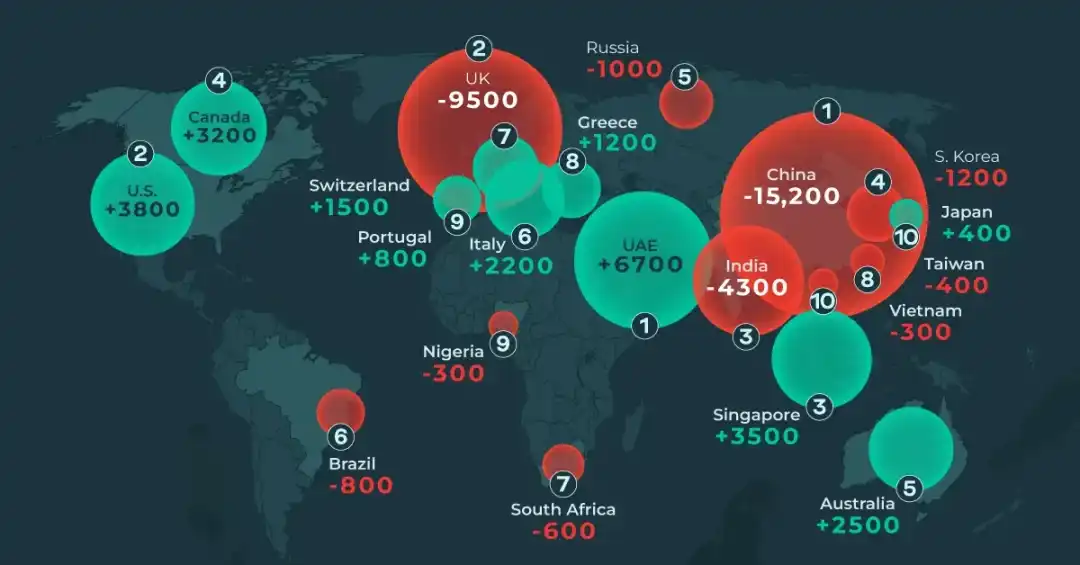
2024 Global Fund Flows, Source: Henry & Partners
South Korea is also part of this trend. The Henry & Partners' "2024 Private Wealth Migration Report" shows that South Korea leads in high-net-worth individual migration in Asia. Economic, social, and cultural factors are driving this migration wave. Although not directly related to the Web3 industry, these individuals often serve as canaries in the coal mine, signaling changes in a country's business environment.
Against this backdrop, it is crucial to reexamine South Korea's Web3 industry. This report explores the movement of capital, companies, and talent in the South Korean Web3 market, as well as the key challenges this industry must address.
2. Capital Flight: Offshore Exchanges and Accelerated On-Chain Transfers
The cryptocurrency market in Korea has been rapidly growing. With 15.6 million cryptocurrency investors holding assets worth $73 billion, the daily trading volume of cryptocurrency exchanges now rivals the combined trading volume of the Korea Composite Stock Price Index (KOSPI) and the Korea Securities Dealers Automated Quotations (KOSDAQ). This reflects Korean investors' enthusiasm for crypto assets, driven by low stock market returns and politically related unrest.
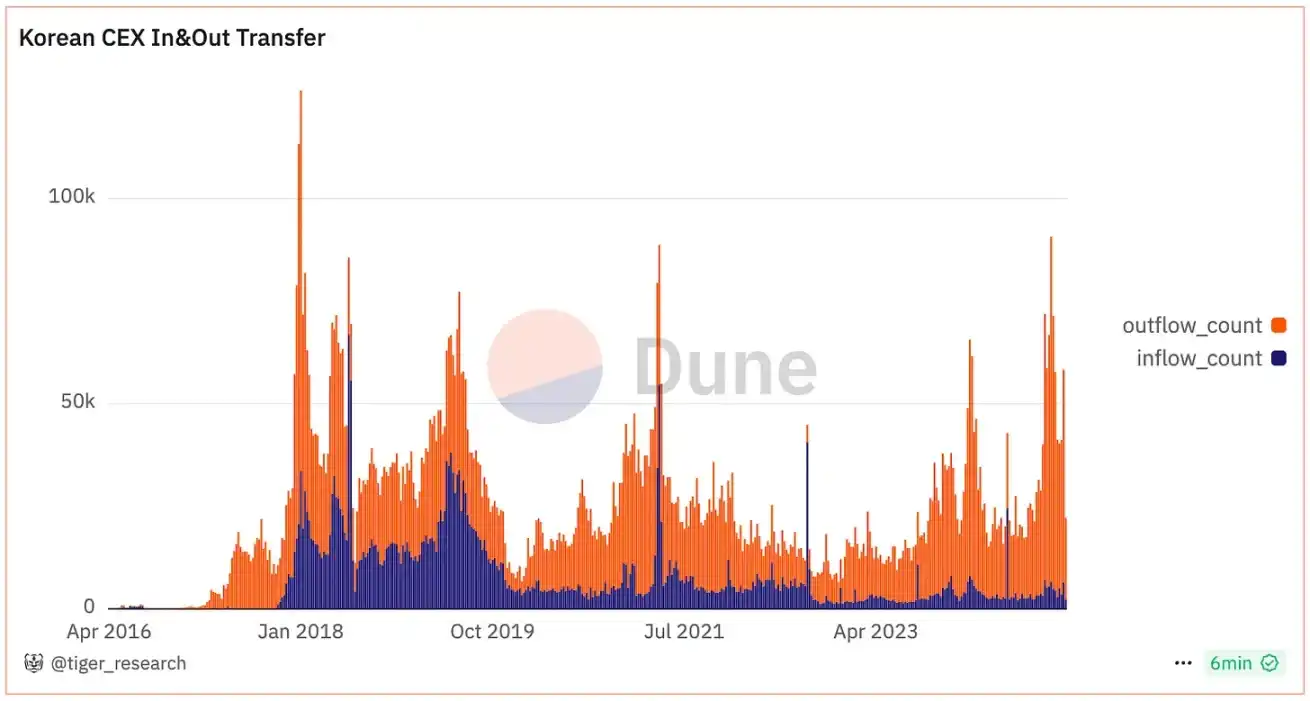
However, cryptocurrency outflows have reached concerning levels recently. During times of unrest, service disruptions at major local exchanges undermined people's trust in the stability of these platforms. Meanwhile, foreign exchanges and the diverse investment opportunities offered by decentralized finance (DeFi) have further fueled capital migration.
A survey by the Financial Services Commission of Korea in the first half of 2024 on Virtual Asset Service Providers (VASPs) revealed a 2.3-fold year-on-year increase in funds transferred to overseas VASP wallets. On-chain data confirms this trend, indicating a continuous rise in asset migration from local exchanges to foreign platforms.
In the long run, capital flight may harm Korea's Web3 industry. Transaction fees and service revenues flowing abroad erode the competitiveness of the local ecosystem and diminish investor protection. This has also raised concerns about declining demand for the Korean won and increased volatility in its value.
3. Migration Wave: Relocating Headquarters to Crypto-Friendly Countries
Korea's Web3 companies are accelerating their offshore migration. In 2024, Nexon's blockchain division Nexpace, as well as Klaytn and Line Finschia's Kaia Foundation, moved to Abu Dhabi. WeMade's Wemix relocated to Dubai. The Web3 industry is swiftly shifting to countries with clearer and more favorable regulations.
Korea faces numerous obstacles in promoting Web3-related businesses. Companies are unable to open corporate accounts for cryptocurrency transactions, making the use of crypto assets challenging. This complexity hinders the monetization of crypto assets and creates issues in accounting, taxation, and business operations. For example, in a cryptocurrency payment business, Company A may receive crypto assets from a consumer and need to settle payments with the seller in Korean won. Without a corporate account, cashing out assets becomes nearly impossible.
While Korea has established a regulatory framework, the lack of specific guidance on stablecoins, DeFi, and Web3 gaming restricts industry growth. The country's proactive regulatory approach limits unlicensed activities. In contrast, the global market benefits from regulatory sandboxes supporting various pilot projects.
The Trump administration's stance on cryptocurrency may highlight this difference, and a favorable regulatory environment overseas is accelerating the migration of Web3 companies from Korea.
4. Brain Drain: Weakening the Technical Competitiveness of the Web3 Industry
The migration of Korean Web3 companies abroad may have a negative impact on the domestic Web3 talent pool. As companies move to countries with clearer and more favorable regulations, domestic employment opportunities may decrease, leading to a brain drain. This could hinder the development of the domestic Web3 ecosystem.
Talent migration is not just a problem for the Web3 industry in Korea. Korea is one of the countries with the highest proportion of key talent migrating to the United States, especially those with master's and doctoral degrees. This trend is particularly pronounced in the technology-dependent Web3 industry and could undermine the industry's competitiveness.
In contrast, countries like the United States and the UAE are promoting their Web3 industry development through clear regulations and supportive policies. Korea's unclear regulatory environment is accelerating talent outflow, posing a long-term threat to Korea's technological competitiveness and industry ecosystem.
5. Challenges and Opportunities for the Korean Web3 Market in 2025: Regulatory Reform and Industry Growth
Korea has received global attention due to its cryptocurrency trading volume. However, this trading volume has not promoted industry development, making the country a liquidity conduit for global traders. This structure is not conducive to sustainable growth. Korea urgently needs to make progress in business and technology to strengthen the Web3 ecosystem.

Source: Arthur Hayes
Due to a lack of local innovation and regulatory uncertainty, Korea is on the edge of the global Web3 development. This overreliance on trading volume rather than ecosystem development has led to a "Korea discount" in the international market.
By 2025, with a new government in place, significant changes are expected in the global industry. In these changes, Korea stands at a critical crossroads. Positive steps include allowing cryptocurrency operators to open corporate accounts, establishing stablecoin regulatory guidelines, and advancing cryptocurrency legislation. However, these efforts only scratch the surface.
To make progress, Korea must address risks, analyze global policy shifts, and develop a regulatory framework tailored to domestic conditions. Korea must shift from a focus solely on trading volume to establishing a sustainable innovation hub characterized by outstanding business and technical leadership.
You may also like

March 4th Market Key Intelligence, How Much Did You Miss?

Taking Stock of Crypto's Washington Power Players: Who is Advocating for US Crypto Regulation?

DDC Enterprise Limited Announces 2025 Unaudited Preliminary Financial Performance: Record Revenue Achieved, Bitcoin Treasury Grows to 2183 Coins
On March 4, 2026, DDC Enterprise Limited (NYSE American: DDC) today announced preliminary, unaudited full-year financial performance for the year ended December 31, 2025. The company expects to achieve record revenue and record positive adjusted EBITDA, primarily driven by continued growth in its core consumer food business and overall margin improvement. The final audited financial report is expected to be released in mid-April 2026.
Revenue: Expected to be between $39 million and $41 million, reaching a new company high.
Organic Growth: Excluding the impact of the company's strategic contraction of its U.S. operations, core revenue is expected to grow 11% to 17% year over year.
Gross Profit Margin: Expected to be between 28% and 30%, reflecting continued operational efficiency improvements.
Adjusted EBITDA: The company expects to achieve a positive full-year result in 2025, a significant improvement from a $3.5 million loss in 2024, mainly due to rigorous cost controls and a higher-margin sales mix.
In 2025, DDC's core consumer food business maintained strong operational performance.
The company also disclosed Core Consumer Food Business Adjusted EBITDA, a metric that further excludes costs related to its Bitcoin reserve strategy and non-cash fair value adjustments related to its Bitcoin holdings from adjusted EBITDA to more accurately reflect the core business performance.
In 2025, Core Consumer Food Business Adjusted EBITDA is expected to be between $5.5 million and $6 million.
In the first half of 2025, DDC initiated a long-term Bitcoin accumulation strategy, holding Bitcoin as its primary reserve asset.
As of December 31, 2025: The company holds 1,183 BTC.
As of February 28, 2026: Holdings increased to 2,118 BTC
Today's additional purchase of 65 BTC brings the company's total holdings to 2,183 BTC
DDC Founder, Chairman, and CEO Norma Chu stated, "We are proud to have closed 2025 with record revenue and positive adjusted EBITDA, demonstrating the steady growth of the company's consumer food business and the ongoing improvement in profitability. We are building a disciplined, growth-oriented food platform and strategically allocating capital to Bitcoin assets with a long-term view, aligning with our core beliefs. We believe that this dual-track model of 'Steady Consumer Business + Strategic Bitcoin Reserve' will help DDC create lasting long-term value for shareholders."
For the full year 2025, the company defines "Adjusted EBITDA" (a non-GAAP financial measure) as: Net income / (loss) excluding the following items:· Interest expense· Taxes· Foreign exchange gains/losses· Long-lived asset impairment· Depreciation and amortization· Non-cash fair value changes related to financial instruments (including Bitcoin holdings)· Stock-based compensation
DDC Enterprise Limited (NYSE: DDC) is actively implementing its corporate Bitcoin Treasury strategy while continuing to strengthen its position as a leading global Asian food platform.
The company has established Bitcoin as a core reserve asset and is executing a prudent, long-oriented accumulation strategy. While expanding its portfolio of food brands, DDC is gradually becoming one of the public company pioneers in integrating Bitcoin into its corporate financial architecture.

Uncovering YZi Labs 229 Investment: Over 18% of the portfolio is already inactive, with an average project transparency score of 78

The business of crypto VC is becoming promising

China's AI Compute Power Counterstrike

Global Assets Plunge: Hormuz, Chips, and a South Korean Holiday

Bloomberg has reported twice, Hyperliquid once again in Wall Street's radar

Trump Backs Crypto Bill, SEC Halts Leveraged ETF, What Is the English-Speaking Crypto Community Talking About?

OpenClaw Floods Into Polymarket, Some Making Tens of Thousands Per Month
Understanding Trump's "Warfare Playbook": Ten Signals Investors Must Know

Iranian Missile Heading Toward UAE, Claude Also Within Range
Successive Core Team "Heroes" Depart, Has Aave's DAO Dream Crumbled?

Is This the Year of the Robot? A Deep Dive into Robotics Projects
When AI Takes Over Money: Bitcoin Becomes the "First Choice," Fiat Is Left Out

AI Trading in Live Markets: 4 Lessons From a WEEX Hackathon Top 10 Finalist
AI trading meets real markets. Explore 4 lessons from a WEEX Hackathon Top 10 finalist on surviving volatility, trusting AI models, and building smarter crypto trading systems.

MegaETH Co-founder: 48 Hours After Leaving Dubai, I Reassessed the Entire Crypto Space

Web3 Winter Mass Exodus: Resignations, Closures, Transformations, and Acquisitions
March 4th Market Key Intelligence, How Much Did You Miss?
Taking Stock of Crypto's Washington Power Players: Who is Advocating for US Crypto Regulation?
DDC Enterprise Limited Announces 2025 Unaudited Preliminary Financial Performance: Record Revenue Achieved, Bitcoin Treasury Grows to 2183 Coins
On March 4, 2026, DDC Enterprise Limited (NYSE American: DDC) today announced preliminary, unaudited full-year financial performance for the year ended December 31, 2025. The company expects to achieve record revenue and record positive adjusted EBITDA, primarily driven by continued growth in its core consumer food business and overall margin improvement. The final audited financial report is expected to be released in mid-April 2026.
Revenue: Expected to be between $39 million and $41 million, reaching a new company high.
Organic Growth: Excluding the impact of the company's strategic contraction of its U.S. operations, core revenue is expected to grow 11% to 17% year over year.
Gross Profit Margin: Expected to be between 28% and 30%, reflecting continued operational efficiency improvements.
Adjusted EBITDA: The company expects to achieve a positive full-year result in 2025, a significant improvement from a $3.5 million loss in 2024, mainly due to rigorous cost controls and a higher-margin sales mix.
In 2025, DDC's core consumer food business maintained strong operational performance.
The company also disclosed Core Consumer Food Business Adjusted EBITDA, a metric that further excludes costs related to its Bitcoin reserve strategy and non-cash fair value adjustments related to its Bitcoin holdings from adjusted EBITDA to more accurately reflect the core business performance.
In 2025, Core Consumer Food Business Adjusted EBITDA is expected to be between $5.5 million and $6 million.
In the first half of 2025, DDC initiated a long-term Bitcoin accumulation strategy, holding Bitcoin as its primary reserve asset.
As of December 31, 2025: The company holds 1,183 BTC.
As of February 28, 2026: Holdings increased to 2,118 BTC
Today's additional purchase of 65 BTC brings the company's total holdings to 2,183 BTC
DDC Founder, Chairman, and CEO Norma Chu stated, "We are proud to have closed 2025 with record revenue and positive adjusted EBITDA, demonstrating the steady growth of the company's consumer food business and the ongoing improvement in profitability. We are building a disciplined, growth-oriented food platform and strategically allocating capital to Bitcoin assets with a long-term view, aligning with our core beliefs. We believe that this dual-track model of 'Steady Consumer Business + Strategic Bitcoin Reserve' will help DDC create lasting long-term value for shareholders."
For the full year 2025, the company defines "Adjusted EBITDA" (a non-GAAP financial measure) as: Net income / (loss) excluding the following items:· Interest expense· Taxes· Foreign exchange gains/losses· Long-lived asset impairment· Depreciation and amortization· Non-cash fair value changes related to financial instruments (including Bitcoin holdings)· Stock-based compensation
DDC Enterprise Limited (NYSE: DDC) is actively implementing its corporate Bitcoin Treasury strategy while continuing to strengthen its position as a leading global Asian food platform.
The company has established Bitcoin as a core reserve asset and is executing a prudent, long-oriented accumulation strategy. While expanding its portfolio of food brands, DDC is gradually becoming one of the public company pioneers in integrating Bitcoin into its corporate financial architecture.


 App
App