Spain's Ibex Falls as Bonds Hit Highs: Bitcoin Under Debt Pressure

 Prefer us on Google


- Spain's 10-year bond rose to 4.12%, while its U.S. counterpart climbed to 5.32%.
- High rates make credit more expensive and reduce liquidity for digital and stock assets.
European stock markets interrupted their bullish streak amid rising tensions in the fixed income market and the energy sector.
The Spanish index Ibex 35 closed yesterday's session down 1.68%, settling at 19,118 points, primarily dragged down by the collapse of banking entities such as CaixaBank, BBVA, Unicaja, and Bankinter, as well as the steelmaker ArcelorMittal.
As seen in the following chart, the decline of this index is not a one-day event, but has been ongoing since August, raising concerns about the magnitude this correction could take:
 Ibex 35 index over the last 5 years. Source: TradingView.
This setback occurs during a session where sovereign bond yields surged globally, creating a domino effect that pressures both stock markets and the price of bitcoin (BTC) and cryptocurrencies.
The interest on the Spanish 10-year bond rose four basis points to reach 4.12%, its highest level since 2013.
A similar trend is observed in major economic powers: the U.S. 10-year bond climbed to 5.32%, marking a record not seen since 2002, while France's public debt rose to 4.86%.
This pressure on fixed income coincides with a 1% increase in Brent crude oil prices, which surpassed $105 per barrel following Houthi attacks on Saudi Arabia and due to sustained disruptions in the Strait of Hormuz from the conflict between the United States and Iran, which, as reported by CriptoNoticias, has persisted since February 2026.
The macroeconomic outlook reflects a scenario of indebtedness that approaches historically unsustainable levels. Kristalina Georgieva, president of the International Monetary Fund (IMF), warned that global public debt is on track to exceed 100% of Gross Domestic Product (GDP).
Advanced economies lead this burden and face fiscal deficits amid a persistent increase in the cost of servicing their liabilities.
As Georgieva explained, the massive issuance of private bonds to finance artificial intelligence infrastructure directly competes for available savings, further pushing up the yields of sovereign debt.
The sustained increase in these supposedly risk-free rates has a direct impact on the price of bitcoin and the liquidity of digital assets.
By offering higher guaranteed returns, U.S. Treasury bonds divert capital from institutional investors away from markets considered to be of higher volatility.
This tightening of financial conditions has already left its mark on bitcoin, causing it to retreat to the $82,700 range after surpassing $87,000 weeks ago, still below its all-time high of $126,000 reached in October 2025.
 Bitcoin price chart over the last 12 months. Source: CoinGecko.
The capital flight towards fixed income is reinforced by expectations of new restrictive measures from the U.S. Federal Reserve (FED).
The minutes from the latest Federal Open Market Committee reveal that the entity does not rule out a new rate hike before the end of the year, as the rising cost of energy and potential tariffs represent upside risks for inflation.
In the future, this scenario of high rates and record indebtedness generates deep concerns about the stability of financial and corporate markets.
Analyst Henrik Zeberg warns that current conditions --- a tech stock bubble financed with debt, a weakened real economy, and a central bank raising rates --- dangerously replicate the climate before the 1929 crisis.
If this environment triggers an abrupt correction in stock valuations, the impact could also be severe for bitcoin, cryptocurrencies, and digital asset treasury companies such as Strategy and Bitmine, causing a "domino effect" whose magnitude is difficult to predict.
-- Price
This content is provided for general informational purposes only and doesn't constitute financial, investment, legal, or tax advice. Any events, rewards, online promotions, or related information mentioned herein should not be considered a recommendation, solicitation, or invitation to purchase, sell, trade, or otherwise deal in any crypto assets. Crypto assets are highly volatile and may result in loss. The availability of WEEX services, products, and related events may vary by region. You are responsible for ensuring that your participation is in accordance with applicable local laws and regulations.
You may also like

BingX, YouHodler and Santander’s Openbank join EU MiCA register

QCP: AI Credit Risk Heats Up, Bitcoin May Face Range Breakthrough

French National Assembly Passes Tax Amendment on Stablecoin Transactions, Effective 2027

Bitcoin miner stocks driven by AI sentiment, not BTC prices

Black Monday Posts Break Records
Bitcoin Recovery Faces Challenges as Exchange Reserves Rise and Spot Demand Turns Negative
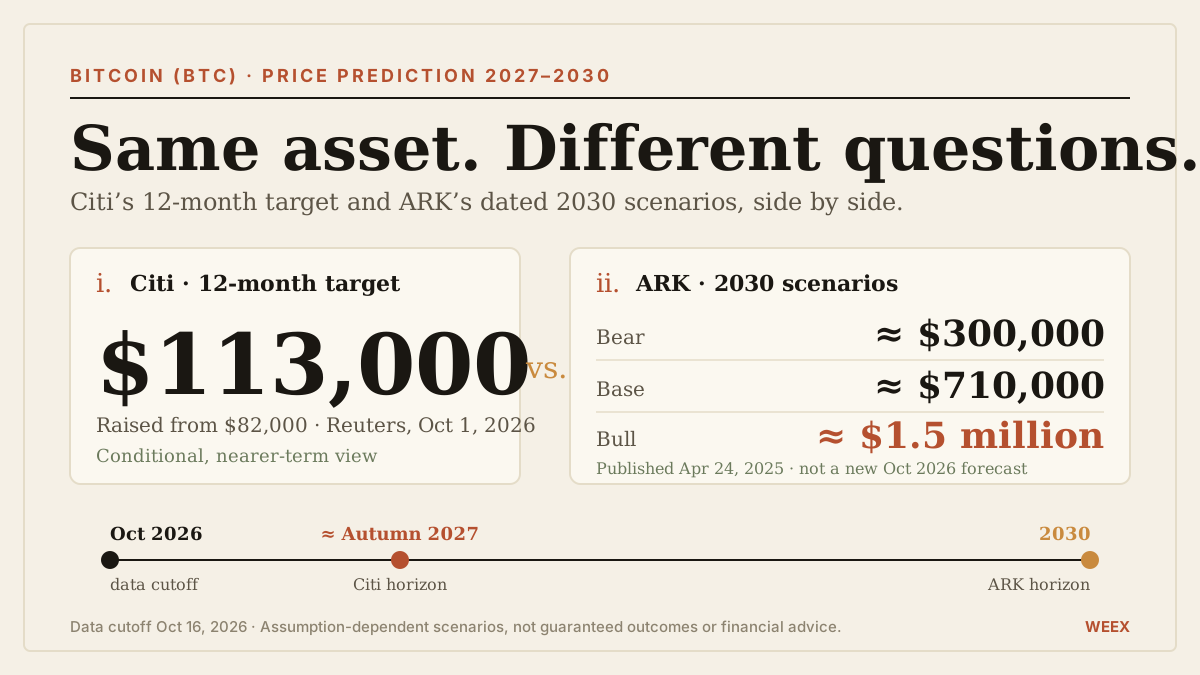
Bitcoin (BTC) Price Prediction 2027–2030: Citi’s $113,000 Target vs. Cathie Wood’s ARK Scenarios
Bitcoin price prediction for 2027–2030: compare Citi’s $113,000 target with ARK’s dated scenarios, demand assumptions, valuation math and key risks.

Mr&强 Analyzes BTC and ETH Short-Term Strategies

Bitcoin futures open interest declines, signaling weaker demand

Cathie Wood Predicts Long-Term Growth for Bitcoin Despite Dollar Strength

Peter Schiff Predicts Bitcoin Crash Over 99%
Liquidity in Cryptocurrency Market Approaches a Turning Point! Circle Aims to Enter 40 Emerging Markets

One dead, Qonto in flames, Nuñez resigns: why the streets worry crypto investors

Security Vulnerability Detected in ILITY Network, Cross-Chain Bridge Suspended

Bitcoin Spot ETF Sees Net Outflow of $229 Million Last Week, BlackRock's IBIT Leads with $165 Million Outflow

Morgan Stanley Recommends Up to 4% in Cryptocurrencies for Aggressive Portfolios

Deutsche Bank to Start Bitcoin and Ethereum Custody Within Weeks — Expansion to Asia by 2027

Bitcoin Ranges After Weekly Low Sweep| WEEX TradFi Daily(October 19, 2026)
Early on October 19, equity futures rebounded from last week’s chip selloff. Major indexes closed lower last week, the Nasdaq posted its worst week since June, the semiconductor ETF fell about 10%, and CoreWeave lost about 25%, while energy stocks were relatively resilient. Bitcoin traded near $82,000 after sweeping lows around $80,000, with markets watching the $79,800 and $83,600 zones.
WEEX Exclusive:Bitcoin Ranges After Weekly Low Sweep| WEEX TradFi Daily(October 19, 2026)

ECB: Lagarde defends rate hikes before the IMF and urges Brussels on digital euro

Sam Price Discusses Bitcoin Market Divergence

唐华斑竹 Analyzes Bitcoin Trends, Suggests Monitoring Support Levels

Saylor Envisions Bitcoin-Backed Stablecoin with Annual Yield of 6% to 8%

Strive CEO Emphasizes Going Long on Bitcoin and Short on USD, Claims Currency Depreciation is Irreversible

Bloomberg analyst warns BTC 50-week average decline may signal stock and metal downturns

Sam Price Focuses on Strategy Stock Price Drop and MSCI Index Adjustment
US Institutions See Net Inflows in Bitcoin as Demand for Dollar-Based Stablecoins Grows
Sam Price Focuses on the Hormuz Strait Tanker Incident, Crude Oil Prices Fluctuate
$4.8 Million Bitcoin Stolen from Scammer with Manipulated Ledger Wallet

Sazmining Offers Proto Hashboards at 4187 Dollars Each
BingX, YouHodler and Santander’s Openbank join EU MiCA register
QCP: AI Credit Risk Heats Up, Bitcoin May Face Range Breakthrough
French National Assembly Passes Tax Amendment on Stablecoin Transactions, Effective 2027
Bitcoin miner stocks driven by AI sentiment, not BTC prices
Black Monday Posts Break Records
Bitcoin Recovery Faces Challenges as Exchange Reserves Rise and Spot Demand Turns Negative