
- Buy Crypto
- Markets
 Futures
- Spot
- Copy Trade
- Earn
- More
The Democratic Party has proposed the "Clean Cloud Act," requiring U.S. Bitcoin mining companies and AI compute centers to embrace green energy: achieve zero carbon emissions by 2035.

Original Article Title: "Democratic Party Proposes 'Clean Cloud Act' Demanding U.S. Bitcoin Miners and AI Computing Centers Embrace Green Energy: Achieve Zero Carbon Emission by 2035"
Original Article Author: Joe, BlockTempo of ChainNews
The U.S. Senate has introduced the "2025 Clean Cloud Act," which requires cryptocurrency mines and AI data centers to gradually phase out fossil fuels or face fines, with the goal of achieving zero carbon emissions by 2035.
This bill was jointly proposed by Democratic Senators Sheldon Whitehouse and John Fetterman and aims to strictly limit the carbon emissions of cryptocurrency mining enterprises and artificial intelligence (AI) data centers, establishing a clear timetable to achieve net-zero emissions by 2035. Facilities continuing to use non-renewable energy sources will face fines.
Core Mechanism of the Act: Regional Emission Caps and Yearly Decrement
According to the draft, the "Clean Cloud Act" will amend the existing "Clean Air Act." In the future, all data centers with an energy capacity of over 100 kilowatts (including cryptocurrency mines and AI computing centers) must comply with regionally defined emission caps.
These caps will be based on the power region divisions set forth in the U.S. Department of Energy's "National Electricity Delivery Demand Study." Due to different energy structures and grid conditions in various regions, the emission reduction requirements will also vary.
The bill mandates that emission caps for each region must be established by the end of 2025 and then decrease by 11% annually until reaching zero emissions by 2035. Non-compliant enterprises will pay fines based on their excess emissions adjusted for inflation.
It is worth noting that the draft explicitly prohibits companies from passing on the fine costs to customers to ensure that companies bear the responsibility for environmental protection.
Strict Reporting Obligations and Accountability
The bill also requires relevant facilities to submit detailed reports annually, including key information such as total electricity consumption and the ratio of electricity sources (renewable energy vs. fossil fuels).
Of note, the draft assigns the responsibility for paying fines to the "lessee of the leased facility" rather than the facility owner. This means that even individuals or companies leasing servers for mining or AI operations may be required to report data and bear potential fines, expanding the scope of applicability.
Contributes to Green Energy Development, But Also Increases Pressure on SMEs
If the bill is passed, it will drive cloud service providers and data centers to actively adopt green energy, attracting environmentally conscious customers. However, for small and medium-sized enterprises, this may be a challenge as they may lack sufficient resources to address energy transformation and compliance costs.
The Cryptocurrency Mining Industry Shows a Green Trend
By the end of 2024, over 50% of the global Bitcoin mining network's energy comes from renewable sources such as hydroelectric, wind, and solar energy. Regions with abundant and affordable green energy, such as Iceland and Quebec, Canada, have become the preferred choices for miners.
If the "Clean Cloud Act" is smoothly passed, mining enterprises and AI data centers will quickly transition to using renewable energy, while those who do not adapt will face the risk of being phased out of the market.
Overall, the bill lays out a positive and stringent emissions reduction timetable, prompting relevant companies to plan for energy transformation as early as possible. However, in the overarching environment of the Trump administration, considering his repeated denial of the relationship between global warming and carbon emissions, this bill is bound to encounter resistance in Congress from the Republican Party (which may view the bill as too strict, stifling innovation, and weakening U.S. competitiveness in the cryptocurrency and AI fields). The final outcome of whether it can be passed still remains highly uncertain.
You may also like

Wall Street Shorts ETH: Vitalik is aware and has front-run, while Tom Lee remains oblivious

Social Capital CEO: How Equity Tokenization is Reshaping Capital Markets from US Stocks to SpaceX?

CoinGecko Report: Surge of 346% vs Dip of 20.8%, The Wild Rise of DEX

a16z: The Real Opportunity of Stablecoins Lies Not in Disruption but in Filling Gaps

Mining Exodus: Someone Holds $12.8 Billion AI Order

March 6 Market Key Intelligence, How Much Did You Miss?

a16z: The True Opportunity of Stablecoins is in Complementing, Not Disrupting

Predict LALIGA Matches, Shoot Daily & Win BTC, USDT and WXT on WEEX
The WEEX × LALIGA campaign brought together football excitement and crypto participation through a dynamic interactive experience. During the event, users predicted matches, completed trading tasks, and took daily shots to compete for rewards including BTC, USDT, WXT, and exclusive prizes.

Ray Dalio Dialogue: Why I'm Betting on Gold and Not Bitcoin

Who Took the Money in the AI Era? A Must-See Investment Checklist for HALO Asset Trading
Wall Street Bears Target Ethereum: Vitalik In the Know Takes Flight, Tom Lee Remains Bullish
Pump.fun Hacker Steals $2 Million, Receives 6-Year Prison Sentence, Opts for 'Self-Detonation'

6% Annual Percentage Yield as Musk Declares War on Traditional Banks
36 years, 4 wars, 1 script: How does capital price the world in conflict?

Mining Companies' Great Migration: Some Have Already Secured $12.8 Billion in AI Orders
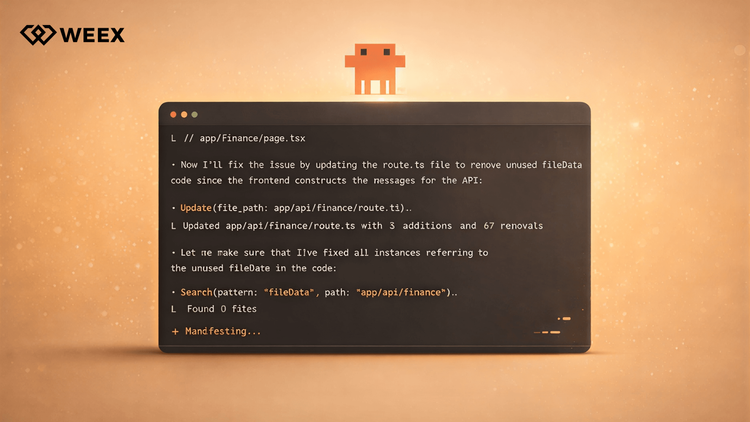
What Is Vibe Coding? How AI Is Changing Web3 & Crypto Development
What is vibe coding? Learn how AI coding tools are lowering the barrier to Web3 development and enabling anyone to build crypto applications.
The parent company of the New York Stock Exchange strategically invests in OKX: The intentions behind the $25 billion valuation

WEEX P2P update: Country/region restrictions for ad posting
To improve ad security and matching accuracy, WEEX P2P now allows advertisers to restrict who can trade with their ads based on country or region. Advertisers can select preferred counterparty locations for a safer, smoother trading experience.
I. Overview
When publishing P2P ads, advertisers can now set the following:
Allow only counterparties from selected countries or regions to trade with your ads.
With this feature, you can:
Target specific user groups more precisely.Reduce cross-region trading risks.Improve order matching quality.
II. Applicable scenarios
The following are some common scenarios:
Restrict payment methods: Limit orders to users in your country using supported local banks or wallets.Risk control: Avoid trading with users from high-risk regions.Operational strategy: Tailor ads to specific markets.
III. How to get started
On the ad posting page, find "Trading requirements":
Select "Trade with users from selected countries or regions only".Then select the countries or regions to add to the allowlist.Use the search box to quickly find a country or region.Once your settings are complete, submit the ad to apply the restrictions.
When an advertiser enables the "Country/Region Restriction" feature, users who do not meet the criteria will be blocked when placing an order and will see the following prompt:
If you encounter this issue when placing an order as a regular user, try the following solutions.
Choose another ad: Select ads that do not restrict your country/region, or ads that allow users from your location.Show local ads only: Prioritize ads available in the same country as your identity verification.
IV. Benefits
Compared with ads without country/region restrictions, this feature provides the following improvements.
Aspect
Improvement
Trading security
Reduces abnormal orders and fraud risk
Conversion efficiency
Matches ads with more relevant users
Order completion rate
Reduces failures caused by incompatible payment methods
V. FAQ
Q1: Why are some users not able to place orders on my ad?
A1: Their country or region may not be included in your allowlist.
Q2: Can I select multiple countries or regions when setting the restriction?
A2: Yes, multiple selections are supported.
Q3: Can I edit my published ads?
A3: Yes. You can edit your ad in the "My Ads" list. Changes will take effect immediately after saving.


 App
App