
The volatility trend of Bitcoin: less volatile than 57% of S&P 500 stocks

 Prefer us on Google


Bitcoin is less volatile than 57% of individual companies in the S&P 500, according to a report by Grayscale on Bitcoin's volatility trends. The realized volatility over one year stands at 43%.
Key Points
- According to Grayscale, 57% of S&P 500 companies are more volatile than Bitcoin.
- The realized volatility over one year has decreased from 81% five years ago to 43%.
- The report links the increased stability to liquidity, institutional participation, and regulated access.
Bitcoin's Volatility Trends Over Five Years
The realized volatility of Bitcoin has dropped from 81% to 43% over five years, a decrease of 38 percentage points. The current figure is also below the ten-year average, which stands at 64%.
The report is titled "Putting Bitcoin's Volatility in Context." Grayscale Research published it on October 14, 2026, as reported by Crypto Briefing.
Realized volatility measures how much the price of an asset has moved over a past period. It is based on actual fluctuations, not expectations for future trades.
The comparison with stocks provides a familiar benchmark. According to Grayscale, 57% of individual companies in the S&P 500 have a volatility higher than that of Bitcoin, placing it in a comparable range to many established blue-chip stocks.
This data challenges Bitcoin's reputation as an asset with extreme fluctuations.
A Comparison with Stocks, Not the Index
The comparison concerns individual company stocks, not the S&P 500 as a whole. Therefore, the report does not establish that Bitcoin is less volatile than the index.
The S&P 500 comprises hundreds of companies and benefits from diversification.
Liquidity, Institutional Participation, and Spot ETFs Behind the Decline
Grayscale attributes the decline to three factors: deeper liquidity, greater institutional participation, and the emergence of regulated trading venues. The company views these as signs of Bitcoin's maturation as an asset class.
Greater liquidity reduces the price impact of large purchases or sales and helps to dampen sudden spikes. According to the company, trading has also become more stable due to a broader base of large professional investors.
As an example of regulated access, Grayscale points to spot ETFs on Bitcoin. These products allow exposure through a known investment structure without going directly through crypto exchanges.
These are, according to Grayscale, the factors that explain Bitcoin's volatility trends.
-- Price
Bitcoin in a Portfolio Like a Growth Stock
Grayscale argues that investors should consider Bitcoin in their portfolios similarly to growth stocks, focusing on position size and overall context. The message is that historical volatility alone is not enough to exclude the asset.
The comparison frames Bitcoin's fluctuations alongside movements that stock investors already manage. For the company, the strategies used for stock volatility can also guide the sizing of an allocation in Bitcoin.
However, historical measures have limitations. Lower realized volatility does not guarantee future price stability nor eliminate other risks.
Bitcoin remains exposed to deep drawdowns and regulatory shocks, which a figure based on the past cannot anticipate.
This content is provided for general informational purposes only and doesn't constitute financial, investment, legal, or tax advice. Any events, rewards, online promotions, or related information mentioned herein should not be considered a recommendation, solicitation, or invitation to purchase, sell, trade, or otherwise deal in any crypto assets. Crypto assets are highly volatile and may result in loss. The availability of WEEX services, products, and related events may vary by region. You are responsible for ensuring that your participation is in accordance with applicable local laws and regulations.
You may also like

Bitcoin Recovery Faces Challenges as Exchange Reserves Rise and Spot Demand Turns Negative
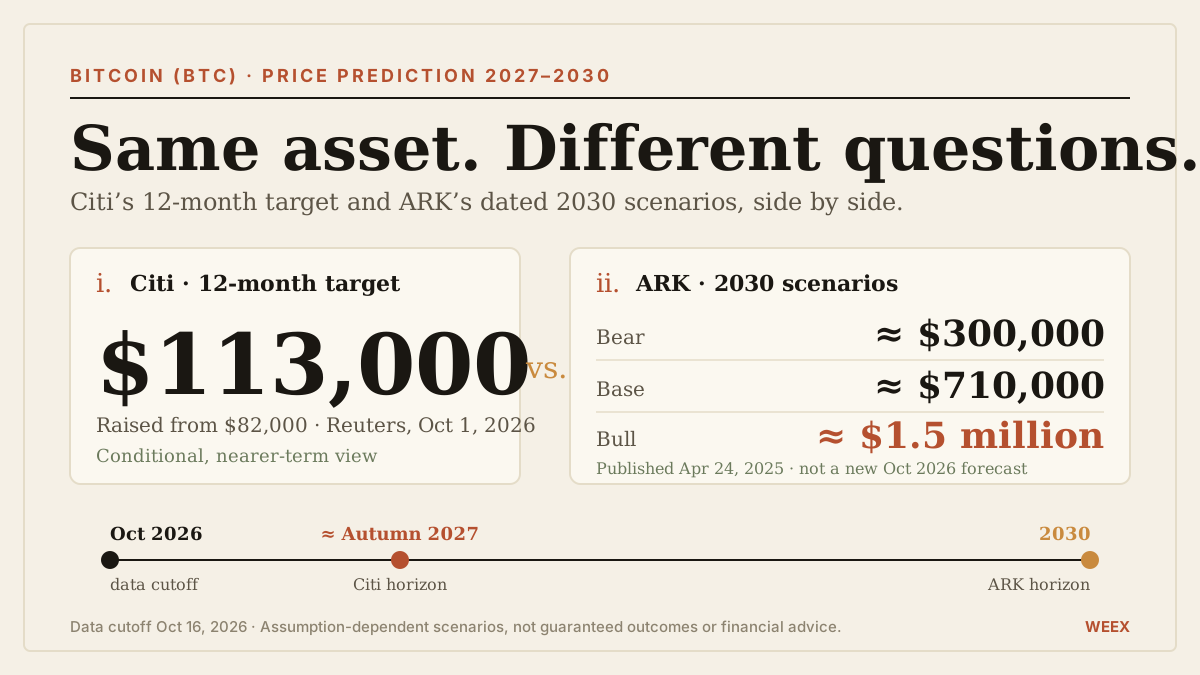
Bitcoin (BTC) Price Prediction 2027–2030: Citi’s $113,000 Target vs. Cathie Wood’s ARK Scenarios
Bitcoin price prediction for 2027–2030: compare Citi’s $113,000 target with ARK’s dated scenarios, demand assumptions, valuation math and key risks.

Mr&强 Analyzes BTC and ETH Short-Term Strategies

Bitcoin futures open interest declines, signaling weaker demand

Cathie Wood Predicts Long-Term Growth for Bitcoin Despite Dollar Strength

Peter Schiff Predicts Bitcoin Crash Over 99%
Liquidity in Cryptocurrency Market Approaches a Turning Point! Circle Aims to Enter 40 Emerging Markets

One dead, Qonto in flames, Nuñez resigns: why the streets worry crypto investors

Security Vulnerability Detected in ILITY Network, Cross-Chain Bridge Suspended

Bitcoin Spot ETF Sees Net Outflow of $229 Million Last Week, BlackRock's IBIT Leads with $165 Million Outflow

Morgan Stanley Recommends Up to 4% in Cryptocurrencies for Aggressive Portfolios

Deutsche Bank to Start Bitcoin and Ethereum Custody Within Weeks — Expansion to Asia by 2027

Bitcoin Ranges After Weekly Low Sweep| WEEX TradFi Daily(October 19, 2026)
Early on October 19, equity futures rebounded from last week’s chip selloff. Major indexes closed lower last week, the Nasdaq posted its worst week since June, the semiconductor ETF fell about 10%, and CoreWeave lost about 25%, while energy stocks were relatively resilient. Bitcoin traded near $82,000 after sweeping lows around $80,000, with markets watching the $79,800 and $83,600 zones.
WEEX Exclusive:Bitcoin Ranges After Weekly Low Sweep| WEEX TradFi Daily(October 19, 2026)

ECB: Lagarde defends rate hikes before the IMF and urges Brussels on digital euro

Sam Price Discusses Bitcoin Market Divergence

唐华斑竹 Analyzes Bitcoin Trends, Suggests Monitoring Support Levels

Saylor Envisions Bitcoin-Backed Stablecoin with Annual Yield of 6% to 8%

Strive CEO Emphasizes Going Long on Bitcoin and Short on USD, Claims Currency Depreciation is Irreversible

Bloomberg analyst warns BTC 50-week average decline may signal stock and metal downturns

Sam Price Focuses on Strategy Stock Price Drop and MSCI Index Adjustment

US Institutions See Net Inflows in Bitcoin as Demand for Dollar-Based Stablecoins Grows
Sam Price Focuses on the Hormuz Strait Tanker Incident, Crude Oil Prices Fluctuate
$4.8 Million Bitcoin Stolen from Scammer with Manipulated Ledger Wallet

Sazmining Offers Proto Hashboards at 4187 Dollars Each
Bitcoin or Dollar Returns: Same Strategy, Opposite Results
Bitcoin: AI Crash or Superabundance, Bitwise Sees Only One Winner

Bitcoin Mining Stocks Can Decline More Sharply Than Bitcoin

Crypto doesn’t need your party to win, just its candidates

Bitcoin’s Quantum Transition Won’t Stop at Bitcoin
Bitcoin Recovery Faces Challenges as Exchange Reserves Rise and Spot Demand Turns Negative
Bitcoin (BTC) Price Prediction 2027–2030: Citi’s $113,000 Target vs. Cathie Wood’s ARK Scenarios
Bitcoin price prediction for 2027–2030: compare Citi’s $113,000 target with ARK’s dated scenarios, demand assumptions, valuation math and key risks.
Mr&强 Analyzes BTC and ETH Short-Term Strategies
Bitcoin futures open interest declines, signaling weaker demand
Cathie Wood Predicts Long-Term Growth for Bitcoin Despite Dollar Strength
Peter Schiff Predicts Bitcoin Crash Over 99%
Contents
Latest articles




Latest coin listings on WEEX


