
Uber Stock: A $40 Million Wrongful Death Ruling Just Challenged Its Business Model

 Prefer us on Google

Uber stock is trading near $70, well off its 52-week high of $101.99, as the company faces the fallout from a specific legal ruling that goes beyond the dollar figure attached to it.
Uber stock's underlying business model, the legal argument that it operates merely as a technology platform connecting riders with independent drivers, was directly challenged and rejected by a retired California judge earlier this month. Uber stock's near-term price action matters less here than what this specific ruling could mean for how the company defends itself in future cases, a question worth understanding in detail rather than treating this as a routine legal headline.
What Actually Happened
Retired Judge Richard A. Stone, serving as arbitrator, ordered Uber and one of its drivers, Vu Tran, to pay $40 million to the parents of Emily Normandin-Parker, a 23 year old UCLA graduate, following the driver's abandonment of her on a Southern California freeway. According to the family's account and reporting from ABC News, Normandin Parker had chosen not to drive after a night out and called an Uber specifically to get home safely. Evidence presented during the five-day arbitration showed that after a friend in the car became sick during the ride, the driver illegally stopped at a freeway gore point on State Route 73, rather than exiting to a safe location. Rather than render aid or call 911, the driver left the scene and shortly afterward requested that Uber charge a cleaning fee to Normandin-Parker's account. She was later struck and killed after wandering into traffic.
Judge Stone found the driver's testimony "largely, in fact, almost entirely, incredible and unbelievable," concluding he had "needlessly placed" his passengers in danger and showed "far more worry for his new car than he did for his passengers." The arbitration also established that Uber had received multiple prior complaints about the driver's conduct before this incident. The $40 million award provides $20 million each to Normandin-Parker's parents, Carol Normandin and Ken Parker, with a separate $300,000 award to the friend who survived the incident, Luna Moore.

Why The Legal Reasoning Matters More Than The Dollar Amount
The specific legal basis for this ruling is what makes it significant for Uber's broader business model, not just this individual case. Judge Stone explicitly rejected Uber's argument that it operates merely as a technology platform, ruling instead that the company functions as a common carrier with a non-delegable duty to protect its passengers. In his written decision, Stone concluded that Uber effectively offers transportation services directly to the public through its app, controls key aspects of the rider experience, sets fares, and profits directly from rides, characteristics he found inconsistent with Uber's position that it simply connects independent drivers with riders through software.
Stone also separately ruled that Proposition 22, the 2020 California voter-approved measure that permits gig companies to classify drivers as independent contractors rather than employees, does not shield Uber from liability when a driver's negligence leads to a passenger's death. That's a specific, two-part legal defeat: Uber lost both its argument that it's purely a technology intermediary and its argument that Prop 22's independent-contractor framework insulates it from this kind of liability.
Why This Isn't Binding Precedent, But Still Matters
It's worth being precise about the legal weight this specific ruling actually carries. As an arbitration award rather than a court ruling, the decision resolves this particular case and isn't binding legal precedent for future lawsuits, according to Karmactive's legal analysis of the ruling. Uber itself maintains it disagrees with the outcome, with a company spokesperson telling ABC News that "the arbitrator was wrong in holding Uber legally responsible for the tragic events of that night."
That said, the ruling's reasoning could still influence how similar claims get argued going forward, even without formal precedential force. Uber resolves the overwhelming majority of rider disputes through mandatory arbitration rather than public court proceedings, meaning individual arbitrator decisions like this one, while not binding on future arbitrators, can still shape the legal arguments plaintiffs' attorneys bring in subsequent cases, particularly on the specific common-carrier and Prop 22 questions this ruling addressed directly.
-- Price
Why Uber Fought To Keep This Case Confidential
A detail worth including directly: before the arbitration ruling, Uber had offered the family a $10 million settlement that included a non-disclosure condition preventing the parents from speaking publicly about the incident. The family declined that offer. After the arbitration award was issued, Uber further sought to keep both the proceedings and the award confidential, filing a motion in Orange County Superior Court seeking to compel the family's silence, proposing an agreement that would have prevented Normandin Parker's parents from making even truthful public statements about the company's connection to their daughter's death, backed by a threatened $10 million penalty for each violation.
The family refused that confidentiality arrangement. They've stated that arbitration proceeds will go toward the Emily Normandin-Parker Foundation, an organization created in their daughter's memory to advocate for greater safety standards across the ride hailing industry. That sequence, an initial confidential settlement offer, followed by an attempt to seal the arbitration outcome itself, is worth understanding as its own separate signal about how seriously Uber's legal team treated the reputational exposure this specific case carried, independent of the ultimate financial award.
What Uber Has Actually Changed In Response
Uber has stated it has since updated its safety protocols to include new instructions for drivers regarding where they may and may not let passengers out of vehicles, according to the company's response to ABC News. That's a concrete, if narrow, operational change directly tied to the specific failure at the center of this case, a driver stopping in an unsafe location rather than continuing to a safe exit point.
Whether that specific policy update meaningfully addresses the broader legal questions this ruling raised, about Uber's classification as a common carrier and the limits of Prop 22 protection, is a separate question from whether it prevents a similar specific incident from recurring. The company's stated safety change addresses the proximate cause of this particular tragedy without necessarily resolving the more structural legal exposure the ruling's reasoning could create for future cases involving different circumstances.
Why This Case Sits Within A Broader Pattern Of Legal Challenges
This ruling isn't happening in isolation from Uber's other ongoing legal exposure. Separately, Uber recently lost an appeal challenging $91 million in mass arbitration fees in New York, according to Holland & Knight's legal analysis, part of a broader litigation trend involving mass arbitration claims against the company. A separate Illinois wrongful-death case has also raised questions specifically about whether Uber's arbitration provisions properly route certain claims to arbitration versus open court, according to USA Herald's reporting, illustrating that the legal questions surrounding Uber's business model, and specifically its independent-contractor classification framework, extend well beyond this single Southern California case.
What Would Actually Determine How Much This Matters For The Stock
None of this settles whether this specific ruling produces a meaningful, lasting change in how Uber operates or defends itself legally going forward. Whether plaintiffs' attorneys in future arbitration cases successfully cite this ruling's specific reasoning, on both the common carrier classification and the Prop 22 question, to win comparable outcomes is the most direct test of whether this becomes a genuine pattern rather than an isolated result. Whether Uber's updated safety protocols meaningfully reduce the specific kind of incident at the center of this case is a separate, more measurable question worth tracking over time. And whether this ruling's underlying legal reasoning eventually surfaces in non-arbitration court proceedings, where it could carry more formal precedential weight than it does as a single arbitration award, is the development that would most directly elevate this from a single costly case into a genuine structural risk for Uber's broader business model.
Trading Uber Stock Directly
For traders looking to position around how this legal exposure develops alongside Uber's broader business trends, UBER trades on WEEX Spot, letting you hold a direct position with USDT funded from the same account used for crypto trading, without needing a separate brokerage relationship to react as new developments in this case, or similar ones, emerge. Given how directly this ruling's reasoning touches Uber's core legal defense, its classification as a technology platform rather than a common carrier, having a low friction way to adjust a position as further legal or regulatory developments land is more practical than treating this as a single, resolved headline.
Trading on WEEX is backed by a publicly disclosed 1,000 BTC protection fund, worth knowing for anyone holding a position in a stock currently trading near its 52 week low while carrying a Strong Buy analyst consensus, a genuine divergence that legal exposure like this ruling is one of several factors worth weighing directly.
Conclusion
Uber stock faces legal exposure from a $40 million arbitration award that goes beyond its dollar value: the ruling specifically rejected Uber's core legal argument that it operates merely as a technology platform, finding instead that the company functions as a common carrier with direct responsibility for passenger safety, while separately ruling that Proposition 22 doesn't shield Uber from this kind of liability. While the award isn't binding legal precedent, its reasoning arrives alongside other ongoing legal challenges to Uber's business model, including a separate $91 million mass arbitration fee dispute, suggesting the underlying legal questions extend well beyond this single tragic case. Whether this specific ruling's reasoning gains traction in future proceedings, arbitrated or otherwise, is the development that would most directly determine how much structural weight it ultimately carries for Uber's business.
FAQ
1. What did the arbitrator actually rule in this case?
Retired Judge Richard Stone ordered Uber and driver Vu Tran to pay $40 million to the parents of Emily Normandin-Parker, finding Uber functions as a common carrier with a duty to protect passengers, rejecting the company's argument that it operates purely as a technology platform.
2. Does this ruling set legal precedent for future Uber cases?
Not formally. As an arbitration award rather than a court ruling, it resolves this specific case and isn't binding on future arbitrators, though its reasoning could influence how similar claims get argued going forward.
3. Does Proposition 22 protect Uber from this type of liability?
No, according to this ruling. The arbitrator specifically found that Prop 22 only affects how drivers are classified for employment purposes and doesn't shield Uber from liability when a driver's negligence leads to a passenger's death.
4. What changes has Uber made in response to this case?
The company says it has updated safety protocols to include new instructions for drivers on where they may and may not let passengers out of vehicles, though it maintains it disagrees with the arbitrator's finding of legal responsibility.
5. Is this Uber's only current legal challenge related to its business model?
No. Uber separately lost an appeal over $91 million in mass arbitration fees in New York, and a separate Illinois wrongful death case has raised comparable questions about the company's arbitration provisions.
This content is provided for general informational purposes only and doesn't constitute financial, investment, legal, or tax advice. Any events, rewards, online promotions, or related information mentioned herein should not be considered a recommendation, solicitation, or invitation to purchase, sell, trade, or otherwise deal in any crypto assets. Crypto assets are highly volatile and may result in loss. The availability of WEEX services, products, and related events may vary by region. You are responsible for ensuring that your participation is in accordance with applicable local laws and regulations.
You may also like

Hyperliquid Requests Five Changes to SEC's Crypto Regulations

Fake Demand, Real Losses: How Popular Crypto Schemes Work

Michael Saylor: "Bitcoin is returning to a bull market"

Korea's Largest Pension Fund Suffers Over $130 Billion Loss Due to Heavy Investment in Samsung and SK Hynix

Ripple to Address XRP Ledger Security at Swell 2026

Hatem Douidar Joins Tactful AI Investors to Support Its Expansion in AI Solutions

Cardano Project Catalyst selects 12 projects for 2 million ADA pilot fund

From Zero to Financial Freedom: A Trader's HYPE Airdrop Review and Trading Philosophy

BingX, YouHodler and Santander’s Openbank join EU MiCA register

Slow Fog Releases DarkSword Trojan Analysis Report: Public Code Weaponized, iOS Crypto Wallets Face Threats

Emirati Nabta Health Secures Investment from PVP in $3 Million Round

XRP holders can now earn fees from Kraken’s DeFi customers, but there is a catch

Can Celestia Turn the Tide with AI Payments After a 97% Drop?

Why is it difficult for meme coins to break the $50,000 market cap? This market is draining retail investors' funds

QCP: AI Credit Risk Heats Up, Bitcoin May Face Range Breakthrough

BlackRock wants tokenized funds to back traditional Wall Street trades
The New PayPal Mafia: 10 Interns, $100 Billion

Variant Investment Partner: In the Second Half of the Bull Market, Which Two Camps Are Marginal Dollars Flowing To?

BNB Chain claims 42.6% of tokenized stock market, beating Ethereum and Solana
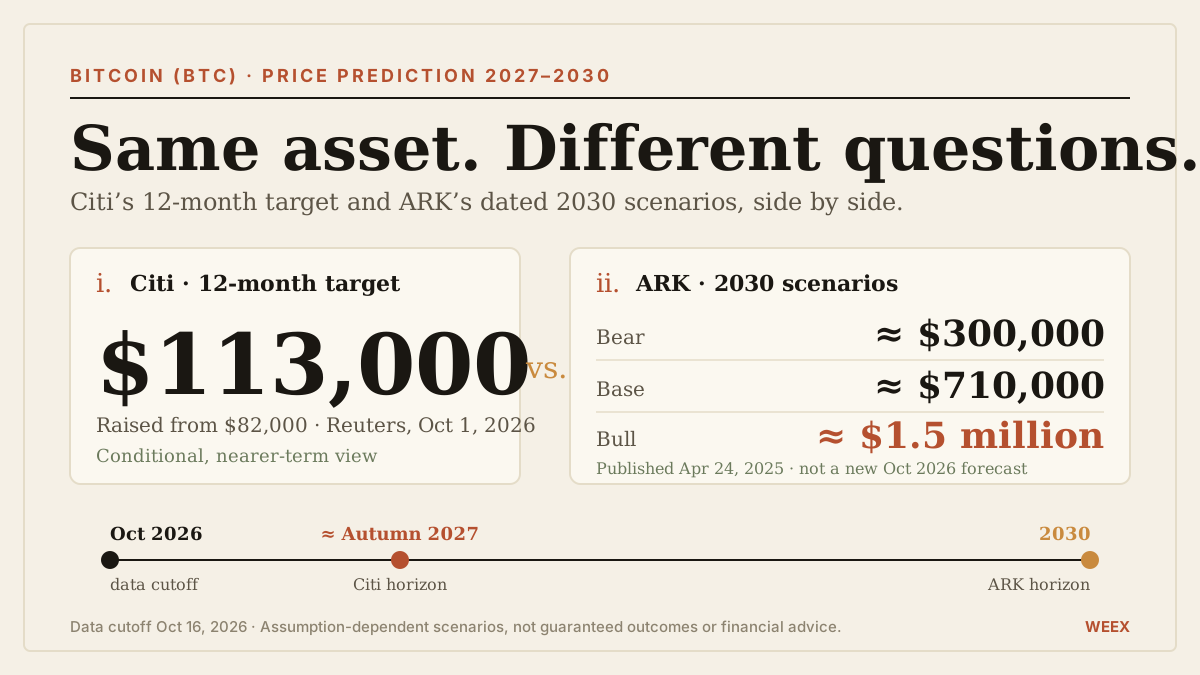
Bitcoin (BTC) Price Prediction 2027–2030: Citi’s $113,000 Target vs. Cathie Wood’s ARK Scenarios
Bitcoin price prediction for 2027–2030: compare Citi’s $113,000 target with ARK’s dated scenarios, demand assumptions, valuation math and key risks.

XRP (XRP) Price Prediction: Can BarriC’s $750 Target Pass the Market-Cap Test?
XRP price prediction: examine BarriC’s $750 target, market-cap math, next-bull-run scenarios, token demand and what could support a recovery to $5.
Musk Says He Will Give “One of My SpaceX Shares to Every Kid in America”: What the Post Says and What Is Still Unclear
Elon Musk said on October 19, 2026 that he will give one of his SpaceX shares to every kid in America next year. The post gave no details on delivery, eligibility or which shares. Estimates put the cost near $10 billion at recent SPCX prices, and a link to Trump Accounts remains unconfirmed.

Perp DEX Generates $125 Million in Fees Monthly, Who Really Gets Rewarded?
Freezing and Confiscation of Cryptos: Europe Strengthens Cooperation Against Criminal Networks

Hedera vs Algorand: Which Network is More Suitable?

Saudi Vrtx Raises $3.6 Million to Develop Its Integrated Financial Technology Infrastructure
Programmable Trading Arrives: How Hook Becomes the 'Brain' of the Trading Pool?

Tiger Research: The Second Growth Curve of the Korean Crypto Market - RWA and Compliant Stablecoins

TRON Industry Weekly Report: Stagflation May Lead BTC to Test $80,000 Support Again, Detailed Explanation of Building Chain Abstract Web3 Experience Infrastructure Newton

Yuga Labs Tells a New TCG Story, Generously Distributing NFT Community Card Packs—Will the Market Respond?
Hyperliquid Requests Five Changes to SEC's Crypto Regulations
Fake Demand, Real Losses: How Popular Crypto Schemes Work
Michael Saylor: "Bitcoin is returning to a bull market"
Korea's Largest Pension Fund Suffers Over $130 Billion Loss Due to Heavy Investment in Samsung and SK Hynix
Ripple to Address XRP Ledger Security at Swell 2026
Hatem Douidar Joins Tactful AI Investors to Support Its Expansion in AI Solutions


