UK Court Rules Chinese Law Applies to £4 Billion Fraud Case

 Prefer us on Google


UK Court Rules Chinese Law Applies to Fraud Case
The High Court of England and Wales has made a significant judicial ruling in a lawsuit concerning a massive cryptocurrency fraud amounting to billions of pounds, stating that the victims' claims for the return of seized Bitcoin (BTC) will be governed by Chinese law rather than English law.
This ruling clearly emphasizes the importance of the origin of rights arising from transactions and the background of the damages, even for seized assets managed within mainland Britain. The case originated from a large Ponzi scheme led by Zhimin Qian from 2014 to 2017 in China. He illegally raised funds through companies like Tianjin Lantian Ge Rui Electronic Technology, signing over 120,000 contracts under the guise of services for the elderly and investments in digital currency, collecting approximately 40.2 billion yuan (about £9.5 billion) unlawfully.
While some of the funds raised through the fraud were used for dividends to existing customers, much of it was converted into over 100,000 BTC through cryptocurrency exchanges like Huobi.
To evade Chinese authorities, Qian fled to London via Myanmar, where he, along with accomplices, attempted to launder and cash out the cryptocurrency. However, he was caught in an investigation by the Metropolitan Police in London. As a result, 61,000 BTC and a memory device recording approximately $5.07 billion (about £8.03 billion) were seized from safe deposit boxes and related locations, leading Qian to eventually plead guilty to possession of criminal proceeds.
Legal Battle Over Asset Return and Governing Law
Victims who lost funds initiated a civil lawsuit based on the UK’s Proceeds of Crime Act 2002 (Section 281), seeking a declaration that the seized assets are their property.
The main point of contention in the trial was the determination of the "governing law" under which the legitimacy of the return claims should be assessed. The victims argued for the application of English law (or a combination of English and Chinese law) based on claims that the funds were managed under a constructive trust and unique tracing provisions of English law.
However, the DPP (Director of Public Prosecutions) and the bankruptcy trustee firmly countered that since the transactions originated in China, Chinese law should apply.
Judge Turner's Ruling and Future Challenges for Victims
Judge Mark Turner of the High Court dismissed the victims' claims, concluding that the rights in this case should be adjudicated under Chinese law. He stated that since all core actions, including contract formation, fundraising by investors, and Bitcoin purchases, occurred within China, the mere fact that the seized items currently exist in the UK does not change the governing law to English law. This ruling merely clarifies the judicial premise, and it remains uncertain whether the victims will be able to recover their assets.
To receive compensation under Section 281 of the UK Proceeds of Crime Act, it is insufficient to merely prove that one is a victim of fraud; it is necessary to clearly demonstrate "direct ownership interests in individual Bitcoins" under Chinese law.
Moving forward, the focus will be on proving claims under Chinese law, and the hurdles for actual asset recovery remain high.
-- Price
This content is provided for general informational purposes only and doesn't constitute financial, investment, legal, or tax advice. Any events, rewards, online promotions, or related information mentioned herein should not be considered a recommendation, solicitation, or invitation to purchase, sell, trade, or otherwise deal in any crypto assets. Crypto assets are highly volatile and may result in loss. The availability of WEEX services, products, and related events may vary by region. You are responsible for ensuring that your participation is in accordance with applicable local laws and regulations.
You may also like

BingX, YouHodler and Santander’s Openbank join EU MiCA register

QCP: AI Credit Risk Heats Up, Bitcoin May Face Range Breakthrough

French National Assembly Passes Tax Amendment on Stablecoin Transactions, Effective 2027

Bitcoin miner stocks driven by AI sentiment, not BTC prices

Black Monday Posts Break Records
Bitcoin Recovery Faces Challenges as Exchange Reserves Rise and Spot Demand Turns Negative
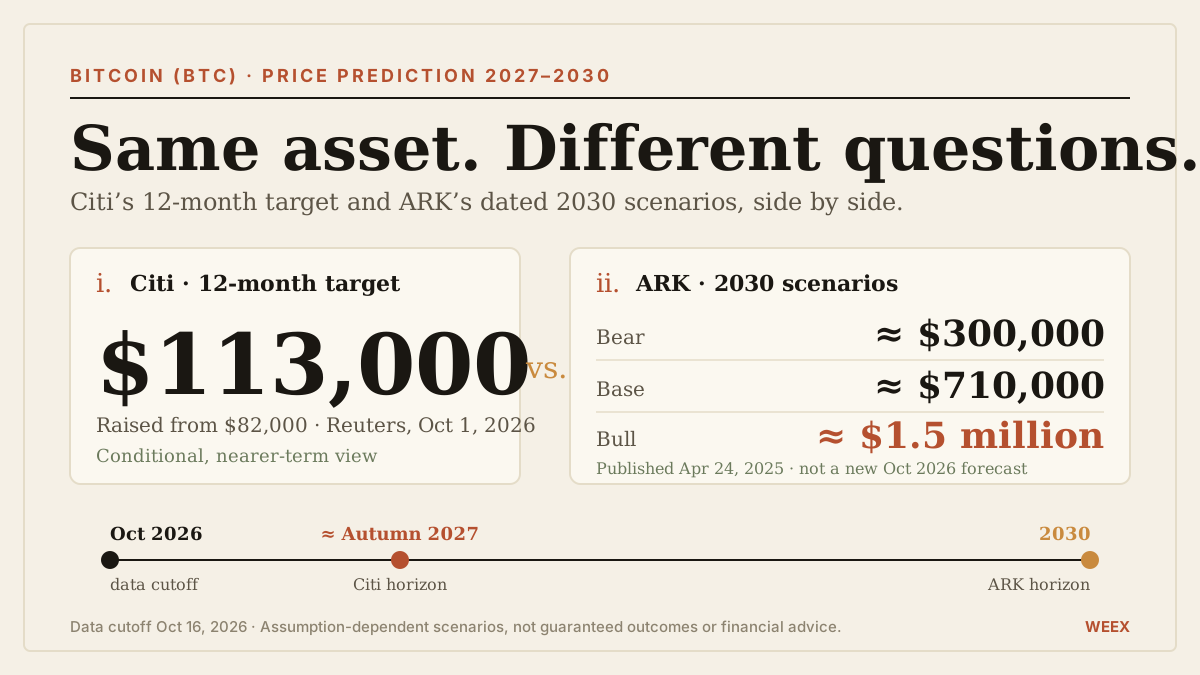
Bitcoin (BTC) Price Prediction 2027–2030: Citi’s $113,000 Target vs. Cathie Wood’s ARK Scenarios
Bitcoin price prediction for 2027–2030: compare Citi’s $113,000 target with ARK’s dated scenarios, demand assumptions, valuation math and key risks.

Mr&强 Analyzes BTC and ETH Short-Term Strategies

Bitcoin futures open interest declines, signaling weaker demand

Cathie Wood Predicts Long-Term Growth for Bitcoin Despite Dollar Strength

Peter Schiff Predicts Bitcoin Crash Over 99%
Liquidity in Cryptocurrency Market Approaches a Turning Point! Circle Aims to Enter 40 Emerging Markets

One dead, Qonto in flames, Nuñez resigns: why the streets worry crypto investors

Security Vulnerability Detected in ILITY Network, Cross-Chain Bridge Suspended

Bitcoin Spot ETF Sees Net Outflow of $229 Million Last Week, BlackRock's IBIT Leads with $165 Million Outflow

Morgan Stanley Recommends Up to 4% in Cryptocurrencies for Aggressive Portfolios

Deutsche Bank to Start Bitcoin and Ethereum Custody Within Weeks — Expansion to Asia by 2027

Bitcoin Ranges After Weekly Low Sweep| WEEX TradFi Daily(October 19, 2026)
Early on October 19, equity futures rebounded from last week’s chip selloff. Major indexes closed lower last week, the Nasdaq posted its worst week since June, the semiconductor ETF fell about 10%, and CoreWeave lost about 25%, while energy stocks were relatively resilient. Bitcoin traded near $82,000 after sweeping lows around $80,000, with markets watching the $79,800 and $83,600 zones.
WEEX Exclusive:Bitcoin Ranges After Weekly Low Sweep| WEEX TradFi Daily(October 19, 2026)

ECB: Lagarde defends rate hikes before the IMF and urges Brussels on digital euro

Sam Price Discusses Bitcoin Market Divergence

唐华斑竹 Analyzes Bitcoin Trends, Suggests Monitoring Support Levels

Saylor Envisions Bitcoin-Backed Stablecoin with Annual Yield of 6% to 8%

Strive CEO Emphasizes Going Long on Bitcoin and Short on USD, Claims Currency Depreciation is Irreversible

Bloomberg analyst warns BTC 50-week average decline may signal stock and metal downturns

Sam Price Focuses on Strategy Stock Price Drop and MSCI Index Adjustment
US Institutions See Net Inflows in Bitcoin as Demand for Dollar-Based Stablecoins Grows
Sam Price Focuses on the Hormuz Strait Tanker Incident, Crude Oil Prices Fluctuate
$4.8 Million Bitcoin Stolen from Scammer with Manipulated Ledger Wallet

Sazmining Offers Proto Hashboards at 4187 Dollars Each
BingX, YouHodler and Santander’s Openbank join EU MiCA register
QCP: AI Credit Risk Heats Up, Bitcoin May Face Range Breakthrough
French National Assembly Passes Tax Amendment on Stablecoin Transactions, Effective 2027
Bitcoin miner stocks driven by AI sentiment, not BTC prices
Black Monday Posts Break Records
Bitcoin Recovery Faces Challenges as Exchange Reserves Rise and Spot Demand Turns Negative