
Russia Used ChatGPT for Operations in Argentina and Bolivia

 Prefer us on Google


- The Russian campaign "Dark Clark" aimed to influence political leaders in Argentina and Bolivia.
- There is a growing malicious use of AI, even against the cryptocurrency ecosystem.
The artificial intelligence company OpenAI ---creator of ChatGPT--- reports having recently detected and dismantled two covert influence operations, one originating from Russia and another from Iran, that used its language models to spread political messages.
According to a statement issued on October 8, 2026, the Russian campaign, dubbed "Dark Clark," specifically aimed to influence the political outcomes in Argentina and Bolivia, in addition to seeking to discredit Ukraine throughout Latin America.
Since access to OpenAI services is not permitted from Russia, the operators used virtual private networks to connect.
The report details that Russian operators primarily used ChatGPT to draft internal reports, create content for their campaigns, and manage a fake think tank called the Social Research Center (SRC, for its acronym in English).
Through this front entity, controlled by a fictitious identity named "Mia Clark," the operation managed to recruit employees in Latin America who were unaware they were working for a Russian-origin group.
The SRC, according to OpenAI's report, managed to publish over sixty original articles written by locally hired staff.
In the case of Argentina, the operation claimed to have executed two campaigns during the year 2024 against President Javier Milei. Internal reports indicated that they spread a false news story claiming that the president had purchased jewelry collars from the Cartier brand for his dogs. The dissemination of false news to discredit the Argentine government was directed from Russia, according to OpenAI. Source: elcallejon809 -- Instagram (screenshot by CriptoNoticias).
Additionally, they claimed to have paid local individuals to create graffiti against Milei in the city of Buenos Aires. According to the investigation, these actions were linked to "Politology" and "La Compania," Russian entities identified as successors to the Wagner Group, founded by oligarch Yevgeniy Prigozhin.
In Bolivia, the disinformation offensive intensified in late May 2026, coinciding with a context of protests against the national government.
The explicit goal of the campaign was to exacerbate the crisis. To achieve this, they spread a false audio recording attributed to a worker from the state water company, EPSAS, claiming that the supply to La Paz would be cut off.
Subsequently, in June, they disseminated another fake audio of a supposed employee of the Central Bank of Bolivia warning about imminent limits on cash withdrawals, in addition to a false letter from the hydrocarbons agency regarding restrictions on fuel sales.
OpenAI classified "Dark Clark" as a category 5 threat on its scale of reach, marking the first time a campaign has reached this level since the company began evaluating these operations.
Its penetration was evidenced by the fact that several of the false contents, which also included deceptions aimed at Peru and Ecuador, prompted fact-checking and official denials.
On the other hand, the Iranian operation, dubbed "Bogus Bylines," used seven fictitious journalist identities to place extensive articles about the conflict between the United States and Iran in digital media worldwide.
There is a growing malicious use of AI that affects bitcoin
This sophistication in the malicious use of artificial intelligence tools transcends state influence operations and represents a growing threat to technological security.
For example, in the Bitcoin and cryptocurrency ecosystem, artificial intelligence has facilitated a new generation of attacks by inexperienced hackers or script kiddies. As reported by CriptoNoticias, the use of these tools allowed vulnerabilities in platforms such as LNP2Pbot, BTCPayServer, and wallets like ZEUS and Coldcard.
The reduction of technical barriers allows individuals with little experience to accelerate their attempts at exploitation at a minimal cost, exploiting flaws through text commands instead of complex programming.
This economic asymmetry benefits attackers, multiplying systemic vulnerabilities for the digital asset industry, which recorded 212 security incidents linked to thefts of over $1.1 billion during the first half of 2026.
-- Price
This content is provided for general informational purposes only and doesn't constitute financial, investment, legal, or tax advice. Any events, rewards, online promotions, or related information mentioned herein should not be considered a recommendation, solicitation, or invitation to purchase, sell, trade, or otherwise deal in any crypto assets. Crypto assets are highly volatile and may result in loss. The availability of WEEX services, products, and related events may vary by region. You are responsible for ensuring that your participation is in accordance with applicable local laws and regulations.
You may also like

Inside CZ's Haven: Exploring the Life Behind the Most Powerful Figure in Crypto

The 'Roller Effect' of AI and the 'Workshopization' of Software as a Prelude to the Internet of Intelligent Agents

What Are Other Chains Doing Amidst the Hype of Robinhood?
Some establishments are likely to be closed

MARVIN Mars Dog Announces 40% Token Buyback and Burn Plan

Non-consensus Decisions in the Robotics Sector: Why Sequoia Chose to Double Down on Yushu at Its Most Difficult Time?

August 6, Veterinarian Day in Argentina: origin of this date

Trial for Loan Peña: New Hearing with Three Witnesses in Corrientes

12 Dachshund Puppies Rescued at Argentina-Uruguay Border

Approved Welfare Protocol for Federal Police Dogs
Korea's Largest Pension Fund Suffers Over $130 Billion Loss Due to Heavy Investment in Samsung and SK Hynix

Ripple to Address XRP Ledger Security at Swell 2026

Hatem Douidar Joins Tactful AI Investors to Support Its Expansion in AI Solutions

Cardano Project Catalyst selects 12 projects for 2 million ADA pilot fund

From Zero to Financial Freedom: A Trader's HYPE Airdrop Review and Trading Philosophy

BingX, YouHodler and Santander’s Openbank join EU MiCA register

Slow Fog Releases DarkSword Trojan Analysis Report: Public Code Weaponized, iOS Crypto Wallets Face Threats

Emirati Nabta Health Secures Investment from PVP in $3 Million Round

XRP holders can now earn fees from Kraken’s DeFi customers, but there is a catch

Can Celestia Turn the Tide with AI Payments After a 97% Drop?

Why is it difficult for meme coins to break the $50,000 market cap? This market is draining retail investors' funds

QCP: AI Credit Risk Heats Up, Bitcoin May Face Range Breakthrough

BlackRock wants tokenized funds to back traditional Wall Street trades
The New PayPal Mafia: 10 Interns, $100 Billion

Variant Investment Partner: In the Second Half of the Bull Market, Which Two Camps Are Marginal Dollars Flowing To?

BNB Chain claims 42.6% of tokenized stock market, beating Ethereum and Solana
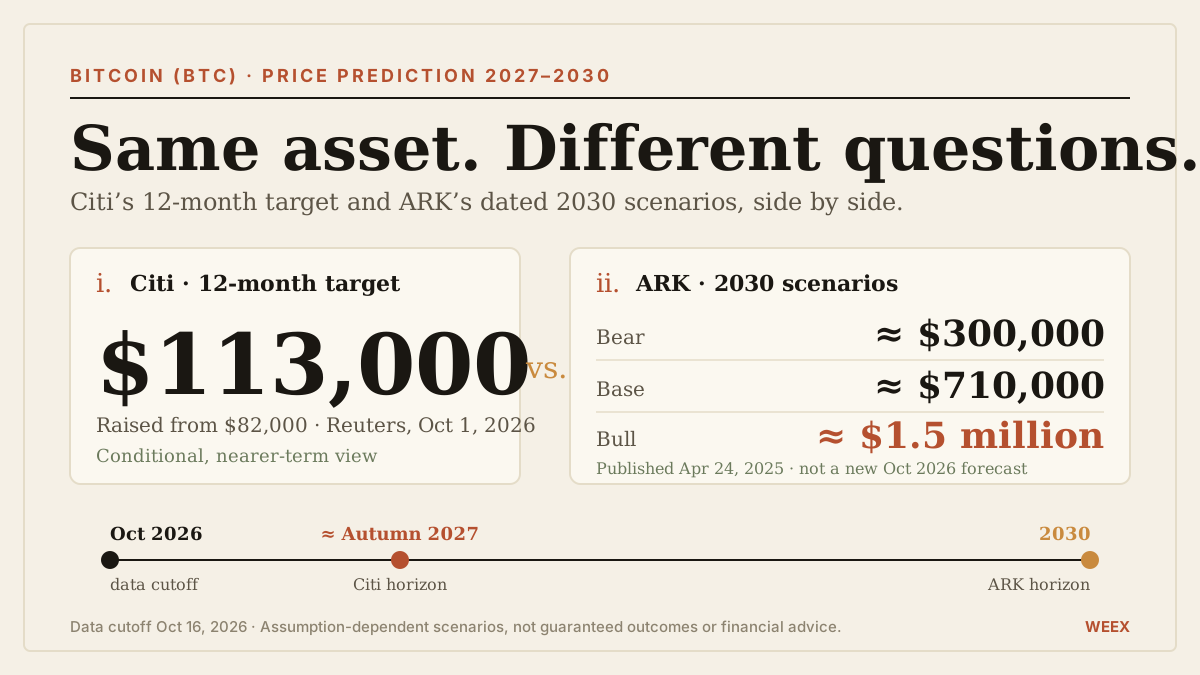
Bitcoin (BTC) Price Prediction 2027–2030: Citi’s $113,000 Target vs. Cathie Wood’s ARK Scenarios
Bitcoin price prediction for 2027–2030: compare Citi’s $113,000 target with ARK’s dated scenarios, demand assumptions, valuation math and key risks.

XRP (XRP) Price Prediction: Can BarriC’s $750 Target Pass the Market-Cap Test?
XRP price prediction: examine BarriC’s $750 target, market-cap math, next-bull-run scenarios, token demand and what could support a recovery to $5.
Musk Says He Will Give “One of My SpaceX Shares to Every Kid in America”: What the Post Says and What Is Still Unclear
Elon Musk said on October 19, 2026 that he will give one of his SpaceX shares to every kid in America next year. The post gave no details on delivery, eligibility or which shares. Estimates put the cost near $10 billion at recent SPCX prices, and a link to Trump Accounts remains unconfirmed.
Perp DEX Generates $125 Million in Fees Monthly, Who Really Gets Rewarded?
Inside CZ's Haven: Exploring the Life Behind the Most Powerful Figure in Crypto
The 'Roller Effect' of AI and the 'Workshopization' of Software as a Prelude to the Internet of Intelligent Agents
What Are Other Chains Doing Amidst the Hype of Robinhood?
Some establishments are likely to be closed
MARVIN Mars Dog Announces 40% Token Buyback and Burn Plan
Non-consensus Decisions in the Robotics Sector: Why Sequoia Chose to Double Down on Yushu at Its Most Difficult Time?


