
"Without Changing the Nature of Government Bonds" Toward Tokenization: Progmat's Saito Explains

 Prefer us on Google



Key Points of This Article
- WG evaluates that the adoption of claim-type is unlikely
- Proposal to start from areas that do not require connection to the Bank of Japan system
Mechanism of Rights Transfer
Tatsuya Saito, CEO of Progmat, explained the interim report on tokenized government bonds published by the working group (WG) of the Digital Asset Co-Creation Consortium (DCC), which his company serves as the secretariat, on the 22nd in his note. The interim report focuses on a method that links record management to blockchain without changing the legal nature of government bonds.
Most Japanese government bonds are issued as "transfer government bonds," which do not have paper certificates and manage ownership through ledger records. The main proposal of the interim report is to treat these transfer government bonds as they are even after tokenization. Since the essence of the government bonds remains unchanged, their value as collateral remains intact, and there is no need to revise tax systems such as exemption from withholding tax. The change lies in the mechanism of ledger records, aiming to enable transfers 24/7.
At the center of the main proposal is the establishment of a new "on-chain management account (OC account, provisional name)" that investors open separately from their current accounts. When a portion of the government bonds held is moved to the OC account, a corresponding token is issued on the blockchain, and when it is returned to the original account, the token disappears. On the ledger, it is merely a transfer of government bonds between accounts of the same investor, and no new government bonds are created.
In the transfer procedure indicated by the interim report, the target token is first locked on the blockchain to prevent its use in other transactions, and both parties verify signatures and balances. Rights transfer occurs when the OC account's ledger is rewritten, and unlocking the token for transfer happens afterward. The order does not allow tokens to move before the ledger.
Source: Saito's note{#caption-attachment-744349}
The interim report proposed placing the record (original) that serves as the basis for rights in a new system that operates 24/7. If the current account management system used by financial institutions is made the original, transaction confirmations would be constrained by business hours and batch processing times, requiring significant renovations for 24/7 operation. The reason for not making the blockchain record itself the original is the issue of widely sharing personal information, such as names required on the ledger, among stakeholders.
Blockchain is positioned as a common platform where stakeholders share the same information and automatically advance locking and simultaneous settlement of securities and funds (DvP). The existing account management system is expected to continue using the balance of the new system during business hours for traditional tasks such as fee and tax calculations and 10 years of ledger preservation. It serves as a role division to enable 24/7 transfers while minimizing the impact on the existing system.
Source: Saito's note{#caption-attachment-744350}
From the Start of Consideration in May to the Interim Report
The DCC established the WG in May 2026, with participation from three megabanks and BlackRock Japan from the beginning, expanding to 69 organizations by the time of the interim report. At the start of discussions, Saito explained that the focus was on a "claim-type" that tokenizes the right to withdraw government bonds while keeping the bonds themselves in existing accounts. The concept was to borrow stablecoins using the bonds as collateral, and it was considered difficult to tokenize the bonds themselves due to interoperability issues across financial institutions.
In August, Mitsubishi UFJ Financial Group (MUFG) and its three subsidiaries announced that they would begin a proof of concept to process government bond repos on the blockchain in collaboration with Progmat and U.S. Digital Asset. This design updates the ledger in accordance with transaction results on the blockchain while maintaining the legal nature of transfer government bonds. Although it is a separate individual project from the WG, Saito explained that it serves to verify the systems and practices being advanced in the WG through a concrete system.
The interim report in October compared three methods from four perspectives: the effects of on-chain implementation, practicalities for market participants, and the burden of tax and legal reforms. Regarding the method of tokenizing registered government bonds, it was judged that while the legal arrangements are relatively light, the current government bond market and tax system are built on the premise of transfer government bonds, making it difficult to coexist with existing transactions.
Source: Saito's note{#caption-attachment-744351}
Claim-type tokens are not government bonds themselves but rights to request the delivery of government bonds from issuers, etc. The interim report views that it is essential to be regarded as the same as government bonds to be widely accepted as collateral for repo transactions. The claim-type is not treated the same as transfer government bonds for tax purposes, and special legal provisions would be necessary to assert rights against third parties, leading the WG to evaluate the likelihood of adoption as low.
Saito points out that the ability to realize this flexibly in the short term and being widely accepted as government bonds in the market are separate issues.
Proposal to Start Implementation Within One Financial Institution
The interim report envisions transactions that are completed between one financial institution that has a direct account with the Bank of Japan (BOJ) and its customers or subordinate institutions as the first target for practical implementation. Since the BOJ's ledger records the holdings of such customers collectively, if only the breakdown is swapped, the BOJ's records do not change, allowing the start without connecting to the BOJ system.
Transactions across financial institutions that have direct accounts with the BOJ would involve rewriting the BOJ's ledger and be subject to the BOJ network's operating hours. The interim report is considering a method of sending data to the BOJ system based on the locking information on the blockchain while leaving the specific connection method as a topic for further examination. Before commercialization, it will also be necessary to confirm with the BOJ and relevant authorities whether it meets the requirements as a ledger.
Saito sees the significant advantage of 24/7 operation as beneficial for transactions with overseas investors. Government bond settlements are concentrated during Japan's daytime, requiring European and American investors to finalize their instructions within the previous business day. The latter half of the interim report deals with the on-chain implementation of repo transactions considering these circumstances, and Saito plans to explain this in his next note.
Details of the OC account and original mechanism are explained by Saito in his note with diagrams. He also delves into the system structure within financial institutions and the processing flow for each transaction.
-- Price
This content is provided for general informational purposes only and doesn't constitute financial, investment, legal, or tax advice. Any events, rewards, online promotions, or related information mentioned herein should not be considered a recommendation, solicitation, or invitation to purchase, sell, trade, or otherwise deal in any crypto assets. Crypto assets are highly volatile and may result in loss. The availability of WEEX services, products, and related events may vary by region. You are responsible for ensuring that your participation is in accordance with applicable local laws and regulations.
You may also like

LDP Proposes Establishing a Cyber Response Headquarters Ahead of Cybersecurity Crisis, Emphasizing Cryptocurrency Tracking and Post-Quantum Cryptography

Former FTX Executive Slams Netflix's New Series: Turning Financial Fraud into a 'Romantic Film' is Absurd

Delphi Digital: Why Speculation is the Theme of the Next Decade

Bitgo Launches AI Financial Application 'Gokubu' and Research Organization
"Millions of devices are vulnerable": Ledger CTO

Private Jets and Investor Pressure Force Polymarket CEO to Mature

Doctor Profit Warns of a Very Big Monero (XMR) Liquidation Event

Stuttgart Stock Exchange Gets Green Light to Trade and Settle Tokenized Securities
WEEX Exclusive:Tech Rebounds; Bitcoin Holds $81,000–$82,000 Support| WEEX TradFi Daily (October 20, 2026)
Tech Rebounds; Bitcoin Holds $81,000–$82,000 Support| WEEX TradFi Daily (October 20, 2026)
On October 19, tech rebounded. The three major indexes were mixed, with the Nasdaq relatively stronger. Intel rose after a JPMorgan upgrade, and SpaceX closed up more than 2%. Bitcoin traded near $81,000–$82,000, a zone traders viewed as strong support and a local bottom. Worldcoin (WLD) rose more than 10% in 24 hours, leading majors. October 20 focus includes earnings from SPCX and other listed names.
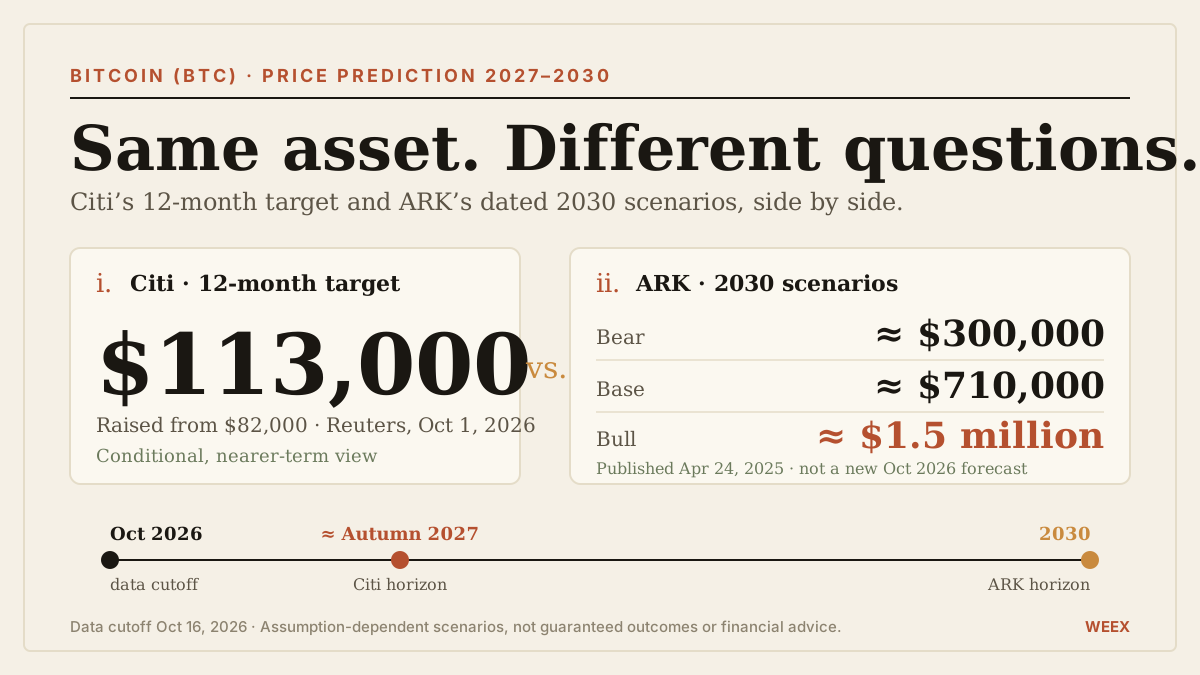
Bitcoin (BTC) Price Prediction 2027–2030: Citi’s $113,000 Target vs. Cathie Wood’s ARK Scenarios
Bitcoin price prediction for 2027–2030: compare Citi’s $113,000 target with ARK’s dated scenarios, demand assumptions, valuation math and key risks.

Crypto: 107 incidents and $1.18 billion stolen in Q3 2026

Is Pearl, Dreaming of Bitcoin in the AI Era, an Innovation or Just Simple Hype?

唐华斑竹 Analyzes Bitcoin Trends, Suggests Monitoring Support Levels

Howard Marks: If Everyone is Talking About a Bubble, Then the Bubble May Not Have Burst Yet

Quantum Alliance Established to Protect Blockchain from Quantum Computers
唐华斑竹 Analyzes the Current State of the Crypto Market, Advises Caution

U.S. Treasury Department's Survey Fails to Signal Debt Reduction, Bond Yields Rise with 10-Year Yield Back Above 5.12%
The Past and Present of Currency in the Age of Exploration

What Business Does Solana Want to Do in Shanghai?
Fractional Reserve: Reserve Requirement Abolished. Where is the Value?

Cyberattack on the ports of Marseille and La Rochelle? Hackers paid 1 dollar in crypto

G20 warns that stablecoins may lose value even if fully backed

[Legal Insights] Hard Wallet Hacking Incident: Is My Digital Asset Safe in Exchanges?

[Full Text] DAXA: "Digital Asset Taxation Should Be Linked to Basic Law Classification and Enforcement Infrastructure"

Crypto Billionaires Invest $100 Million to Disrupt UK Politics

Cybersecurity Incident Involving GoPax and PraBank in the Virtual Asset Industry
Financial Stability Board Highlights Unclear Bankruptcy Laws for Stablecoin Failures
The Era of Industry: Q3 2026 Virtual Asset Industry Investment Status Report – Tiger Research

Ledger Wallet Reveals Method of Unauthorized Components Reading Recovery Phrases from Screens
LDP Proposes Establishing a Cyber Response Headquarters Ahead of Cybersecurity Crisis, Emphasizing Cryptocurrency Tracking and Post-Quantum Cryptography
Former FTX Executive Slams Netflix's New Series: Turning Financial Fraud into a 'Romantic Film' is Absurd
Delphi Digital: Why Speculation is the Theme of the Next Decade
Bitgo Launches AI Financial Application 'Gokubu' and Research Organization
"Millions of devices are vulnerable": Ledger CTO
Private Jets and Investor Pressure Force Polymarket CEO to Mature


